
Fans of a satisfying seed crunch
You’re looking for rusks with visible seeds for breakfast or lunch, and pay attention to their texture and size.


Choose multiseed rusks based on what matters most to you: a clear seed texture, wholegrain or organic qualities, or the balance of carbohydrates and protein. Compare the nutritional information per 100 g and per rusk, and check the ingredients and allergens for the variety you’re buying.
You’re looking for rusks with visible seeds for breakfast or lunch, and pay attention to their texture and size.
You want to compare product features side by side: fibre per 100 g and per rusk, the ingredients and any organic labelling.
You’re mainly interested in the nutritional information and want to know how the values per 100 g translate to the portion you eat.
First, decide which product feature matters most to you. Then check the ingredients list, nutritional information and allergen labelling for the specific variety you’re considering.
| What to consider | What to check before buying | Who it matters to |
|---|---|---|
| Seeds and texture | Check which seeds are listed, their percentages if stated, and the size of each rusk. | If I’m mainly looking for visible seeds and a satisfying crunch, the ingredients list matters more than the name on the pack alone. Around 36% of consumers prioritise this seed texture. |
| Fibre, wholegrain and organic | Compare fibre per 100 g and per rusk; check the ingredients and organic labelling if these features matter to you. | To make my choice, I want to be able to see whether a rusk is wholegrain or organic, and how much fibre my portion contains. Around 36% of consumers put these features first. |
| Carbohydrates and protein | Read the values per 100 g, then use the weight of each rusk to work out the values for your usual portion. | When I compare products for carbohydrates and protein, I want to use the same basis rather than rely on a claim. For around 28% of consumers, this nutritional profile is the main consideration. |
The name doesn’t tell you how much fibre, protein or carbohydrate a particular variety contains. The value per 100 g isn’t automatically the value for one rusk either.
Compare the nutritional information on the same basis, then check the weight and values per rusk or portion.
The PLUS Spelt rusks with seeds and kernels included in this comparison list spelt and wheat as gluten-containing ingredients.
If you need a gluten-free product, check the latest allergen information and don’t choose a product solely because it says ‘spelt’.
Rusks with visible seeds may also contain ingredients that matter to your choice, such as sesame, egg or gluten-containing grains. Consumentenbond recommends checking fibre claims on the front against the nutritional information.
Before buying, read the ingredients list, allergen information and nutritional details for the variety you’ve chosen.
These examples show which product features you can compare. The details apply to the varieties named, not to every rusk made by each brand.
The Vezelrijk Meerzaden Beschuit is worth a look if you’re after a range of visible seeds and kernels.
AH offers a standard multiseed rusk and an organic wholegrain multiseed variety to compare by product features.
TastyBasics multiseed rusks are worth considering if you mainly want to compare carbohydrates and protein in the nutritional information.
PLUS offers both a premium plain rusk with seeds and a spelt rusk with seeds and kernels.
These products match two of the choices covered in this article: rusks with several types of seeds, and rusks for comparing carbohydrate and protein content. Check the information on the relevant pack before you decide.
 Image unavailable
Worth a look if you’re after rusks with a variety of seeds.
Pack size: 10 pieces. Check the latest ingredients information if wheat or sesame is relevant to you.
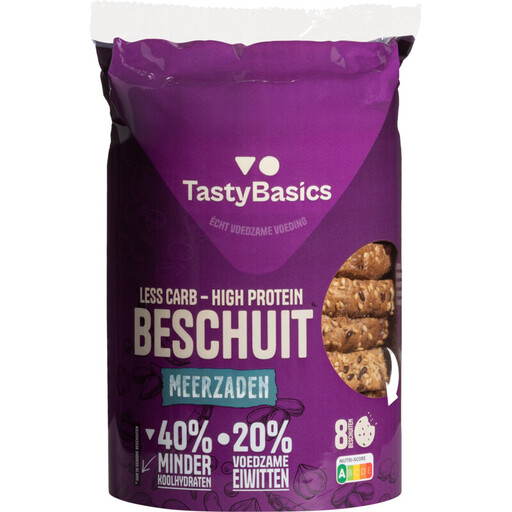 Image unavailable
Worth a look if you mainly want to compare carbohydrate and protein content in multiseed rusks.
Pack size: 184 g. Compare the nutritional information per 100 g and check the latest allergen information for gluten-containing grains, egg and sesame.
Don’t assume they are. The Bolletje, AH, TastyBasics and PLUS varieties included in this comparison list gluten-containing grains; several also list sesame. Always check the latest packaging for the exact product you’re buying.
No, don’t assume that every rusk contains iodine. If this matters to your purchase, check the ingredients information for the variety you’ve chosen.
After opening, store rusks in a dry, airtight container. Also follow the storage advice and use-by date on the pack.
No. Compare the fibre content per 100 g and per rusk, as well as the other nutritional information and ingredients. Consumentenbond advises against relying solely on a fibre claim on the front of the pack.