What should you look for when choosing?
Start with the nutritional information and ingredients if they’re important to your choice. Then check the pack size and whether the variety is available from your chosen shop.
| What to consider |
What should you check? |
Who might this matter to? |
| Fibre and grain base |
Compare the fibre per 100 g and check whether the ingredients list wholegrain cereals or mainly wheat flour. |
If I choose rusks for their fibre content, I want to look beyond the seeds on the outside. For around 36% of consumers, fibre content would be the top priority. |
| Protein and carbohydrates |
Compare the protein and carbohydrates per 100 g; if there’s a comparative claim, also check which products are being used as the benchmark. |
When having rusks with toppings for breakfast, I want to know how much protein the rusks themselves provide. Comparing protein would be the top priority for around 29% of consumers. |
| Ingredients and allergens |
Check the current information about sesame, egg and cereals containing gluten, and look for a vegan label if relevant. |
If I need to avoid certain ingredients or want to eat vegan, I need to make sure the variety I choose is suitable. For around 21% of consumers, this suitability would be the main consideration. |
| Pack size and availability |
Check the weight, the number of rusks and whether they’re available from your chosen shop. |
For a shared breakfast table, I want to know how many rusks are in the pack and whether I can pick them up at my usual shop. This would be the most important consideration for around 14% of consumers. |
Relevant brands and varieties
The differences below apply to the specific rusk varieties mentioned, not to a brand’s entire range.
Bolletje
Bolletje Vezelrijk Meerzaden is a variety labelled vegan, with sesame, sunflower seeds, pumpkin seeds and linseed.
- Albert Heijn lists 10 g of fibre and 17 g of protein per 100 g for this variety.
- The ingredients start with wheat flour; the variety contains wheat and sesame, so it isn’t suitable if you need to avoid gluten.
Albert Heijn
AH Multiseed Rusks is a 230 g own-brand variety, with over 16% seeds and kernels according to Albert Heijn.
- The product information lists 7 g of fibre, 17 g of protein and 0.8 g of salt per 100 g.
- This variety contains egg, sesame, barley and wheat; check the pack if you have an allergy or a particular dietary preference.
Jumbo
Jumbo’s online rusk range includes Bolletje Vezelrijk Meerzaden, Jumbo Robuust Multigrain Rusks and TastyBasics Multiseed.
- You can browse several named rusk varieties side by side at this shop.
- To compare ingredients and nutritional information, check the details for each variety and its packaging.
PLUS
PLUS stocks products including Spelt Rusks with Seeds and Kernels and Luxury Plain Rusks with Seeds.
- For the Spelt variety reviewed, PLUS lists 5.8 g of fibre and 17.1 g of protein per 100 g.
- The Spelt variety contains egg, sesame and cereals containing gluten. Check which variety is available from your chosen shop.
Lidl
Lidl Netherlands lists Ambachtelijk Multigrain Rusks in a 230 g pack.
- Check the packaging for ingredients, allergens and nutritional information before comparing this variety with other rusks on those points.
Multiseed rusks at Joybuy
These two multiseed rusks suit different Sunday breakfast priorities: comparing protein and fibre, or choosing a seed mix to suit a vegan diet. If you have a particular dietary preference or an allergy, always check the packaging of the product you buy.
 No image available
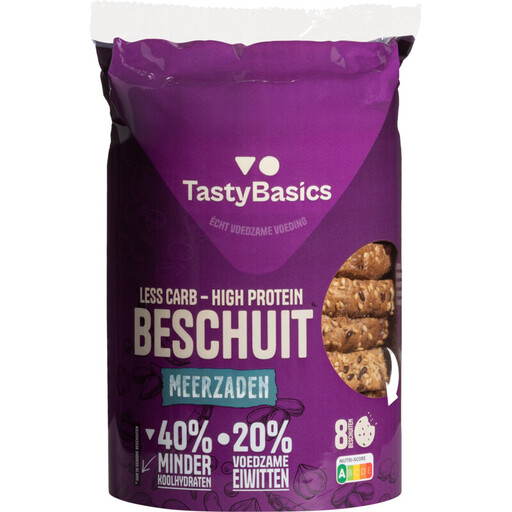
TastyBasics multiseed rusks, 184 g
An option if you mainly want to compare the protein and fibre content of rusks for Sunday breakfast.
Albert Heijn and Jumbo’s product information lists 11 g of fibre and 20 g of protein per 100 g for TastyBasics Multiseed. The pack contains 8 rusks and weighs 184 g.
The listed ingredients include egg, sesame and cereals containing gluten, including wheat, spelt and barley. If you have an allergy, check the current label.
View at Joybuy
 No image available
Bolletje multiseed rusks, 10 pieces
An option if you’re looking for rusks with a mix of different seeds and kernels to enjoy at breakfast.
The product information lists sunflower seeds, linseed, sesame and pumpkin seeds. For the Bolletje Vezelrijk Meerzaden variety reviewed, Albert Heijn lists 10 g of fibre and 17 g of protein per 100 g, and labels it vegan.
The listed ingredients include wheat and sesame. If you have an allergy or follow a vegan diet, check that the claims and ingredients on the pack you receive match the variety you’re looking for.
View at Joybuy
Frequently asked questions
Are multiseed rusks automatically wholegrain?
No. Seeds and kernels don’t tell you whether wholegrain flour has been used to make the rusks. Read the grain ingredients and check whether the variety you choose is labelled wholegrain; for example, according to Albert Heijn, wheat flour is the first ingredient in AH Multiseed Rusks.
Which allergens should I check in multiseed rusks?
At the very least, check whether the variety you choose contains sesame, cereals containing gluten or egg. For TastyBasics Multiseed, Albert Heijn lists egg, sesame, wheat, spelt and barley; AH Multiseed Rusks also contains egg, sesame, barley and wheat. The current packaging is the definitive guide to the variety you’re buying.
Is baker’s salt with iodine compulsory in Dutch rusks?
No. According to the Netherlands Nutrition Centre, bakers aren’t required to use baker’s salt. So don’t rely on the product category alone: check the ingredients of the rusks you choose or ask the manufacturer or baker.
How should I store rusks after opening?
Store rusks in a cool, dry place, away from light, and keep them tightly sealed. PLUS gives this storage advice for Bolletje Vezelrijk Meerzaden; close the packaging carefully or use an airtight container.


