
Hosts who want to taste the seeds
If the rusk needs to add texture alongside cheese, dips or spreads, check which kernels and seeds are listed in the ingredients. Compare the size too before deciding how many rusks to serve.


Choose multiseed rusks for Friday afternoon drinks based on what you plan to serve: a rusk with a distinctive seed mix, an option whose nutritional values you want to compare, or an organic wholemeal variety. Then check the nutritional information per 100 g and per rusk, the ingredients and the allergens on the current packaging. The presence of seeds does not mean a product is suitable for every guest or that it contains iodised baker’s salt.
If the rusk needs to add texture alongside cheese, dips or spreads, check which kernels and seeds are listed in the ingredients. Compare the size too before deciding how many rusks to serve.
If fibre, protein or salt are important to your choice, read the nutritional information rather than relying on the front-of-pack wording. Values per 100 g make products easier to compare; values per rusk help you work out what you’re serving.
If allergens or organic sourcing matter to your guests, checking the exact packaging takes priority over choosing a seed mix. Pay particular attention to sesame, cereals containing gluten and egg where relevant to your guests.
Start by thinking about the role of the rusk on your drinks platter, then check the nutritional values and whether it’s suitable for your guests. A seed mix, a nutrition claim and an organic label each answer a different question.
| What to consider | What to check when buying | Who it matters to |
|---|---|---|
| Seeds and texture | Check which seeds and kernels are listed, and compare the size of the rusks. | If I’m serving rusks alongside soft drinks-party nibbles, I want the seed mix itself to add texture. For around 33% of consumers, texture would be the most important factor when choosing. |
| Nutritional values | Compare fibre, protein and salt per 100 g; to work out the amount served, also check the values per rusk and consider the topping. | If you want to weigh up products based on their nutritional information, a front-of-pack claim alone isn’t enough. Nutritional values would be the top priority for around 25% of consumers. |
| Suitability for guests | Read the current ingredients and allergen information for the exact variety. Check the type of salt separately if it’s relevant to your choice. | When I’m buying for guests with a food allergy, I need to know what’s in the rusk before serving it. Product suitability would be the main concern for around 42% of consumers. |
According to Jumbo, the Bolletje variety reviewed contains wheat and sesame. TastyBasics lists wheat, spelt, egg, sesame and barley, among other ingredients, in its multiseed rusks. So the seed mix says nothing about whether a product is suitable for someone with a specific allergy.
Check the allergen information on the packaging you’re actually serving, and provide a suitable alternative separately if needed.
Terms such as multiseed, wholemeal or organic don’t tell you what type of salt has been used. The Netherlands Nutrition Centre says that baker’s salt isn’t compulsory in bread; this doesn’t confirm which salt is used in an individual rusk variety.
If you want to know whether a rusk is made with iodised baker’s salt, check the current ingredients list or ask the manufacturer.
The varieties reviewed also differ in protein, salt, ingredients and allergens. A value per 100 g also doesn’t necessarily tell you how much you’ll serve per rusk with its topping.
Compare the full nutritional information, then consider how many you’ll put on the drinks platter.
Albert Heijn warns that ingredients, nutritional values and allergen information can change. If a guest has an allergy, the description you read previously isn’t enough to assess a different pack.
Read the allergen information on the physical packaging just before serving. If the information is unclear for a guest with a severe allergy, don’t serve that variety to them.
The Vezelrijk Beschuit Meerzaden variety reviewed is an option if you’re looking for a rusk with a range of seeds and kernels.
TastyBasics multiseed rusks are worth considering if you want to compare fibre, protein and other nutritional values.
Within the AH range reviewed, you can compare standard multiseed rusks with an organic wholemeal variety.
These two multiseed rusks are a good fit for a drinks platter where you want the rusk itself to add a mix of seeds. Choose between the packs based on the quantity you need, and always check the current product packaging for nutritional values and allergen information.
 Image unavailable
For a drinks platter where you want to serve rusks with seeds. The pack contains 10 pieces; if anyone has an allergy, check the current ingredients and allergen information.
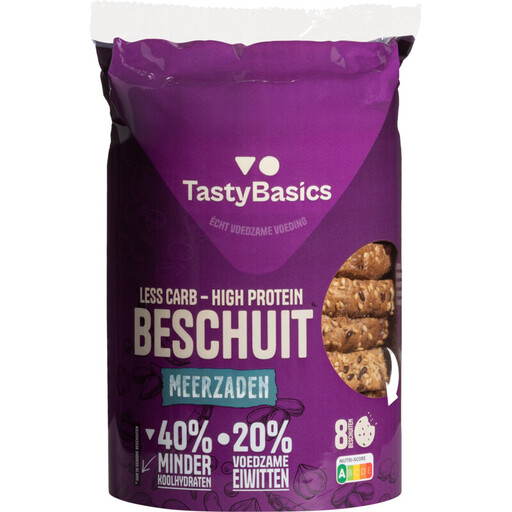 Image unavailable
For anyone who wants to serve multiseed rusks with drinks and compare the nutritional information too. The pack contains 184 g; if serving guests with allergies, check the current packaging.
You can’t assume that every multiseed rusk contains them; check the exact variety. The Bolletje variety reviewed lists wheat and sesame, while the TastyBasics variety reviewed lists wheat, spelt, sesame and barley, among other ingredients. If you have a food allergy, always read the current packaging.
No, the organic label doesn’t confirm what type of salt has been used. For bread, the Netherlands Nutrition Centre advises checking the label to see whether baker’s salt has been used. For rusks, check the ingredients on the specific pack or ask the manufacturer.
Store opened rusks in a cool, dark, dry place in a tightly sealed container. This storage advice appears in the product information reviewed for Bolletje and Albert Heijn. If you don’t want to leave them out for too long, only put the rusks out when you’re ready to serve.
No, compare the other nutritional values, ingredients and allergens too. Values per 100 g help you compare products; also consider the amount per rusk and the topping you plan to serve.