
Fans of a seeded snack base
If you want to taste the seeds as well as your sweet or savoury toppings, check the ingredients list. Bolletje lists sunflower seeds, pumpkin seeds, linseeds and sesame seeds in its Vezelrijk Meerzaden rusks.


Looking for a large rusk with a mix of seeds? Bolletje Vezelrijk Meerzaden is one option, with 10 g of fibre per 100 g. If protein or carbohydrate content matters more to you, compare the nutritional information per 100 g for the specific TastyBasics variety with your usual rusks. Whichever you choose, check the latest allergen information and make sure the size suits your toppings.
If you want to taste the seeds as well as your sweet or savoury toppings, check the ingredients list. Bolletje lists sunflower seeds, pumpkin seeds, linseeds and sesame seeds in its Vezelrijk Meerzaden rusks.
If fibre is one of your priorities, compare the nutritional values per 100 g rather than relying on the name ‘multiseed’. The nutritional information for the varieties discussed lists different amounts.
If you’re comparing nutritional values, the TastyBasics variety with sunflower and pumpkin seeds may be worth considering. Check the values on the pack you’re buying, though: varieties from the same brand may have different compositions.
Start with the seed mix and a size that suits your toppings. Then compare the nutritional values on the same basis, and check the ingredients and allergen information before buying.
| What to consider | What to check when buying | Who should consider this? |
|---|---|---|
| Seed texture and size | Check which seeds are listed in the ingredients and whether the size suits your toppings. | For generous toppings, I want a rusk where you can still notice the seeds. This is the top priority for around 40% of shoppers. |
| Fibre | Compare the number of grams of fibre per 100 g in the nutrition table. | I want to compare varieties by their fibre content, not just by their name. This is the main priority for around 30% of shoppers. |
| Protein and carbohydrates | Read both values per 100 g and compare the specific variety with the rusks you would otherwise choose. | If nutritional balance matters more to me than size, I want to compare these values side by side. Roughly 20% of shoppers prioritise protein or carbohydrates. |
| Practical packaging | Check the pack size, availability at your chosen shop and storage instructions. | I want to buy a pack that suits my needs and save the rest for another snack night. This is the first thing around 10% of shoppers consider. |
The varieties discussed contain sesame and gluten-containing cereals; some also list egg in the ingredients. A different seed mix does not necessarily mean the same allergen information applies.
Check the latest ingredients and allergen information on the pack every time you buy, even if you’ve bought that variety before.
The fibre content varies between the rusks discussed. The product name doesn’t tell you how many grams of fibre a specific variety contains per 100 g.
Compare the nutrition tables per 100 g, then decide which size and seed mix suit your snack.
According to the Voedingscentrum, bakers aren’t required to use baker’s salt. So the word ‘multiseed’ doesn’t tell you what type of salt was used in the rusks.
If the type of salt matters to you, check the ingredients list or ask the manufacturer.
The Vezelrijk Meerzaden variety is a large rusk for anyone looking for a snack base with a range of seeds.
The multiseed rusks with sunflower and pumpkin seeds discussed here are one option to compare for protein, fibre and carbohydrates.
AH Ambachtelijk multiseed rusks combine several types of seeds, making them an option to compare with other varieties.
PLUS offers large rusks with seeds, including a luxury plain variety and a spelt variety.
These Joybuy products are multiseed rusks to enjoy with toppings as a snack. Don’t choose on the seed mix alone: check the pack size, nutritional information and any allergens that matter to you.
 Image unavailable
An option if you’re looking for a large rusk with a range of seeds to top for a snack.
The product description lists sunflower seeds, linseeds, sesame seeds and pumpkin seeds, and gives 10 g of fibre and 17 g of protein per 100 g.
Contains wheat, gluten-containing cereals and sesame seeds. Check the latest packaging if allergens or the type of salt used matter to your choice.
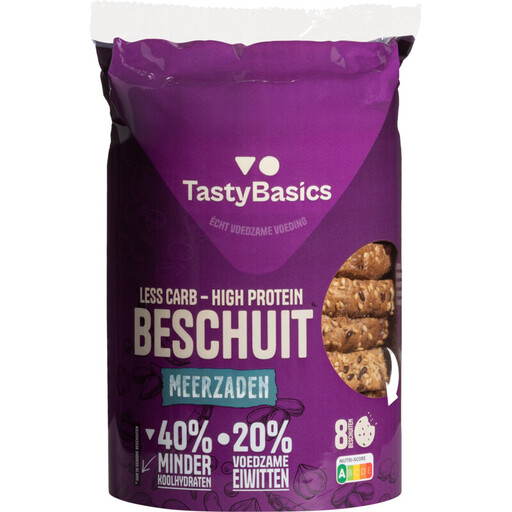 Image unavailable
An option if you’re looking for seeded rusks and want to compare the nutritional values of the variety you buy.
The ingredients information lists sesame, linseeds and sunflower seeds. Compare protein, fibre and carbohydrates using the nutrition table on this pack, on the same basis as your alternative.
Contains wheat, spelt, barley, egg and sesame. Check the latest allergen information before buying.
Don’t rely on the name ‘multiseed’; check the latest label for the specific variety. The Bolletje rusks discussed contain wheat, gluten-containing cereals and sesame seeds. Egg is also listed for the TastyBasics variety discussed.
Store the opened pack according to the product instructions. For Bolletje Vezelrijk Meerzaden, PLUS advises storing the rusks in a sealed pack in a cool, dry and dark place after opening.
No, you can’t tell that from the name of the rusks. The Voedingscentrum says bakers aren’t required to use baker’s salt. If the type of salt used matters to your choice, check the ingredients list or ask the manufacturer.
Compare the nutrition tables per 100 g for the varieties you’re considering. Then think about how much you’ll actually eat and what you’ll add on top; values per 100 g don’t automatically describe the whole snack.