For the Sinterklaas parade, choose multiseed rusks with ingredients and allergens that are suitable for the people you’re taking them for. Then compare fibre and, if relevant, protein per 100 g, and think about how to keep the rusks dry and sealed until you’re ready to eat them. Don’t assume they contain iodine from iodised baker’s salt based only on the product name or the mention of salt.
Who is this relevant for?
Shoppers comparing fibre and wholegrain
You’re looking for rusks with seeds, but also want to know how much fibre they contain and whether wholemeal flour is on the ingredients list. Compare the nutritional information per 100 g: visible seeds don’t tell you how much fibre a product contains.
Shoppers who need to check allergens
You’re buying rusks for yourself or a group and need to take sesame, egg or gluten-containing cereals into account. These ingredients are found in the multiseed varieties discussed here, so check the current packaging before taking any with you.
Visitors taking rusks with them in advance
You’re buying the rusks before the parade and want to keep them crisp until you’re ready to eat them. Albert Heijn and PLUS advise storing opened packs in a cool, dry place and keeping them sealed.
What should you look for when choosing?
If you’re buying for a group, check the allergens first. Then compare the nutritional information on the same basis and think about how many rusks you’ll actually take with you.
| What to consider |
What to check when buying |
Who it matters to |
| Allergens and dietary requirements |
Check the current ingredients and allergen information for sesame, egg and gluten-containing cereals. Also look out for warnings about possible traces. |
If I’m taking rusks for a group, I first want to know whether everyone can eat the ingredients. For around 42% of consumers, checking allergens would be the most important factor when buying. |
| Fibre and wholegrain |
Compare fibre per 100 g and check whether wholemeal flour is on the ingredients list. Don’t confuse values per 100 g with values per serving. |
I don’t choose based only on the visible seeds. I want to know how much fibre the rusks contain and whether they include wholemeal flour. Around 33% of consumers would prioritise fibre and wholegrain. |
| Protein as well as fibre |
Compare protein and fibre on the same basis, ideally per 100 g, and then check the serving size. |
For my snack, I want to be able to compare both the protein and fibre content. Around 25% of consumers would make this combination their top priority. |
Common mistakes
-
Assuming seeded rusks are allergen-free
The multiseed rusks discussed here contain sesame and gluten-containing cereals. Several varieties also list egg as an ingredient. A vegan label alone doesn’t mean a product is suitable for someone with a sesame or gluten allergy.
For anyone with a relevant allergy, check the current ingredients, allergens and any warnings on the packaging.
-
Assuming that salt on the label means iodised baker’s salt
According to the Netherlands Nutrition Centre, using iodised baker’s salt in bread is not compulsory. So the word ‘salt’ on a pack doesn’t tell you whether iodised baker’s salt was used in the rusks.
If iodine content is important to your choice, check the ingredients information or ask the manufacturer which type of salt was used in the product.
-
Treating online product information as a permanent label
Ingredients and nutritional values can change. A product page you viewed previously is therefore no substitute for checking the packaging of the product you buy.
If you have allergen or dietary requirements to consider, check the information on the current packaging before taking the rusks to the parade.
-
Taking an opened pack with you unsealed
For the products discussed here, Albert Heijn and PLUS advise storing rusks in a dry, sealed pack after opening. An open pack is therefore less practical if you won’t be eating them until later.
Take the pack unopened, or seal it well after opening and protect it from moisture.
Brands compared
These examples show the ingredients and nutritional values you can compare for specific multiseed varieties. Always check the packaging of the variety you choose when you buy it.
Bolletje
Bolletje Vezelrijk Meerzaden is a rusk that includes sunflower seeds, linseed, sesame seeds and pumpkin seeds.
- Bolletje and PLUS product information lists 10 g of fibre per 100 g. The variety is labelled vegan.
- The same variety contains wheat and sesame. The vegan label doesn’t make it suitable for someone with a relevant allergy.
AH
AH offers both regular multiseed rusks and an organic wholegrain multiseed variety.
- According to Albert Heijn, AH Meerzadenbeschuit contains over 16% seeds and kernels and 7 g of fibre per 100 g. AH Biologisch Volkoren beschuit meerzaden lists 11 g of fibre per 100 g.
- Both varieties mentioned contain egg, sesame and gluten-containing cereals, among other ingredients. The nutritional values relate to different products.
TastyBasics
TastyBasics Beschuit Meerzaden is an option if you want to compare protein as well as fibre on the label.
- Jumbo product information lists 20 g of protein and 11 g of fibre per 100 g for this variety.
- The ingredients listed include egg, sesame, wheat, spelt and barley. Check that these ingredients are suitable for the people you’re buying for.
Multiseed rusks on Joybuy
These seeded rusks are a good option if you want to take something along to the parade. Choose by checking the ingredients, allergens and nutritional information on the packaging for the specific variety. The product name alone doesn’t give you the full picture.
 Image unavailable
Bolletje multiseed rusks, 10 pieces
An option if you want to take rusks with a mix of seeds along for your snack. The pack contains 10 pieces. If you have a sesame or gluten allergy, check the current allergen information, and keep an opened pack dry and well sealed.
View on Joybuy
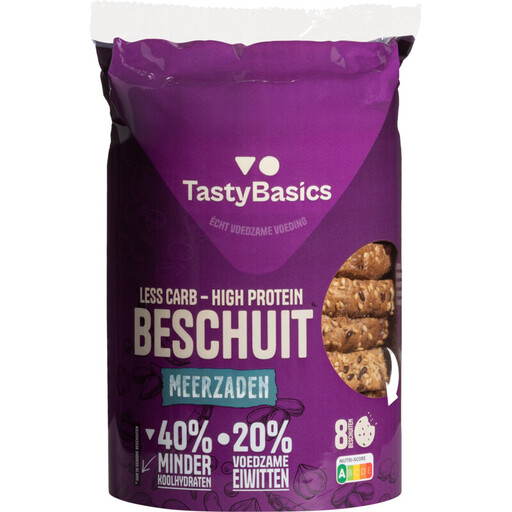 Image unavailable
TastyBasics multiseed rusks, 184 g
An option if you want to compare protein and fibre as well as seeds in your rusks. The pack contains 184 g. Compare nutritional values per 100 g and, if you have an allergy, check the current information about egg, sesame and gluten-containing cereals.
View on Joybuy
Frequently asked questions
Are multiseed rusks always high in fibre?
No, fibre content varies between varieties. Albert Heijn product information lists 7 g of fibre per 100 g for AH Meerzadenbeschuit and 11 g per 100 g for AH Biologisch Volkoren beschuit meerzaden. So compare the nutritional information per 100 g rather than judging by the seeds you can see on the rusks.
Can I take multiseed rusks for someone with a food allergy?
Only if the ingredients and allergens in the variety you choose are suitable for that person. The multiseed rusks discussed here contain sesame and gluten-containing cereals, and several varieties also contain egg. Check the current packaging, including any warnings about possible traces.
Do rusks always contain iodine from iodised baker’s salt?
No, don’t assume they do. The Netherlands Nutrition Centre says using iodised baker’s salt in bread isn’t compulsory. And with rusks, the word ‘salt’ on its own doesn’t confirm which type was used either. Check the ingredients for the rusks you’ve chosen, or ask the manufacturer if this matters for your purchase.
How can I keep rusks crisp until the parade?
Keep an opened pack dry and well sealed. Albert Heijn and PLUS also recommend storing the products discussed here in a dark place. If you’re planning to serve the rusks later, it’s best to take an unopened pack with you.


