
Nursery staff following the group’s policy
When preparing lunch for several children, check the ingredients and allergens before choosing a variety. The Netherlands Nutrition Centre advises childcare organisations to have their own food policy.


Start with the nursery’s food and allergy policy, then check the packaging of the exact type of rusk you’re thinking of bringing in. Next, compare the seeds and fibre listed, the portion size and availability. A seed mix or nutritional value alone won’t tell you whether a product is right for the group.
When preparing lunch for several children, check the ingredients and allergens before choosing a variety. The Netherlands Nutrition Centre advises childcare organisations to have their own food policy.
You’re looking for rusks with a particular seed mix or stated fibre content. Compare the information for the exact variety: Bolletje, PLUS and TastyBasics don’t all describe the same product feature.
You want to know whether the same pack will remain available from your shop or delivery location. Check the specific variety, as availability can vary by location.
First, check that the multiseed rusks meet the group’s requirements. Then use the packaging to assess the nutritional information, portion size and practical availability of the variety you’ve chosen.
| What to consider | What to check before buying | Who it’s most relevant to |
|---|---|---|
| Allergens and policy | Read the current ingredient and allergen information on the exact pack, and check it against the group’s requirements. | When I’m buying for the whole group, I want to know before choosing whether the ingredients meet our requirements. This is the top priority for around 31% of consumers. |
| Fibre and seeds | Compare fibre on the same basis, preferably per 100 g, and check which grains, seeds and kernels are listed for the variety. | I’m looking for a particular seed mix or want to compare the stated fibre content of different varieties. Around 31% of consumers give this profile top priority. |
| Texture and portion size | Look at the size and visible seeds, and tailor the portion to the child and the topping you’ve chosen. | For a group lunch, I want to know whether the rusks are practical to eat and portion out. This is the top priority for around 19% of consumers. |
| Supply | Check the number of pieces per pack and availability from your own shop or delivery location. | When I’m planning several lunches, I want to be able to order the same variety again. This is the main purchasing priority for around 19% of consumers. |
A seed mix alone tells you nothing about the allergens in the pack you’ve chosen. The European Commission says that cereals containing gluten and sesame, among other allergens, must be clearly listed when present as ingredients.
Check the current ingredient and allergen information for the exact variety against the nursery’s policy.
Fibre content, the proportion of seeds and Nutri-Score describe different aspects of a product. None of them replaces checking the ingredients or portion size.
Only compare values expressed in the same units, and assess allergens and how practical the product is to eat separately.
According to the Netherlands Food and Consumer Product Safety Authority, iodine compounds may be used in bakery products. This doesn’t tell you how much iodine a particular rusk contains or what salt was used.
If this is an essential requirement, check the information from the relevant manufacturer or on the packaging.
A variety of rusks may be available from one shop or delivery location but not another. This matters when planning regular lunches.
Check the availability of the exact variety at your location before planning your lunch supplies.
Bolletje’s range includes Vezelrijk Meerzaden Beschuit.
PLUS offers Beschuit volkoren met zaden, as well as a separate luxury plain variety with seeds.
TastyBasics sells Beschuit Meerzaden, with nutritional values listed per 100 g.
Lidl lists Ambachtelijk beschuit meergranen in a 230 g pack.
These are multiseed rusks for anyone looking for a variety to serve at nursery lunch. Check the current packaging and group policy for both products. The product listing alone can’t tell you whether the rusks are suitable for your group.
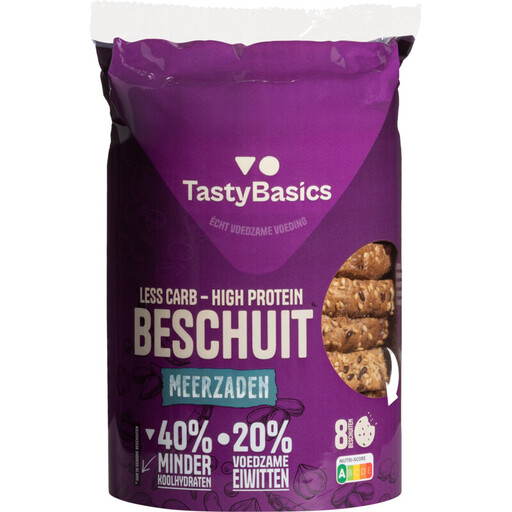 Image unavailable
An option to compare if you’re looking for multiseed rusks for nursery lunch. The listed pack contains 184 g.
Before serving, check the current ingredients and allergen information on the packaging, particularly against the group’s requirements.
 Image unavailable
An option if you’re looking to buy multiseed rusks in a roll for lunch. The listed pack contains 10 pieces.
Check the allergens on the current packaging and consider whether the size and portion are right for the children and meet the nursery’s requirements.
Don’t rely on the category name: check the exact packaging against the nursery’s allergy policy. The European Commission says cereals containing gluten and sesame must be clearly listed when they’re ingredients in a prepacked product.
Compare like-for-like values per 100 g, and check the listed seeds, ingredients and portion size separately. Bolletje states that Vezelrijk Meerzaden contains 10% fibre, PLUS says its wholemeal rusks contain over 25% seeds and kernels, and TastyBasics lists 11 g of fibre per 100 g for Beschuit Meerzaden. These figures don’t all describe the same product feature.
No. General information about iodised baker’s salt doesn’t confirm the iodine content of every rusk. If the type of salt used or iodine content matters to your choice, check the information for the exact variety.
No. Tailor the portion to the child and the nursery’s requirements. The Netherlands Nutrition Centre points out that children don’t all eat the same amount. Also check whether the size and texture of the rusks you’ve chosen are practical.