For fakeaway night, choose a multiseed rusk with a seed mix and size that work well with your savoury toppings. If nutritional values matter more to you, compare fibre, protein and carbohydrates per 100 g and per rusk. Whatever you choose, check the latest ingredients and allergen information: multiseed rusks aren’t automatically suitable if you need to avoid gluten or sesame.
Who might enjoy multiseed rusks?
Fans of crunchy rusks with savoury toppings
If you want to use a rusk as a crisp base for a spread or another savoury topping, check the type of seeds, the size and the ingredients. A larger rusk may leave more room for toppings, but make sure the variety you choose works with what you plan to put on it.
Shoppers comparing nutritional values
If fibre, protein or carbohydrates are important to you when choosing a product, compare the nutritional information per 100 g and per rusk. This helps you account for differences in portion size rather than relying on the product name alone.
Consumers who check ingredients
If you need to avoid ingredients such as wheat, sesame or egg, read the latest ingredients list and allergen information on the specific pack. A seed mix or a spelt label won’t tell you what other ingredients are included.
What should you look for when choosing?
Decide what matters most for your fakeaway night: how well the rusk holds up under savoury toppings, its nutritional values or its ingredients. Then check the packaging of the variety you want to use.
| What to consider |
What to check when buying |
Who it matters to |
| Texture and seeds |
Check which seeds and kernels are listed and how large the rusks are. |
If I’m serving savoury toppings on rusks, I mainly want a crisp base with a noticeable seed texture. For around 42% of consumers, texture may be the top priority. |
| Nutritional values |
Compare fibre, protein and carbohydrates per 100 g and per rusk; also check the weight of each one. |
When I choose rusks based on my own nutritional criteria, I want to be able to compare portions rather than just read claims on the front of the pack. For around 33% of consumers, nutritional profile may come first. |
| Ingredients and allergens |
Read the latest ingredients list and allergen information, including for varieties made with spelt or plenty of seeds. |
If I need to avoid certain grains, sesame or egg, the ingredients determine whether a rusk is suitable for me. For around 25% of consumers, ingredients may be the first thing they consider. |
Common mistakes
-
Assuming ‘multiseed’ means allergen-friendly
The seed-containing rusks reviewed list ingredients including wheat and other gluten-containing grains, as well as sesame; some varieties also list egg. So the seed mix alone doesn’t tell you whether a product is suitable for someone with an allergy.
Check the allergen information and ingredients list on the latest packaging, not just the product name or the front of the pack.
-
Comparing only the number of rusks
Rusks can vary in weight per piece. So the number of pieces and the nutritional values per 100 g don’t tell you on their own what’s in one rusk.
Check the weight per piece and compare the nutritional information both per 100 g and per portion, if one is given.
-
Taking it for granted that baker’s salt contains iodine
According to Brood.net, using iodine-fortified baker’s salt is not a legal requirement in the Netherlands. So you can’t tell what’s in a particular rusk simply by making a general assumption about baker’s salt.
If this ingredient matters to your choice, look for an explicit mention of baker’s salt or iodised salt on the packaging.
Comparing brands and own-label options
These brands and own-label options give you a starting point for comparing different products. Check the ingredients and nutritional information for each variety, as these features don’t necessarily apply to the whole brand.
Bolletje
The multiseed rusk reviewed combines a variety of seeds and kernels in one rusk.
- The product information lists sunflower seeds, linseed, sesame and pumpkin seeds.
- This variety contains wheat and sesame and may contain other gluten-containing grains.
Albert Heijn
The AH range includes multiseed rusks and organic wholegrain multiseed rusks.
- AH states that its Multiseed Rusks contain over 16% seeds and kernels; the organic wholegrain variety lists linseed, sesame and sunflower seeds.
- Check the ingredients and allergens for each variety, including grains, sesame and egg.
Jumbo
Jumbo Robuust Spelt Rusks are a rusk variety made with seeds and kernels.
- Jumbo lists sunflower seeds, pumpkin seeds, sesame and linseed in this variety.
- The allergen information includes spelt, wheat, barley, egg and sesame; spelt rusks are therefore not a gluten-free option.
PLUS
PLUS Wholegrain with Seeds is a wholegrain rusk variety made with seeds and kernels.
- PLUS states that this specific variety contains over 25% seeds and kernels.
- The ingredients list includes wheat, barley, oats, egg and sesame.
Lidl
Lidl lists Ambachtelijk Beschuit Meergranen as a 230 g multigrain rusk variety.
- The product name makes it easier to search for this multigrain variety.
- Check the packaging before choosing this variety based on its ingredients, allergens or nutritional values.
ALDI
ALDI describes plain and wholemeal rusks alongside other products on its shelves.
- Wholemeal rusks are a separate type of rusk you can compare by checking the label.
- Toast and crackers are different product types, so don’t choose them as if they were multiseed rusks.
Multiseed rusks on Joybuy
These two rusk options suit different priorities for a fakeaway night: a Bolletje variety with several types of seed and a TastyBasics variety that also lists nutritional values per 100 g. Always check the latest packaging before use.
 Image unavailable
Bolletje multiseed rusks, 10 pieces
An option if you’re looking for a rusk with a variety of seeds to serve with savoury toppings.
The product information lists sunflower seeds, linseed, sesame and pumpkin seeds, and states that it contains 10 g of fibre and 17 g of protein per 100 g.
Contains wheat and sesame; check the latest packaging for information about other gluten-containing grains too.
View on Joybuy
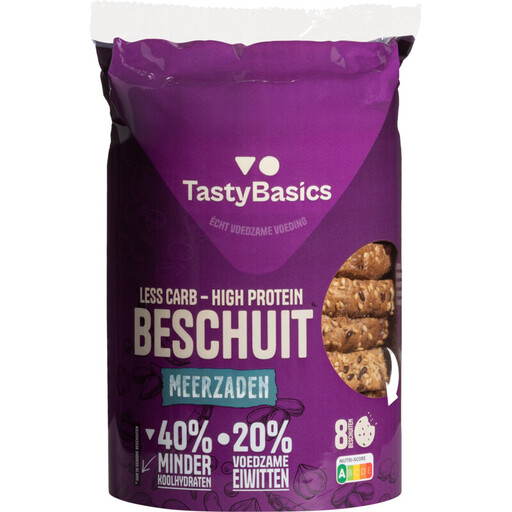 Image unavailable
TastyBasics Multiseed Rusks, 184 g
An option to compare if protein, fibre and carbohydrates are important when choosing a rusk to serve with savoury toppings.
The listed nutritional values are 20 g of protein, 11 g of fibre and 43 g of carbohydrates per 100 g. Compare the latest nutritional table per portion if you want to know what one rusk provides.
The ingredients information lists wheat, spelt, barley, egg and sesame; if you have dietary restrictions, check the latest packaging.
View on Joybuy
Frequently asked questions
Can I use multiseed rusks for savoury fakeaway toppings?
Yes, if you want a dry, crisp base for something like a savoury spread or vegetable toppings. Add very moist toppings just before eating if you want to stop the rusk going soft.
Are spelt rusks gluten-free?
No, spelt is not a gluten-free grain. Jumbo lists spelt, wheat and barley among the ingredients in its Robuust Spelt Rusks; check the label of every other variety separately.
Do all multiseed rusks contain sesame and egg?
You can’t tell from the product type alone. The varieties reviewed often list sesame and some also contain egg, but ingredients vary from product to product. If you have an allergy, always read the latest packaging.
Is iodised baker’s salt compulsory in Dutch rusks?
No. According to Brood.net, using iodine-fortified baker’s salt is not a legal requirement in the Netherlands. To find out what salt has been used in a particular rusk, check the ingredients list on the pack.


