
Visitors who want a satisfying crunch
You’re serving rusks with aniseed sprinkles and looking for a seeded variety rather than plain rusks. If any guests have relevant allergies, first check that the variety you’ve chosen is suitable for them.


Choose multiseed rusks for aniseed-sprinkle rusks if you want a pronounced texture from seeds and kernels. Then let the label guide you: fibre, wholegrain ingredients, an organic option, and the amount of protein or carbohydrates vary by product. Compare nutritional values per 100 g and check the allergens for the exact variety you’re serving.
You’re serving rusks with aniseed sprinkles and looking for a seeded variety rather than plain rusks. If any guests have relevant allergies, first check that the variety you’ve chosen is suitable for them.
You want to consider fibre or wholegrain ingredients as well as the celebratory topping. Compare the nutritional information per 100 g, then check the weight of one rusk.
If wheat, gluten, egg or sesame is a concern for you or your guests, the label ‘multiseed’ isn’t enough. Ingredients and allergens vary by variety, so always check the current packaging.
When choosing rusks with aniseed sprinkles, first decide what matters most to you: the crunch of the seeds, fibre or wholegrain ingredients, the protein and carbohydrate content, or suitable ingredients. Then use the packaging to compare varieties on a like-for-like basis.
| What to consider | What to check when buying | Who it matters to |
|---|---|---|
| Seeds and kernels | Check which seeds and kernels are listed in the ingredients; also look for sesame. | I want the rusks beneath the aniseed sprinkles to have a noticeable texture from seeds and kernels. For around 30% of these consumers, that crunch would be the main reason for their choice. |
| Fibre and wholegrain | Compare fibre per 100 g and check whether the packaging lists wholegrain ingredients. | Alongside the topping, the ingredients in the rusks matter to me, and I want to prioritise fibre or wholegrain. That would be the first consideration for around 40% of these consumers. |
| Protein and carbohydrates | Check the amounts of protein and carbohydrates per 100 g, not just comparative claims on the front of the pack. | When comparing varieties, I focus on protein and carbohydrates in the nutritional information. Around 20% of these consumers would make this their main criterion. |
| Ingredients and dietary requirements | Check the allergen information for the exact variety, including any mention of wheat, gluten-containing cereals, egg and sesame. | I’m serving rusks to someone who needs to avoid certain ingredients, so suitability comes before the texture I want. For around 10% of these consumers, this would be the main factor in their choice. |
The varieties reviewed list ingredients including sesame and gluten-containing cereals; some also contain egg. Bolletje positioning its specific Vezelrijk Beschuit Meerzaden as vegan says nothing about whether it’s suitable for someone with a sesame or gluten allergy.
Read the ingredients and allergen information for the exact variety, even if you already know the brand.
Not all rusks weigh the same. Jumbo lists each Bolletje Vezelrijk Beschuit Meerzaden rusk at around 16 g; Albert Heijn gives a 23 g serving for AH Biologisch Volkoren beschuit meerzaden.
Compare values per 100 g first, then use the weight of each rusk to work out the portion you’re serving.
The word ‘rusk’ doesn’t tell you which type of salt has been used in a particular product.
If iodine matters to your choice, check the type of salt listed in the ingredients.
Ingredients and nutritional information can change. This is especially important if you’re choosing a product based on an allergen or a specific nutritional value.
Check the current packaging of your chosen variety just before buying.
Bolletje Vezelrijk Beschuit Meerzaden is an option if you want to compare different seeds and kernels. Jumbo’s product listing names sunflower seeds, linseed, sesame seeds and pumpkin seeds.
AH Biologisch Volkoren beschuit meerzaden combines wholemeal wheat flour with linseed, sesame seeds and sunflower seeds.
PLUS Beschuit volkoren met zaden is worth considering if you’re mainly interested in the amount of seeds and kernels in a wholegrain rusk.
TastyBasics Beschuit meerzaden gives you specific nutritional values to compare protein and carbohydrates across different types of rusks.
Lidl lists Ambachtelijk beschuit meergranen as a 230 g product. ‘Multigrain’ doesn’t automatically mean the same as a seeded rusk.
These two multiseed rusks are worth considering for aniseed-sprinkle rusks if you want to compare nutritional values as well as texture. Check the current allergen information on the packaging of both products.
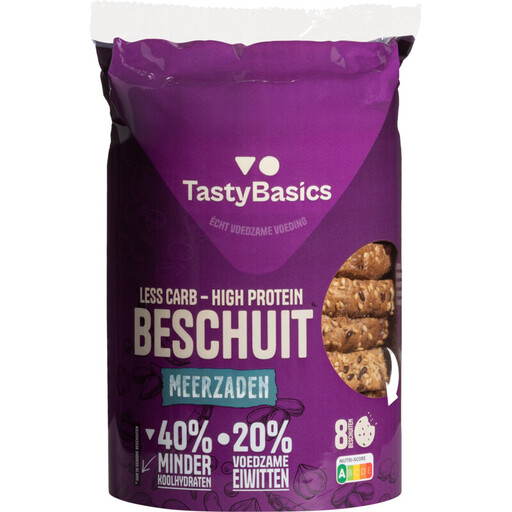 Image unavailable
A variety to consider for aniseed-sprinkle rusks if you’re comparing protein and carbohydrates.
For TastyBasics Beschuit meerzaden, Albert Heijn lists 20 g of protein, 11 g of fibre and 43 g of carbohydrates per 100 g.
The listed ingredients include wheat, spelt, barley, egg and sesame. Check the current allergen information; seal the pack well after opening and store the rusks in a dry place.
 Image unavailable
A variety for anyone who wants a mix of seeds and kernels with their aniseed-sprinkle rusks, and wants to compare fibre content too.
For Bolletje Vezelrijk Beschuit Meerzaden, Jumbo lists sunflower seeds, linseed, sesame seeds and pumpkin seeds, plus 10 g of fibre and 17 g of protein per 100 g.
The variety lists wheat, gluten-containing cereals and sesame. Check the current allergen information, and keep the opened pack tightly sealed in a dry place.
First decide whether texture from the seeds, fibre, wholegrain ingredients, or protein and carbohydrate content matters most to you. Compare nutritional values per 100 g, check the weight of one rusk and read the allergen information on the current packaging.
You can’t tell from the word ‘multiseed’ alone. The varieties discussed here often list sesame and gluten-containing cereals; some contain egg. Check the exact packaging. Albert Heijn lists Schär Zwieback as gluten- and wheat-free, but that doesn’t confirm it’s a multiseed rusk.
Check the salt listed in the ingredients for your chosen rusk, for example ‘baking salt’ or ‘table salt enriched with iodine’. Don’t assume the type of salt from the word ‘rusk’ alone.
Store the rusks in a dry place and seal the pack well after use. Also follow the storage instructions for the specific product; the information for both Bolletje and AH says to store in a dry place and reseal after opening.