
Parents comparing seeds and fibre
You’re looking for rusks with recognisable seeds and kernels, and want to compare how much fibre different products contain per 100 g.


Choose multiseed rusks if your child likes a coarse, crunchy texture and you want to compare the ingredients and nutritional information of different products. Before packing one for school or an after-school club, check the allergens on the current packaging, the portion size and the setting’s rules. Rusks don’t have to be a regular choice for every break: the Netherlands Nutrition Centre also recommends fruit, vegetables and wholemeal bread for children.
You’re looking for rusks with recognisable seeds and kernels, and want to compare how much fibre different products contain per 100 g.
For a snack at school or an after-school club, check the ingredients on the pack you’ve chosen and the setting’s rules. The varieties described here include ingredients such as wheat and sesame, and sometimes egg.
You want to know whether your child likes the crunchy rusk and seeds, and whether a piece with a suitable topping will work for the planned snack.
Start with any ingredients your child needs to avoid, along with the rules at their school or after-school club. Then compare the seeds, nutritional information and the portion you actually want to pack.
| What to consider | What to check when buying | Who it matters to |
|---|---|---|
| Allergens and setting rules | Read the current allergen information on the pack and check what the school or after-school club allows. | If my child needs to avoid certain ingredients, I don’t want to rely on the name ‘multiseed’ alone. This check is the top priority for around 33% of consumers. |
| Fibre and type of grain | Compare fibre per 100 g and check the ingredients list to see whether wholemeal flour has been used. | I want to compare rusks on the same nutritional basis, without mistaking a figure per 100 g for the amount in a child-sized portion. Around 27% of consumers give this their highest priority. |
| Seeds and texture | Check which seeds and kernels are listed and whether their proportion is stated on the pack. | My child also needs to be happy eating the seeds and the coarse, crunchy texture. This combination is the main consideration for around 27% of consumers. |
| Portion and portability | Check the number of pieces and, if stated, the weight per piece. Think about crumbs and toppings, too. | For tea time or a lunchbox, I’m mainly looking for a portion my child can eat easily. This practical consideration comes first for around 13% of consumers. |
The multiseed rusks described here contain wheat and sesame; some also contain egg or other gluten-containing grains. The product name doesn’t indicate whether a product is suitable for someone with a food allergy or coeliac disease.
Check the allergen information on the physical pack and follow the rules that apply to your child.
Nutritional values per 100 g don’t automatically tell you how much fibre is in one rusk. The fibre figure alone also says little about the snack as a whole.
Alongside the nutritional information, check the portion size and what else you’re serving at tea time.
Ingredients and allergen information can change. If you’re packing a snack for school or an after-school club, the information on the pack you’ve bought is what matters.
Read the packaging again, even if you’ve bought the same brand before.
A Dutch rule on iodine compounds and baker’s salt doesn’t confirm which ingredients are in an individual rusk product.
For more information, check the details for the specific product or ask the manufacturer.
Bolletje makes a high-fibre multiseed farmer’s rusk for anyone comparing seeds and fibre within this product category.
AH Multiseed Rusks are an own-brand option that states the proportion of seeds and kernels.
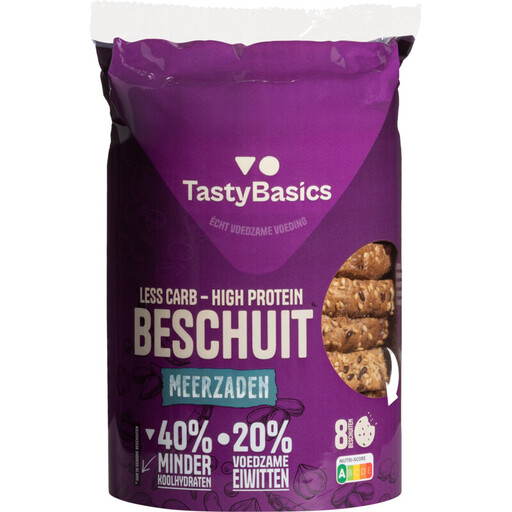
The TastyBasics multiseed rusks described here are worth considering if you want to compare wholemeal flour, fibre and protein on the packaging.
PLUS Luxury Plain Rusks with Seeds are an own-brand option if you want to compare the seeds and kernels listed.
You can compare these two multiseed rusks by packaging, listed ingredients and nutritional information. You’ll need to decide separately whether the texture and portion suit your child.
 No image available
An option if you’re looking for rusks with a listed mix of seeds and kernels. The variety described contains 10 g of fibre per 100 g, as well as wheat and sesame. Check the current packaging before packing a piece for school or an after-school club.
 No image available
An option if you also want to compare wholemeal flour and nutritional values in multiseed rusks. The variety described contains 11 g of fibre and 20 g of protein per 100 g, as well as ingredients including wheat, spelt, barley, egg and sesame. Check the pack for the weight of each rusk and whether the ingredients are suitable.
Not just because they’re called ‘multiseed’: the varieties described here contain wheat or other gluten-containing grains. If your child has coeliac disease, check whether a specific product is suitable for their diet. The Netherlands Nutrition Centre says that people with coeliac disease cannot tolerate gluten.
That depends on your child, the portion and the school’s rules. Don’t choose based on a fibre claim alone: the Netherlands Nutrition Centre also recommends fruit, vegetables and wholemeal bread as snacks for children at home or school.
No. The rule doesn’t confirm that a particular pack of rusks is made with iodised baker’s salt. Check the ingredients information or ask the manufacturer about that product.
Seal the pack tightly after use and follow the storage instructions on the packaging. The products described here should be stored in a dry place.