
Pea soup lovers looking for a crisp contrast
You want a crispbread with seeds and kernels to go with a hearty bowl of soup. If the ingredients matter to you, check which seeds are listed.


If you’re looking for a crisp contrast to pea soup, with seeds and kernels, multiseed crispbread is a good choice. Then compare the fibre and salt content per 100 g for each variety, and check the allergens: the products reviewed differ in these respects. Don’t assume that it contains iodised baker’s salt, either; according to the Netherlands Nutrition Centre, its use isn’t compulsory.
You want a crispbread with seeds and kernels to go with a hearty bowl of soup. If the ingredients matter to you, check which seeds are listed.
You don’t choose on the basis of the word ‘multiseed’ alone. Compare the fibre content per 100 g, then consider how much crispbread you usually eat.
Sesame, egg or cereals containing gluten may affect your choice. The salt content of the crispbread may also be worth considering when you eat it with pea soup.
First decide what matters most to you: the seed mix, the nutritional values, or the allergen and salt information. Then compare the relevant figures on the same basis, and read the label of the variety you’re planning to buy.
| What to consider | What to check when buying | Who it matters most to |
|---|---|---|
| Texture and seed mix | Check which seeds and kernels are listed in the ingredients; compare the size if you’d prefer a larger crispbread. | With a hearty bowl of pea soup, I mainly want something crisp with seeds I can see. For around 36% of consumers, texture is the top priority when choosing. |
| Fibre and nutritional values | Compare fibre per 100 g and consider the portion size too. Albert Heijn lists 10 g of fibre per 100 g for Bolletje Vezelrijk Meerzaden, while Jumbo lists 11 g per 100 g for TastyBasics Meerzaden. | If fibre is my main reason for choosing multiseed crispbread with my soup, I want to be able to compare the values on the labels. It matters most to around 36% of consumers. |
| Allergens and salt | Read the latest allergen information and compare salt per 100 g; take the soup and any toppings into account too. | If sesame, egg or cereals containing gluten are a concern for me, or I’m watching the salt in my whole meal, I read the label especially carefully. For around 28% of consumers, this check is the top priority. |
A higher fibre content doesn’t automatically tell you about salt or allergens. The Netherlands Nutrition Centre gives the average salt content of a 250 g bowl of pea soup as 1,74 g; the ingredients in your soup and the amount of crispbread you eat determine your total. If iodine matters to your choice, check whether the label mentions baker’s salt or iodised salt, or ask the manufacturer.
The name doesn’t tell you how much fibre a crispbread contains. Albert Heijn lists 7 g of fibre per 100 g for AH Meerzadenbeschuit and 10 g per 100 g for Bolletje Vezelrijk Meerzaden; Jumbo lists 11 g per 100 g for TastyBasics Meerzaden.
Compare the nutritional information per 100 g, then consider how much you actually want to eat.
The three multiseed varieties discussed here list sesame and cereals containing gluten. According to the product information from Albert Heijn and Jumbo, AH Meerzadenbeschuit and TastyBasics Meerzaden also contain egg.
If you have an allergy or dietary restriction, check the latest ingredients and allergen information on the packaging.
The soup and any toppings also contribute to the salt in your meal. The Netherlands Nutrition Centre gives the average salt content of a 250 g bowl of pea soup as 1,74 g.
Compare the salt content of crispbread per 100 g, but consider it alongside what you serve with it.
According to the Netherlands Nutrition Centre, the use of baker’s salt isn’t compulsory. So the word ‘crispbread’ in a product name doesn’t confirm which type of salt has been used in that particular variety.
If the type of salt matters to your choice, look for an explicit mention on the label or ask the manufacturer.
Bolletje makes a Vezelrijk Meerzaden crispbread with a range of seeds and kernels. The brand also offers a separate dark wholegrain variety.
AH Meerzadenbeschuit is a supermarket own-brand option for anyone looking to compare the mix of seeds and kernels.
With TastyBasics Meerzaden crispbread, you can factor the fibre and protein content per 100 g into your choice.
These crispbreads are a good match if you’re looking for seeds and kernels to enjoy with pea soup. Use the pack size and the latest nutritional and allergen information to decide which variety suits your priorities.
 Image unavailable
Worth considering if you’re looking for seed crispbread to go with pea soup. The pack contains 10 pieces. If allergens or iodine are a concern, check the latest ingredients list and the type of salt stated on the packaging.
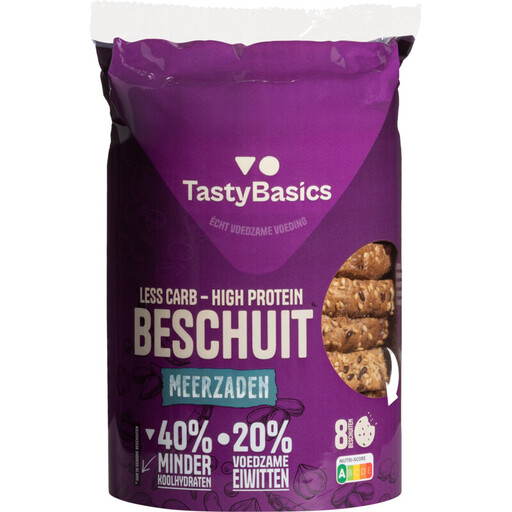 Image unavailable
Worth considering if you’d like multiseed crispbread with your soup and are comparing fibre per 100 g. The pack contains 184 g. Jumbo lists 11 g of fibre, 20 g of protein and 0,59 g of salt per 100 g for TastyBasics Meerzaden; check the latest allergen information before buying too.
Look for a variety whose ingredients list includes the seeds and kernels you’re after. Albert Heijn lists sunflower seeds, linseed, sesame and pumpkin seeds, among other ingredients, for Bolletje Vezelrijk Meerzaden; for AH Meerzadenbeschuit, the retailer lists over 16% seeds and kernels. At the same time, check that the ingredients are suitable for you.
No, the stated amounts vary by variety. Per 100 g, Albert Heijn lists 7 g for AH Meerzadenbeschuit and 10 g for Bolletje Vezelrijk Meerzaden; Jumbo lists 11 g for TastyBasics Meerzaden. Always compare the same amount, then consider your portion size.
At the very least, check the latest information about sesame and cereals containing gluten; the AH and TastyBasics varieties discussed here also list egg. Read the packaging for the exact variety you’re buying rather than relying on the product name alone.
No. According to the Netherlands Nutrition Centre, the use of baker’s salt isn’t compulsory. So the name or category of a crispbread doesn’t confirm that it contains iodine; check the type of salt on the label or ask the manufacturer if it matters to your choice.
Store the crispbread in a dry place in a tightly sealed container to keep it crisp. Follow the storage advice on the packaging for your variety.