
Vandaag of morgen in huis

Kwaliteit gegarandeerd

Welkomstaanbiedingen ontgrendelen: GRATIS bezorging | Tot 80% korting | Gratis 30 dagen JoyPlus-proefperiode
Download de app
A large cat tree for multiple cats needs to offer more than just a high vantage point. In a household with two or more cats, the furniture is used more intensively: cats climb, scratch, play and sleep at the same time. A model that looks spacious on paper may still wobble in practice, wear out quickly or have too few separate resting places.
So don’t focus only on height or appearance. Below, we cover the main buying pitfalls, technical points and three suitable product choices for different households.
A tall cat tree has to withstand considerable force when a cat jumps down from a platform. A narrow base plate or lightweight construction can therefore move more easily. Look for a wide base, several supporting posts and a feature that allows the tree to be attached to the wall or helps limit the risk of tipping over.
A tip-resistant cat tree is not automatically suitable for every situation. Always check the dimensions, the stated maximum weight and whether the floor where you place the furniture is level and solid.
A single sisal post quickly becomes occupied when you have several cats. What’s more, cats do not all scratch at the same height or in the same position. A cat tree with sisal posts at different levels offers more choice and can help redirect scratching towards the cat furniture.
Pay attention to the number of sisal-covered posts, their positioning and whether the covering can be replaced. A product description that only mentions a “scratching area” says little about the total amount of usable sisal.
A cat tree with a hammock may look appealing, but a small hammock or a single enclosed house will not be sufficient for every household. Cats sometimes want to rest at the same time without having to jostle one another. So look for a combination of open platforms, cat houses, a bed or hammock.
The dimensions are important too. A resting area needs to suit the largest cat in your home, especially when you are looking for a cat tree for large cats.
A large cat tree is often between approximately 170 and 213 centimetres tall. Height is particularly useful for cats that like to keep watch over their surroundings, but the route to the top needs to be logical. According to the product information for the models mentioned, platforms spaced approximately 20 to 40 centimetres apart are designed to make movement between levels more gradual.
Also check whether older, heavier or less agile cats can easily reach the upper areas. A very tall tower without wide intermediate platforms may be less practical than a slightly lower model with a better layout.
When assessing a sturdy cat tree, look at:
For the 212.5-centimetre model, the product information states that it has a double integrated base, 17 reinforced support posts and is intended for up to six cats, each weighing less than 6.8 kilograms. This is a product specification provided by the seller, not a universal guarantee for every home or type of flooring. Assemble the cat tree according to the instructions and regularly check that all connections are still secure.
Natural sisal is designed to be a hard-wearing scratching material, but its lifespan depends on use and assembly. Eight sisal-covered posts provide more scratching zones than a model with just one or two posts. Also check which parts are removable or washable.
Plush cushions and hammocks collect hair and dust. Removable covers, detachable cushions and surfaces that can be cleaned with a vacuum cleaner or lint roller make maintenance easier. A viewing opening is useful on cat houses for keeping an eye on your pets, while an enclosed section offers more privacy.
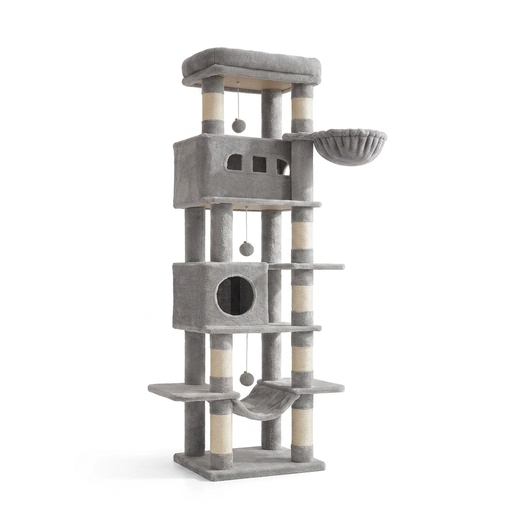
Why it suits this profile: This model offers a well-organised cat tree with multiple levels without requiring you to choose the tallest version straight away. It has one large and one smaller cat house, a hammock and two removable cushions.
The product information states that it has 17 support posts, eight sisal-covered posts and a double reinforced base with a tip-resistant feature.
170 cm tall, with six levels, a 50×30 cm platform and a 50×40 cm cat house. According to the product description, the top platform is removable.
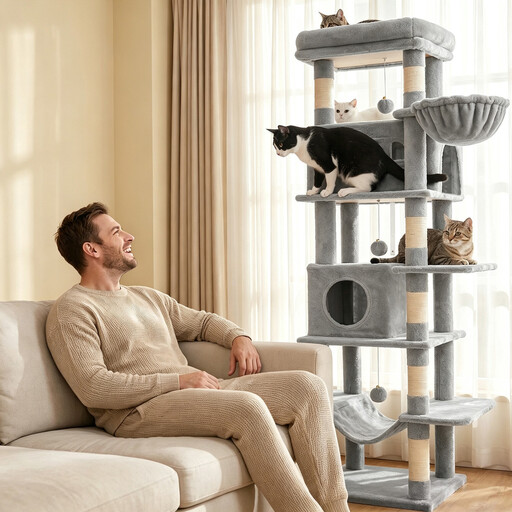
Why it suits this profile: The combination of a height of 212.5 cm, two cat houses, a spacious resting platform and a hammock is ideal for households wanting to provide several separate zones.
There are eight sisal zones distributed along the climbing route and, according to the product information, an integrated anti-tip lock.
A 65×45 cm platform, two cat houses, a 30 cm bed, two thick washable cushions and eight replaceable toy balls.
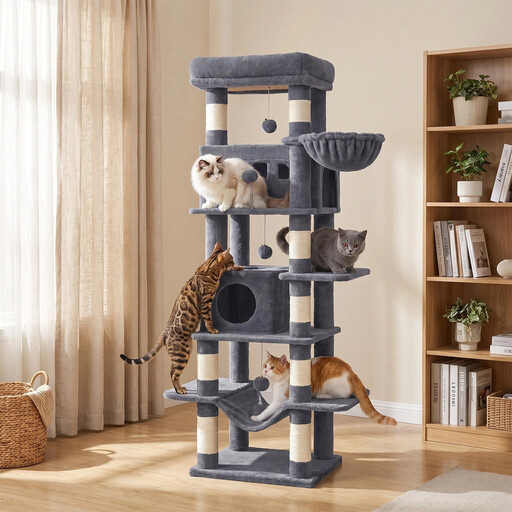
Why it suits this profile: This version is designed for households with several or heavier cats that use multiple resting and scratching areas at the same time.
The description mentions scratching options across five levels, eight sisal posts and a double reinforced base with an anti-tip feature.
Six levels, a 50×30 cm platform, a 50×40 cm cat house, a hammock and two removable washable cushions.
We have put together a complete, up-to-date list of products that fully meet these strict selection criteria and the applicable European safety regulations.
Do not place a large cat tree directly next to a radiator, damp external wall or busy passageway. A spot near a window may be appealing, but keep a sufficient distance from curtains and loose objects. After assembly, check all screws and connections. With several cats using the tree every day, checking it every few weeks is advisable.
Turn or replace worn sisal parts whenever this is possible according to the manufacturer. Washable cushions can be cleaned according to the care label. Hanging toys should be removed as soon as the rope, thread or attachment starts to come loose. This helps prevent a minor defect from becoming a practical problem.
Do not look only at the total height. For two or more cats, several resting areas, at least a few separate hiding places and different scratching zones are important. Also check whether the largest cat can sit comfortably on the widest platform and whether the base provides enough space.
Place the cat tree on a level, hard surface and tighten all the fasteners securely. Use the supplied wall attachment if one is available. A wide base and tip-resistant feature can help support stability, but they do not replace correct assembly and regular checks.
The lifespan varies depending on how intensively it is used, the cats’ weight, the materials and the level of maintenance. With several cats, sisal and soft resting areas tend to wear out more quickly. A model with multiple sisal posts, replaceable toys and washable cushions can be more practical, as you do not need to replace the entire cat furniture when one part becomes worn.
