
Those handing out bread at the parade
If you want to hand out the bread straight away, a loaf from the in-store bakery fits the bill. If you can bake it at home and let it cool first, a bake-at-home option is worth considering too.


For the Sinterklaas arrival parade, first decide how you want to serve your multigrain bread: ready to eat from the shop, baked at home or packaged so you can compare labels in advance. Then check each loaf’s ingredients, nutritional information and allergens. The word sourdough doesn’t tell you how much wholemeal flour it contains or whether iodised salt has been used.
If you want to hand out the bread straight away, a loaf from the in-store bakery fits the bill. If you can bake it at home and let it cool first, a bake-at-home option is worth considering too.
If you want to compare the wholemeal flour content, fibre and salt in advance, packaged bread with an ingredients list and nutritional information per 100 g is a practical choice. Check the current label when you buy it.
Do you need to consider allergens, gluten or whether iodised salt is listed? Check the specific loaf rather than relying on terms such as multigrain, sourdough or organic.
How you plan to serve the bread determines what you need to arrange before the parade. Then compare the information on the bread itself.
Choose this if: you want to serve the multigrain sourdough straight after buying it.
Bear in mind: shop availability and the need to check the ingredients and allergens of the bread you choose.
Choose this if: you want to compare nutritional information and ingredients in advance.
Bear in mind: product information may change, so it’s important to check the label when you buy it.
Choose this if: you want to bake it at home shortly before you set off.
Bear in mind: you’ll need the right equipment and time to bake the bread and let it cool.
| What to consider | What to check when buying | Who it matters to |
|---|---|---|
| Sourdough and serving time | Check whether it’s labelled sourdough and decide when you want to serve the bread. | I want to hand out bread that’s clearly labelled as sourdough at the planned time, without having to bake it at home. Around 40% of consumers would make this their main reason for choosing. |
| Nutritional information | Check the ingredients list for wholemeal flour, and compare fibre and salt per 100 g. | When choosing between multigrain breads, I want to know how much wholemeal flour they contain and how their nutritional values compare. For around 30% of consumers, this comparison would be the main priority. |
| Planning and availability | Check whether it’s available in the shop or read the baking instructions for a bake-at-home loaf. | I need to be able to buy and prepare the bread before setting off for the parade. For around 20% of consumers, this would be the deciding factor. |
| Allergens and type of salt | Read the latest allergen information. If iodine is a consideration, check for iodised salt or baker’s salt. | If I need to avoid an ingredient or the type of salt matters, I want to be clear about it before buying. Around 10% of consumers would make this their main requirement. |
The type of salt used varies from loaf to loaf. According to the Netherlands Nutrition Centre, organic bread usually contains non-iodised salt. The word sourdough also tells you nothing about whether iodine has been added.
If iodine matters to your choice, look for iodised salt or baker’s salt on the label. For unpackaged bread, ask which type of salt has been used.
The word multigrain doesn’t tell you how much wholemeal flour or fibre the bread contains. A dark colour or seeds on the crust won’t give you the full picture either.
Check the ingredients list for wholemeal flour, and compare the fibre and salt in the nutritional information per 100 g.
Sourdough doesn’t make standard bread containing gluten cereals gluten-free. Other ingredients and allergens can vary from product to product.
Check the latest allergen information for packaged bread, or ask about it before buying unpackaged bread.
Buying a loaf from a shop means visiting at a suitable time; a bake-at-home loaf needs to be prepared before you can take it with you.
Decide whether you want to hand it out straight away or bake it at home, then check shop availability or the instructions on the packaging.
Worth considering if you want to compare packaged multigrain breads with product information, including AH OerDesem donker meergranen and AH Liefde & Passie Meergranen.
Jumbo’s sourdough range includes brown multigrain bread, an option if you want to serve bread bought in store.
Lidl lists a 600 g organic brown multigrain sourdough loaf with seeds and kernels.
PLUS Korenlanders Meergranen stokbrood met desem bereid is a bake-at-home option if you want to bake bread at home.
ALDI lists multigrain bread and multigrain baguettes among the freshly baked bread available in stores with an in-store bakery.
Dirk lists multigrain and sourdough as bread categories.
These multigrain baguettes suit the bake-at-home option if you have time to defrost and bake them at home before the parade. Check the baking instructions and ingredients on each pack.
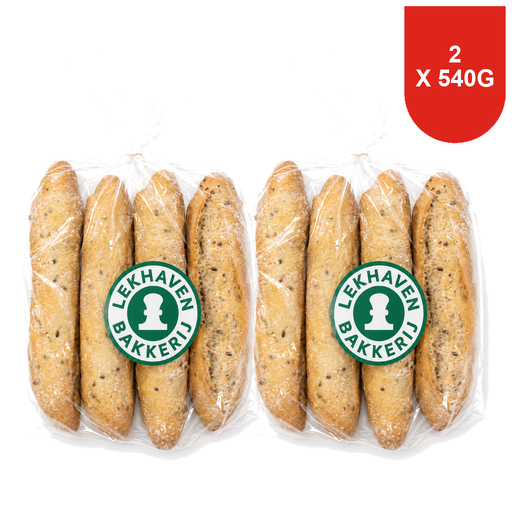 Image unavailable
An option if you can defrost the bread at home and bake it shortly before handing it out.
Pack size: 4 x 135 g x 2. Check the baking instructions on the packaging, as the stated preparation times vary. When checking the ingredients, look out for wheat, sesame and barley malt extract, among other things. Check the type of salt if iodine matters to your choice.
 Image unavailable
Suited to a serving plan that gives you time to defrost and bake the bread at home, then let it cool.
Pack size: 4 x 135 g. Follow the latest preparation instructions. Check the allergen information, including any mention of wheat and sesame, and check the type of salt if it matters to your choice.
Sourdough doesn’t tell you how much wholemeal flour a loaf contains or how sour it tastes. The Dutch Commodities Act Decree on Flour and Bread defines (sour) dough as a product formed by fermenting a mixture based on grain, water and naturally occurring micro-organisms. Check the ingredients list to find out what a loaf contains.
No, don’t rely on the name of the bread alone. According to the Netherlands Nutrition Centre, bread made with special baker’s salt contributes to iodine intake. However, check the packaging of your chosen loaf for iodised salt or baker’s salt, or ask about it when buying unpackaged bread.
No, sourdough doesn’t make bread containing gluten cereals gluten-free. Check the ingredients and allergens of the specific product if you need to avoid gluten.
Ask about the allergens in the specific loaf before buying it. If you’re buying fresh multigrain bread in store, don’t rely on the product name or visible seeds alone.
Yes, if the product is designed to be baked at home and you have enough time to prepare it and let it cool. Follow the instructions on the current packaging rather than assuming the same baking time applies to every multigrain baguette.