
Fibre-conscious lunch planner
You prepare several office lunches in advance and are looking for bread that is explicitly labelled wholemeal. Before choosing, compare the fibre per 100 g shown on the packaging of each bread.


For a fibre-conscious office lunch, start by choosing bread explicitly labelled wholemeal. According to the Netherlands Nutrition Centre, multigrain means that bread contains at least three types of grain; it does not mean that it is entirely wholemeal. Then compare fibre and salt per 100 g, check the allergens and choose a bread format that suits the number of lunches you’re preparing.
You prepare several office lunches in advance and are looking for bread that is explicitly labelled wholemeal. Before choosing, compare the fibre per 100 g shown on the packaging of each bread.
You only want to take what you need for that working day. You can portion a whole loaf at home and freeze it; individual rolls can be handy if you put each lunch together separately. The Netherlands Nutrition Centre recommends freezing bread in portions straight after buying it.
You check the ingredients and allergen declaration for the exact bread you’re taking with you. The grains and other ingredients used can vary between multigrain products.
Start by asking whether a wholemeal base is essential for you. Then consider what your lunch plans and the ingredients mean for the specific bread you choose.
| What to consider | What to check when buying | Most relevant to |
|---|---|---|
| Wholemeal base | Look for the wholemeal label on the specific bread; don’t judge by its colour or the name multigrain. | For my office lunch, I want to know whether the grain base is wholemeal, even if the bread looks dark. This is the top priority for around 50% of consumers. |
| Portions and nutritional values | Compare fibre and salt per 100 g, and decide whether you want to freeze a whole loaf in portions or use individual rolls. | When I prepare lunches for several working days, I want to plan my portions and compare nutritional values. This combination is the top priority for around 30% of consumers. |
| Ingredients and allergens | Read the ingredients list and allergen declaration for the variant you choose, including any warnings about possible traces. | When I’m putting together a lunch where allergens are a concern, I need to know what’s in the bread. Around 20% of consumers put this check first. |
A dark colour, seeds on top or the name multigrain doesn’t prove that the bread is entirely wholemeal. According to the Netherlands Nutrition Centre, multigrain means that it contains at least three types of grain.
Check that the product you’ve chosen is labelled wholemeal, then compare the ingredients and fibre per 100 g.
Breads with similar names can have different nutritional values and ingredients. Product information from Jumbo and PLUS shows that salt and allergens matter too.
Compare fibre and salt on the same basis, preferably per 100 g, and read the allergen declaration for the variant you’ve chosen.
If you only use a few slices each working day, you’ll also need to decide what to do with the rest.
Following the Netherlands Nutrition Centre’s advice, freeze bread in portions straight after buying it and take out what you need. Individual rolls are an alternative if you’d rather take a separate portion for each lunch.
Albert Heijn explains the difference between wholemeal and other bread descriptions. Use this as a starting point, then assess the bread you choose individually.
Two wholemeal multigrain breads from Jumbo provide specific values you can compare on the same basis.
Lidl describes a multigrain bread containing, among other things, wheat, barley and buckwheat.
Aldi offers an Extra High Fibre Wholemeal Bread as a separate wholemeal alternative for anyone looking beyond the multigrain category.
PLUS offers wholemeal multigrain rolls as an option for individual lunch portions.
Dirk presents Bakker van der Akker Casino Multigrain Wholemeal Half Loaf as an example of a half loaf with both descriptions in its name.
These products are multigrain breads and rolls in a range of formats. If a wholemeal base matters for your office lunch, check the current labelling of each product and compare the nutritional values on the same basis.
 Image unavailable
The pack of four rolls suits lunches you’re packing individually. Check the current packaging to see whether this variant is wholemeal, and only compare fibre and salt when the values are given on the same basis.
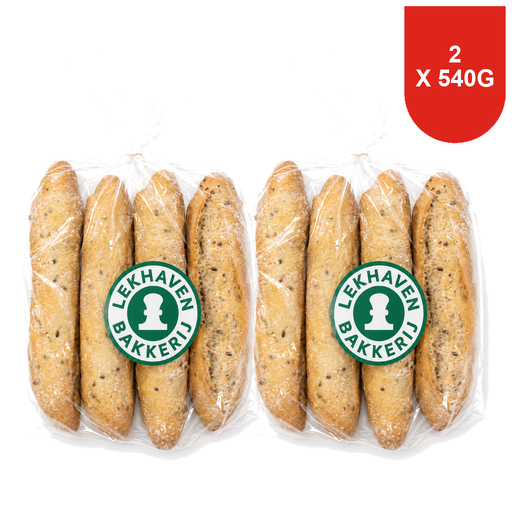 Image unavailable
The baguette format is an option if you plan your lunches around individual rolls. Allow time for thawing and baking, and check the preparation instructions, wholemeal status and allergens on the packaging you choose.
 Image unavailable
A 550 g round loaf lets you cut your own lunch portions. Allow time for thawing and baking, and check the packaging for wholemeal status, allergens and the basis used for the nutritional values.
No. According to the Netherlands Nutrition Centre, multigrain bread contains at least three different types of grain; that alone doesn’t mean the bread is entirely wholemeal. Look for the wholemeal label on the specific product, then read the ingredients and nutritional information.
Compare the fibre and salt values of both breads per 100 g. For two wholemeal multigrain breads, Jumbo lists 7,8 g and 8,0 g of fibre per 100 g respectively; also check the salt value and ingredients of each individual bread.
Yes. The Netherlands Nutrition Centre recommends freezing bread in portions straight after buying it and taking out what you need each day. This lets you divide a whole loaf between several office lunches.
Read the ingredients list for the bread variant you’ve chosen and check whether baker’s salt is listed. A mention on another bread, even from the same brand, doesn’t tell you what’s in the pack you have.