If you’d like to offer bread alongside rusks with sugared aniseed sprinkles, and choosing wholemeal is important to you, look for ‘wholemeal’ in the product description and compare the fibre per 100 g. According to the Netherlands Nutrition Centre, ‘multigrain’ means the bread contains at least three types of grain, but the term alone doesn’t tell you whether it’s wholemeal. For fussy eaters, you could also consider a mixed multigrain loaf. Check the ingredients, and choose individual rolls if separate portions would be more convenient.
Who is this choice relevant to?
Families looking for wholemeal and variety
You want bread that you can check is wholemeal, while also considering a variety of grains, kernels or seeds. Check the description, ingredients and fibre per 100 g rather than relying on the word ‘multigrain’ alone.
Parents of fussy eaters
You’re looking for bread that feels familiar to your family, without mistaking a mixed recipe for fully wholemeal bread. The ingredients list will tell you whether white flour is used alongside wholemeal flour.
People welcoming visitors to meet their new baby
You may want to serve bread or individual rolls alongside rusks with sugared aniseed sprinkles. If any guests have a food allergy, up-to-date allergen information is important; the Netherlands Nutrition Centre recommends checking the label.
What should you look for when choosing?
First, decide whether wholemeal is a must for you. Then compare the ingredients and portion sizes, and check the allergen information if you’re buying for guests.
| What to consider |
What should you check? |
Who is this most important for? |
| Wholemeal and fibre |
Look for ‘wholemeal’ in the description, check the ingredients and compare fibre per 100 g. |
If I want to choose wholemeal bread, the word ‘multigrain’ alone isn’t enough. Around 36% of consumers put choosing wholemeal and fibre first. |
| A familiar type of bread |
Check whether the recipe contains white flour as well as wholemeal flour; don’t judge the ingredients by the colour. |
For a fussy eater, I want to be able to choose between a mixed recipe and bread that’s specifically labelled wholemeal. This is the main consideration for around 29% of consumers. |
| Portions |
Check the number of rolls or slices, and the storage and freezing instructions. |
For a small gathering to meet the new baby, I don’t want to cut more bread than I need. Manageable portions are the main concern for around 21% of consumers. |
| Ingredients and allergens |
Check the current packaging for allergens and any ‘may contain’ warnings. |
If a guest has a food allergy, I need to know what’s in the bread before serving it. Around 14% of consumers give this check top priority. |
Common mistakes
-
Assuming ‘multigrain’ means ‘wholemeal’
According to the Netherlands Nutrition Centre, multigrain bread contains at least three types of grain. The name doesn’t tell you whether the bread is made with a wholemeal base.
If wholemeal is a must, check the product description and ingredients list.
-
Judging bread by its colour
A dark appearance doesn’t tell you which types of flour have been used. For example, the ingredients list for AH Boeren donker meergranen heel includes both wholemeal wheat flour and wheat flour.
Compare the first ingredients listed, and always use the same basis when comparing fibre: per 100 g.
-
Checking allergens only when you’re ready to serve
Multigrain bread may contain ingredients that matter to a guest with a food allergy. Information can vary between products and recipes.
Ask in advance which ingredients and warnings are relevant, and check the packaging of the bread you’re actually serving.
-
Buying more bread than you’ll serve
A whole loaf isn’t always practical if you only need a few portions of bread alongside rusks with sugared aniseed sprinkles.
Work out how many portions you need in advance, and follow the storage or freezing instructions on the packaging for any leftovers.
Brands to consider
Jumbo
Jumbo offers several types of multigrain bread, including wholemeal options.
- The product information for Jumbo Boeren Donker Volkoren Meergranen lists 55,7% wholemeal wheat flour and 8,0 g of fibre per 100 g.
- The allergen information for this product lists cereals containing gluten and possible traces of ingredients including soya, milk, sesame and lupin.
PLUS
As well as loaves, PLUS offers wholemeal multigrain rolls for anyone looking for individual portions.
- PLUS lists Korenlanders Volkoren meergranenbollen as containing 45% wholemeal wheat flour and 7,8 g of fibre per 100 g, in a pack of four.
- According to the product information, these rolls contain cereals containing gluten, soya, milk and sesame, among other ingredients.
Albert Heijn
Albert Heijn’s product information can help you assess the ingredients in a mixed multigrain loaf.
- The ingredients list for AH Boeren donker meergranen heel includes both wholemeal wheat flour and wheat flour.
- This particular product is listed as discontinued, so don’t use it as a guide for a current purchase.
Dirk
Dirk’s search results distinguish multigrain products from options with ‘wholemeal’ in the name.
- These names can give you a useful starting point if wholemeal is a must.
- Before choosing, check the ingredients and nutritional information for the individual product.
Lidl
Lidl provides information about packaged bread, as well as a separate ingredients and allergen guide for freshly baked bread.
- You can use this information to check what details are available for the bread you’re considering.
- Compare fibre or allergen information using details for the specific product only.
Multigrain rolls for individual portions
These multigrain rolls are a good fit if you’d like to serve individual portions of bread alongside rusks with sugared aniseed sprinkles. Check the packaging if choosing wholemeal specifically or checking allergen information is important to you.
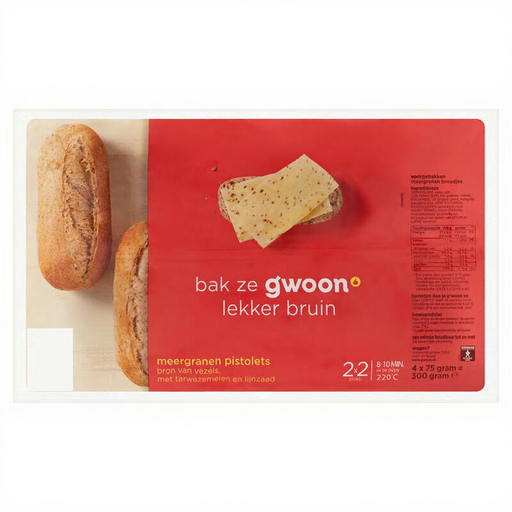 Image unavailable
g'woon Multigrain rolls, 4-pack
A pack of four individual rolls is a handy option if you want to serve bread by the roll alongside rusks with sugared aniseed sprinkles.
If you’re specifically looking for wholemeal bread, compare the current product description with the ingredients on the packaging. If you’re serving guests with a food allergy, also check the allergens and any ‘may contain’ warnings.
View on Joybuy
Frequently asked questions
Is all multigrain bread wholemeal?
No. According to the Netherlands Nutrition Centre, multigrain bread contains at least three different types of grain; that doesn’t automatically mean it’s wholemeal. If choosing wholemeal is important to you, check the description and ingredients.
How do I compare the fibre in two multigrain breads?
Compare the stated fibre per 100 g, along with the product description and ingredients. This gives you the same basis for comparing both breads, without trying to work out the fibre content from the colour or name.
What should I check if a guest has a food allergy?
Check the current packaging of the bread you plan to serve, and ask in advance which ingredients and ‘may contain’ warnings are relevant to your guest. The Netherlands Nutrition Centre emphasises the importance of label information for food allergies.
How can I tell whether multigrain bread contains iodised salt?
Check the ingredients list for the bread in question. The Netherlands Food and Consumer Product Safety Authority explains that iodine compounds may be present in bread through bakers’ salt; this doesn’t mean that all multigrain bread contains iodised salt.
What should I do with bread left over after visitors have met the new baby?
Follow the product’s storage and freezing instructions. For opened wholemeal bread, the Netherlands Nutrition Centre recommends 2–4 days in a kitchen cupboard and 1–3 months in the freezer; check the packaging for the guidance on individual rolls.


