
Shoppers comparing wholemeal bread and fibre
You want to choose a bread for lunch that is clearly wholemeal, and compare the fibre per 100 g. A dark colour or visible seeds aren’t enough to tell you what it contains.


If you want multigrain bread for a wholemeal lunch, choose a variety that is explicitly labelled ‘wholemeal’. According to the Netherlands Nutrition Centre, ‘multigrain’ means that at least three types of grain are used; it does not automatically mean that the bread is made with whole grains. Then compare the fibre and salt per 100 g, and check that the size, allergens and ingredients suit your lunch.
You want to choose a bread for lunch that is clearly wholemeal, and compare the fibre per 100 g. A dark colour or visible seeds aren’t enough to tell you what it contains.
Alongside the product description, you check the salt, allergens and whether baker’s salt is used. This is particularly useful if you need to avoid certain ingredients or want to know what kind of salt has been added to the bread.
You choose between a whole or half loaf, rolls and bake-off bread to suit your lunch plans. The storage and preparation instructions on the packaging are also important.
Start with the product description: wholemeal multigrain bread combines a wholemeal base with several types of grain, while ordinary wholemeal bread is also an option if grain variety matters less to you. Then compare the nutritional information for specific products and choose a size you can use or store as directed.
| What to look for | What to check before buying | Who is this important for? |
|---|---|---|
| Wholemeal base | Look for ‘wholemeal’ in the product description and read the ingredients list. Don’t judge the base by its colour, seeds or the word ‘multigrain’ alone. | If I mainly want wholemeal bread for lunch, I don’t want to rely on a dark crust. Around 50% of shoppers would make a wholemeal base their first consideration. |
| Fibre and salt | Compare fibre and salt on the same basis, preferably per 100 g. If a comparative claim is made, check what the product is being compared with. | If I regularly have bread for lunch, I want to be able to compare two specific products, even if both are labelled wholemeal. For around 30% of shoppers, comparing fibre and salt would come first. |
| Size and storage | Choose a whole or half loaf, rolls or bake-off bread to suit your lunch plans, and follow the storage and preparation instructions on the packaging. | If I don’t eat bread every day, I want a size that suits my plans. Around 20% of shoppers would consider convenience at lunchtime and storage their main priorities. |
According to the Netherlands Nutrition Centre, multigrain bread contains at least three types of grain. This doesn’t mean that it is made exclusively with whole grains; seeds and a dark colour don’t prove that either.
Look for an explicit wholemeal label, then check the ingredients and nutritional information for the variety you want to buy.
Fibre and salt levels vary from one product to another. A claim such as ‘less salt’ only means something in relation to the product it is being compared with.
Put the nutrition tables for the breads you’re considering side by side and compare them on the same basis, such as per 100 g.
Baker’s salt contains iodine, but according to the Netherlands Nutrition Centre, bakers aren’t required to use it. The type or colour of the bread won’t tell you which salt has been added.
Check the ingredients for baker’s salt, or ask your baker what kind of salt was used in the bread.
Whole or half loaves, rolls and bake-off bread suit different occasions. A large loaf is less practical if you can’t use it in time.
Choose a size that suits your lunch plans, and follow the instructions on the specific packaging for freezing or baking.
Bread that isn’t used in time may go to waste.
These supermarket ranges give you a starting point for comparing product descriptions, nutritional information and bread types. Always check the specific variety: information about one loaf doesn’t necessarily apply to the rest of the range.
Albert Heijn has separate online categories for multigrain and corn bread, and for wholemeal bread.
Jumbo lists nutritional values online for specific wholemeal multigrain breads.
Lidl offers fresh-from-the-oven multigrain bread, including a 400 g half loaf of dark multigrain bread.
ALDI lists both wholemeal multigrain bread and a separate extra-high-fibre wholemeal bread.
PLUS offers wholemeal multigrain products in different forms, including rolls and bake-off baguettes.
Dirk sells both breads labelled multigrain and varieties specifically labelled wholemeal multigrain.
These bread options include wholemeal products if you’re mainly looking for a wholemeal base, and multigrain products if the type or shape of the bread matters to you. The word ‘multigrain’ on its own doesn’t confirm that the bread is wholemeal, so check the latest product description.
 Image unavailable
An option for lunch if you’re looking for wholemeal flatbread rather than multigrain bread. Check the latest ingredients and allergen information on the packaging.
 Image unavailable
An alternative to consider if you’d like rye bread for lunch rather than bread explicitly labelled multigrain. Check the packaging for the exact product type, ingredients and basis used for the nutritional values.
 Image unavailable
An option if a wholemeal base matters more to you than a multigrain label. The bread needs to be thawed and baked before use; follow the baking time on the packaging and only compare nutritional values on the same basis.
 Image unavailable
Four multigrain rolls could work well for separate lunch occasions. If you specifically want wholemeal bread, check the latest product description, and read the packaging for allergens and comparable nutritional values.
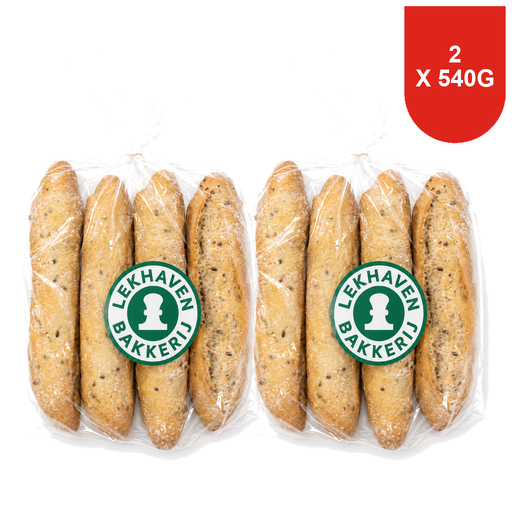 Image unavailable
A multigrain option if you’d like to bake baguettes for lunch. They need to be thawed first; check the packaging for the quantity, preparation instructions, allergens and any wholemeal labelling.
No. According to the Netherlands Nutrition Centre, multigrain bread contains at least three types of grain, but that doesn’t tell you whether the whole grain is used. If you want a wholemeal base, look for an explicit wholemeal label.
At the very least, compare the fibre and salt per 100 g in the specific products. Jumbo lists 7.8 g of fibre per 100 g for its half wholemeal multigrain loaf; PLUS lists 7.8 g of fibre and 0.93 g of salt per 100 g for its wholemeal multigrain rolls. Also check the ingredients and allergens for both varieties.
No. Baker’s salt contains iodine, but according to the Netherlands Nutrition Centre, bakers don’t have to use it. Check the label or ask your baker what kind of salt was used in the bread.
Follow the instructions on the packaging for the variety you choose. PLUS recommends freezing its wholemeal multigrain rolls on the day of purchase and using them within one month; these instructions don’t automatically apply to other breads.
No, check the allergens for each variety. PLUS lists wheat, rye, barley, oats and wheat gluten among the ingredients in its wholemeal multigrain baguettes, and warns that they may contain milk, soya and sesame. Another bread may have a different composition.