
Families who have bread for breakfast every day
Parents who consider loaf size and how much the family actually eats, so a large loaf doesn’t go to waste.


For a regular toddler breakfast, first look for bread explicitly labelled as wholemeal: according to the Netherlands Nutrition Centre, ‘multigrain’ does not automatically mean ‘wholemeal’. Then choose a size your household will actually get through, or can freeze. If you have a relevant allergy, check the latest allergen information. If baker’s salt matters to your dietary choices, check the label or ask the baker.
Parents who consider loaf size and how much the family actually eats, so a large loaf doesn’t go to waste.
Parents who don’t rely on the word ‘multigrain’ alone. The Netherlands Nutrition Centre points out that multigrain bread can also be made with white flour.
Parents who check allergens before packing bread for school or childcare, or want to know whether baker’s salt was used in its preparation.
Start with the ‘wholemeal’ label and the ingredients list. Then consider how much bread your household eats. Check the allergens and baker’s salt on the packaging of the variety you choose if that information is relevant to your family.
| What to consider | What to check | Who it matters to |
|---|---|---|
| Multigrain or wholemeal | Look for ‘wholemeal’ in the product description and check the ingredients list if in doubt; colour and seeds don’t tell you for sure. | If I choose bread for my toddler every day, I want to know whether ‘multigrain’ really means it’s wholemeal. For around 46% of consumers, choosing wholemeal comes first. |
| Size and waste | Compare a half loaf and a whole loaf with how much you actually eat; check the storage instructions if needed. | In a household that eats only a few slices of bread, I want to avoid a whole loaf going stale. For around 36% of consumers, reducing waste is their main concern. |
| Allergens and baker’s salt | Check the latest allergen and ingredient information for the exact variety; ask for this information if buying unpackaged bread. | Before packing bread for childcare, I want to know which allergens it contains and what rules apply there; baker’s salt may also be relevant to my choice. For around 18% of consumers, these checks matter most. |
According to the Netherlands Nutrition Centre, multigrain bread can be made with white flour. A dark colour or visible seeds don’t tell you what it’s made from.
Look for an explicit wholemeal label and check the ingredients of the variety you choose.
With smaller breakfast portions, some of a whole loaf may be left over before it’s eaten.
Consider a half loaf, or check whether you can freeze the bread in portions according to the storage instructions.
Multigrain bread may contain cereals that contain gluten. The Netherlands Food and Consumer Product Safety Authority (NVWA) lists these cereals as allergens that consumers must be informed about.
Check the allergen information on the exact pack and ask for details before buying unpackaged bread. If you’re packing it for school or childcare, also check what rules they have in place.
According to the Netherlands Nutrition Centre, using baker’s salt is not compulsory; the type of bread alone doesn’t tell you whether it’s been used.
Check the ingredients list or ask the baker which salt was used if this matters to your choice of bread.
These bread varieties show why the exact product description and label matter more than the name used in the shop.
AH Vloerbrood multigrain whole loaf is described as brown multigrain bread, not wholemeal bread.
Jumbo offers Boeren Donker Volkoren Meergranen, among other products, as both a whole and half loaf, as well as bread described simply as multigrain.
Lidl offers, among other products, a half loaf of dark multigrain bread, which may suit households that don’t eat much bread.
ALDI explicitly describes its Boeren volkoren meergranen whole loaf as both ‘wholemeal’ and ‘multigrain’.
PLUS describes Korenlanders Donker meergranen rond heel as a wholemeal multigrain loaf.
Dirk offers Bakker van der Akker Bakkers multigrain bread as both a half and a whole loaf.
These multigrain rolls and loaves come in a range of sizes for breakfast. Check the wholemeal label, packaging and storage instructions for each product; the word ‘multigrain’ in the product name doesn’t tell you everything.
 No image available
Four individual rolls may be a good choice if you don’t want to cut into a whole loaf every time. Check the packaging to see whether this variety is wholemeal and which allergens it contains.
 No image available
A 550 g round loaf may suit a household that can spread it across several meals. Check the packaging for wholemeal status, allergens, and storage and preparation instructions.
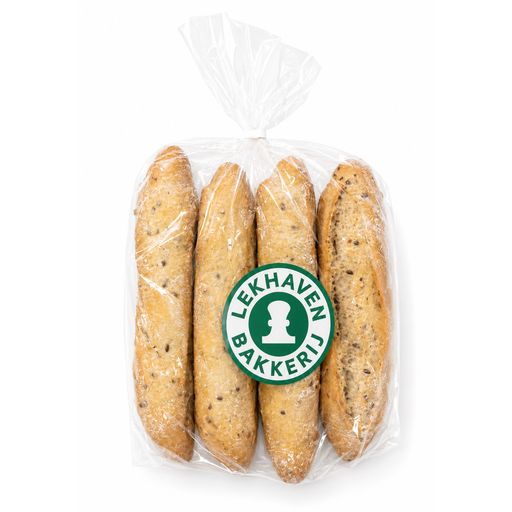 No image available
Four separate 135 g baguettes offer a different size option from one whole loaf. If you plan to use them at different times, check the storage and preparation instructions on the packaging, as well as the wholemeal label and allergen information.
No. According to the Netherlands Nutrition Centre, multigrain bread can also be made with white flour. Look for an explicit wholemeal label and check the ingredients list if in doubt; a dark colour or seeds aren’t proof that it’s wholemeal.
For children aged 1 to 3, the Netherlands Nutrition Centre recommends around 2 to 3 slices of bread a day, usually split between breakfast and lunch. This is a general guideline, not a set amount for every child. When choosing a loaf size, consider how much your household actually eats.
Check the allergen information for the exact bread variety and ask about the school or childcare setting’s rules. The NVWA says allergen information must appear on the label of pre-packed foods. If you’re buying unpackaged bread, you can ask for this information before you buy.
No. According to the Netherlands Nutrition Centre, baker’s salt isn’t compulsory. Check the ingredients list on packaged bread or ask the baker which salt was used if this matters to your choice.