
Bread eaters who pay attention to wholemeal flour and fibre
If you eat multigrain bread regularly, you’ll want to know what you’re choosing from the ingredients and fibre content. A dark crust or visible seeds alone don’t tell you that.


When choosing bread to have with coffee and cake, don’t rely on the name ‘multigrain’ or the dark colour alone. If wholemeal flour and fibre are your priorities, compare the ingredients and nutritional information of wholemeal multigrain breads. If you’re looking for bread with a flavour and texture you prefer, a blend of wholemeal flour and white flour may suit you. Check the allergens and the quantity you need for each product too.
If you eat multigrain bread regularly, you’ll want to know what you’re choosing from the ingredients and fibre content. A dark crust or visible seeds alone don’t tell you that.
You’re looking for bread to enjoy alongside coffee and cake, with a flavour and texture that appeal to you. If a loaf contains both wholemeal flour and white flour, you’ll want to know how much of each it contains rather than relying on its name alone.
You want to know which grains and other allergens are listed for the specific variety before you buy. This is worth checking with unwrapped bread too, as it may not have a label attached.
First, decide what matters most to you for this coffee break: wholemeal flour and fibre, flavour and texture, allergens or a suitable quantity. Then compare the ingredients and nutritional information of the breads that meet your needs.
| What to consider | What to check when buying | Who it matters to |
|---|---|---|
| Wholemeal flour and fibre | Read the ingredients list and compare the fibre content per 100 g. | If I eat this bread regularly, I want to know how much wholemeal flour and fibre it contains, rather than judging by the crust. Wholemeal flour and fibre are the top priorities for around 36% of shoppers. |
| Flavour and texture | Check whether both wholemeal flour and white flour are listed, and see which grains and seeds the bread contains. | With coffee and cake, I want bread with a flavour and texture I enjoy; its dark colour alone doesn’t tell me enough. This is the deciding factor for around 29% of shoppers. |
| Ingredients and allergens | Check the label or, for unwrapped bread, ask for allergen information before buying. | Before I serve bread, I need to know which allergens are listed for that particular variety. This is the top priority for around 21% of shoppers. |
| Portion and freshness | Choose between a whole loaf, a half loaf or individual rolls, and read the storage instructions. | For a small coffee break, I don’t want to buy more bread than I can use or store. A suitable quantity matters most to around 14% of shoppers. |
According to the Netherlands Nutrition Centre, multigrain bread contains at least three types of grain. That doesn’t mean all the flour used is wholemeal flour: a loaf can also contain white flour.
Check the ingredients list for the bread you’ve chosen and compare fibre on the same basis, such as per 100 g.
The colour and visible seeds don’t tell you how much wholemeal flour a loaf contains. Albert Heijn explains that bread can be made with wholemeal flour, white flour or a combination of the two.
Use the name and appearance to find breads that appeal to you, but read the ingredients and nutritional information before making your choice.
Multigrain recipes vary from product to product. With unwrapped bread, the information may not be available on packaging you can read yourself.
Read the label on prepacked bread. For unwrapped bread, ask for the available allergen information before buying.
If you have lots of slices left after serving, you’ll also need to think about how to store them.
Consider a half loaf or individual rolls if that better suits the quantity you need. If you choose a whole loaf, follow the storage instructions and freeze some in good time if necessary.
Breads from the same brand can vary in flour types, nutritional content and allergens. So assess the variety you’re planning to buy, not just the brand.
The AH Whole Multigrain Hearth Loaf is a good example of bread made with both wholemeal wheat flour and wheat flour.
Jumbo’s Dark Country Wholemeal Multigrain Half Loaf is a wholemeal multigrain variety with kernels and seeds.
Lidl’s bread range includes multigrain bread and a rustic multigrain sourdough variety.
ALDI lists both a luxury multigrain hearth loaf and a country-style wholemeal multigrain loaf.
PLUS stocks brown multigrain bread and individual multigrain rolls, including a triangular roll.
Dirk lists various multigrain breads, including half loaves and a wholemeal multigrain variety.
These multigrain rolls and baguettes are options if you want to serve individual portions with coffee. Check the packaging if wholemeal flour content, allergens or preparation instructions are important to your choice.
 Image unavailable
The four individual rolls are ideal for a coffee break when you want to serve separate portions.
Check the packaging for ingredients and allergens, especially if you’re specifically looking for wholemeal flour or need to avoid milk or soya.
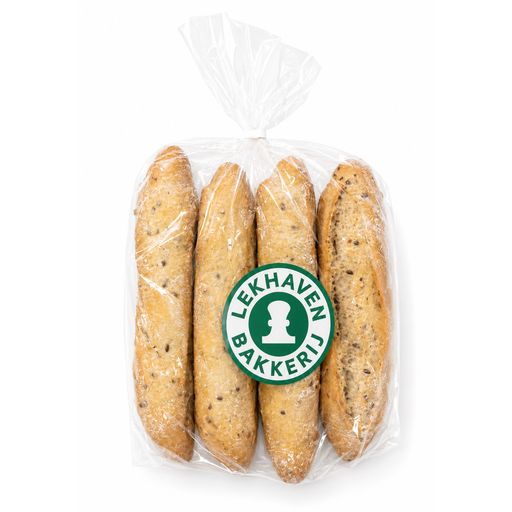 Image unavailable
These four baguettes, each weighing 135 g, are an option if you want to serve individual loaves with coffee.
Before comparing them with other bread or preparing them, check the packaging for the ingredients, nutritional values per stated quantity and baking instructions.
No. According to the Netherlands Nutrition Centre, multigrain bread contains at least three different types of grain, but it can be made with wholemeal flour, white flour or a combination of the two. If wholemeal flour matters to you, read the ingredients for the specific variety.
No, you can’t tell how much wholemeal flour a loaf contains from its colour alone. Check the ingredients list and, if fibre matters to you, compare the values given per 100 g.
Before buying unwrapped bread, ask for the allergen information for the exact variety. The Netherlands Food and Consumer Product Safety Authority says this information should appear on the label of prepacked bread. Don’t rely on the bread’s name alone.
You can’t tell from the name ‘multigrain bread’. The Netherlands Food and Consumer Product Safety Authority explains that iodine compounds may be present in bread through the addition of baker’s salt. Check the ingredients list of the bread you want to buy to see which type of salt has been used.