For children’s everyday meals, start by choosing bread that is explicitly labelled wholemeal, and pick a size your household can finish. Multigrain does not automatically mean wholemeal. If you’re packing bread for school, also check the latest label and the school’s rules on allergens.
Who is this choice relevant to?
Families who serve bread regularly
If bread is a regular part of mealtimes, you’ll want to know whether a multigrain loaf is also wholemeal. The Netherlands Nutrition Centre recommends wholemeal and brown bread as suitable choices for children aged 4 to 12, highlighting their fibre content.
Families looking to reduce waste
If you only get through a little bread at a time, a half loaf or a pack of individual rolls may fit your family’s routine better. Check the pack size and storage instructions.
Parents packing bread for school
If there’s an allergy, intolerance or school rule to consider, the ingredients and allergens in that particular bread are what matter. The Netherlands Food and Consumer Product Safety Authority lists cereals containing gluten as an allergen category that must be declared on food labels.
What should you look for when choosing?
If bread is a regular on your table, start by checking that it’s labelled wholemeal. Then choose a suitable size and check the ingredients and storage instructions before packing it.
| What to consider |
What to look for |
Who it matters to |
| Size and waste |
Check how much bread or how many rolls are in the pack, and whether your household can finish them. |
If I only need a few slices, I don’t want to be left with bread every time; around 31% of consumers prioritise reducing waste. |
| Wholemeal and fibre |
Look for an explicit wholemeal label and, when comparing similar breads, compare the fibre per 100 g. |
For bread that’s often on the table, I want to be able to tell whether it’s wholemeal; around 25% of consumers say this is their most important consideration. |
| Ingredients and allergens |
Read the latest ingredients list and allergen information, and take the school’s rules into account too. |
If the bread is going to school and an allergen or school rule is relevant, I want to know what’s in it; around 25% of consumers prioritise checking this. |
| Storage and preparation |
Check the storage instructions and whether the pack you’ve chosen suits the number of mealtimes. |
When mealtimes vary, I want to be able to store and prepare bread easily; this is the most important factor for around 19% of consumers. |
Common mistakes
-
Assuming multigrain means wholemeal
According to the Netherlands Nutrition Centre, multigrain bread contains at least three types of grain. The name alone doesn’t mean those grains are wholemeal.
If you choose bread regularly, look for an explicit wholemeal label and check the nutritional information per 100 g.
-
Looking only at the number of packs
A half loaf and a whole loaf contain different amounts of bread. Choosing a pack that suits the number of mealtimes can help prevent bread from going uneaten.
Compare the sizes and follow the storage instructions for the bread you choose.
-
Guessing allergens from the product name
Allergens vary from recipe to recipe. Even bread explicitly labelled gluten-free may contain other allergens.
Read the ingredients and allergen information on the latest packaging, and check the school’s rules before packing bread.
Brands and shops to explore
These shops offer different types of multigrain bread. Always check the wholemeal labelling, packaging and ingredients for each product.
Albert Heijn
Albert Heijn has an online category for multigrain and corn bread.
- You can browse product options before choosing a loaf.
- Check the latest product information and packaging for ingredients and allergens.
Jumbo
Jumbo lists products including Stevig Meergranen, described as a wholemeal multigrain loaf with seeds.
- For this specific loaf, you can check the ingredients, allergens and nutritional information.
- Don’t assume that other Jumbo loaves have the same ingredients as Stevig Meergranen.
Lidl
Lidl has an in-store bakery offering multigrain and wholemeal bread, among other options.
- You can choose from different types of bread in the bakery section.
- Check the labelling and available ingredient information for the bread you choose.
ALDI
ALDI lists products including a half loaf of farmhouse wholemeal multigrain bread.
- A half-size loaf is worth considering if you won’t get through a whole one.
- Check the packaging of this specific loaf for ingredients and allergens.
PLUS
PLUS lists various multigrain breads, as well as an explicitly labelled gluten-free multigrain alternative from Schär.
- Packaging and storage instructions are also available for specific products.
- Gluten-free doesn’t mean free from all allergens; check the label on the product you choose.
Dirk
Dirk’s range includes half and whole multigrain loaves.
- The different sizes give you options to suit the number of mealtimes.
- Check whether each loaf is wholemeal and which allergens are listed.
Multigrain rolls for children’s mealtimes
This pack of four multigrain rolls is a handy option when you want individual portions for a child’s mealtime. If you plan to serve them regularly, check whether the pack says they’re wholemeal. Before packing them for school, read the allergen information.
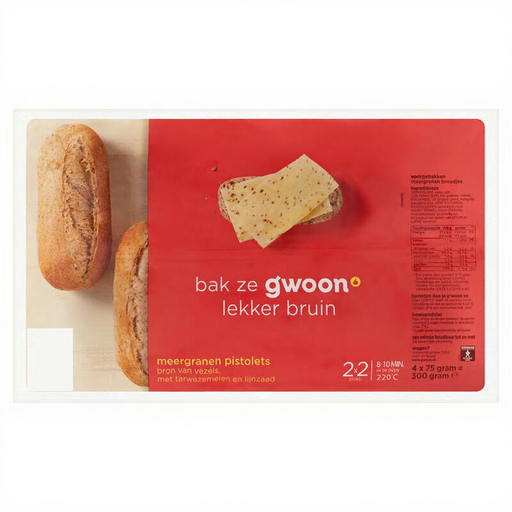 Image unavailable
g'woon multigrain rolls, 4 pack
A pack of four rolls for children’s mealtimes, when individual portions come in handy. Check the packaging for wholemeal labelling, ingredients and allergens if these matter to your choice.
View at Joybuy
Frequently asked questions
Is multigrain bread automatically wholemeal?
No. According to the Netherlands Nutrition Centre, multigrain bread contains at least three different types of grain; that doesn’t mean the bread is wholemeal. Look for an explicit wholemeal label if that’s what you’re looking for.
How can I check bread that’s going to school?
Read the ingredients and allergen information on the latest packaging, and make sure your choice follows the school’s rules. The Netherlands Food and Consumer Product Safety Authority lists cereals containing gluten as an allergen category on food labels; other allergens vary from one type of bread to another.
Does all multigrain bread in the Netherlands contain iodised baker’s salt?
Don’t assume it does. The Dutch Commodities Act Decree on the Addition of Micronutrients to Foodstuffs regulates the addition of iodine to bread through baker’s salt, but that doesn’t mean every loaf contains this ingredient. Check the ingredients on the specific pack if this matters to your choice.
Can I freeze multigrain bread to waste less?
Follow the storage instructions for the bread you choose. PLUS says that its Korenlanders Donker multigrain round loaf can be frozen on the day of purchase and used within a month; don’t apply those instructions to other breads without checking first.


