
Vandaag of morgen in huis

Kwaliteit gegarandeerd

Welkomstaanbiedingen ontgrendelen: GRATIS bezorging | Tot 80% korting | Gratis 30 dagen JoyPlus-proefperiode
Download de app
A multifunctional food processor can chop, slice, grate, mix, knead, blend and sometimes even grind or juice. That sounds convenient, but many consumers end up buying an appliance with accessories they hardly ever use. Or they only discover at home that the bowl is too small, the appliance does not fit in the kitchen cupboard or cleaning takes longer than expected.
With this practical guide, you can focus on features that suit your cooking routine rather than simply counting the accessories listed on the packaging.
A food processor with twenty functions may seem appealing. However, for everyday chopping, slicing and grating, an S-blade and a reversible disc are often all you need. A food processor with a blender, meat grinder and citrus juicer only makes sense if you use these attachments regularly.
So start by making a list of the three tasks you perform most often:
This helps you avoid paying for accessories that end up unused in a drawer.
A higher wattage does not automatically mean that you can process larger quantities. The bowl capacity, maximum dough capacity and recommended operating time are at least as important. A compact 650- or 700-watt food processor may be suitable for everyday portions, while a food processor designed mainly for kneading needs a sturdy bowl and a suitable dough hook.
Always check the product specifications and manual. The stated wattage is a technical value; on its own, it does not tell you how quickly or quietly an appliance will work in every situation.
An appliance may look compact in a product photo, yet take up considerable space because of the blender jug and accessories. Measure the space on your worktop as well as the room inside a cupboard. Also check which parts are dishwasher-safe. The motor base must never be placed in water or in the dishwasher.
Sharp blades and grating discs require extra care. Unplug the appliance before changing or cleaning accessories, and wait until all moving parts have come to a complete stop.
For one or two people, a bowl of around 0.9 to 1.3 litres may be sufficient. Families and keen home cooks will benefit more from a bowl of 2 litres or larger. Pay attention to the difference between total capacity and practical filling capacity. Liquids and dough should generally not be filled right up to the rim.
For larger quantities of dough, the stated maximum dough capacity and the stability of the machine are more important than motor power alone. According to the product specifications, the ETA Gratus Smart Evo has a 5.5-litre stainless-steel bowl and a maximum dough capacity of 2.5 kilograms.
A food processor with accessories is only versatile if those accessories suit the way you use it. Check that the set actually includes what you need:
Compatibility is essential when buying additional attachments separately. For example, the Kenwood KAH65.000PL is an accessory set for certain Kenwood Chef and Major models with a low-speed connection. It is not a standalone food processor.
Look for a safety lock, a stable non-slip base and protection against overheating. These features make the appliance more practical to use, but they do not replace safe handling. Always use the pusher when feeding ingredients into an opening, and never touch blades by their cutting edge.
A pulse function is useful for short processing tasks, such as coarsely chopping herbs or nuts. Multiple speed settings are particularly helpful when you want to achieve different textures. Also check whether the accessories are dishwasher-safe according to the product specifications.

Why it suits this profile: The 2.3-litre bowl and 800-watt motor provide a practical basis for everyday food preparation without immediately moving up to the size of a large stand mixer.
The key functions are clearly defined: chopping, mixing, slicing and grating. This makes the choice more straightforward than a set with numerous unused extras.
800 watts, 2.3-litre bowl and two speed settings with pulse function.
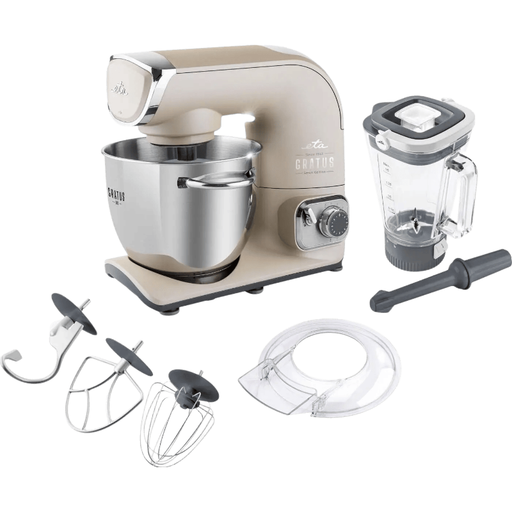
Why it suits this profile: This model is designed for larger preparations and dough-making, with a metal housing, planetary mixing action and a spacious stainless-steel bowl.
The capacity and maximum dough capacity are clearly stated. This makes it easier to match the machine to bread, baking and larger portions.
1500 watts, 5.5-litre bowl, 1.5-litre blender jug and continuous speed control with pulse function.
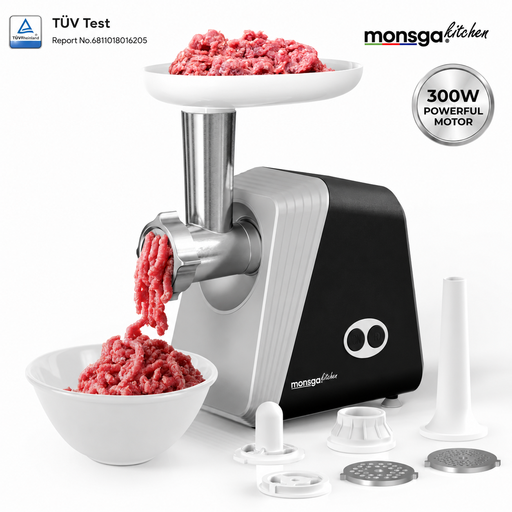
Why it suits this profile: If you mainly want to make your own mince, sausages or kibbeh, a specialised food processor with a meat grinder makes more sense than an all-purpose food processor.
The set includes three grinding plates, a reverse function and accessories for sausages and kibbeh. However, check whether hand-washing is acceptable for you.
Three cutting plates, sausage stuffer, kibbeh attachment and protection against overload and overheating according to the product description.

Why it suits this profile: This model has a 1.3-litre bowl, a 650-watt motor and a design that, according to the product specifications, is suitable for limited storage space.
The accessory set is limited to chopping, slicing and grating. This is useful if you do not need a blender, meat grinder or large mixing bowl.
650 watts, 1.3-litre bowl, pulse function and dishwasher-safe parts according to the product information.
We have put together a complete, up-to-date list of products that fully meet these strict selection criteria and the applicable European safety regulations.
That depends on the model and the accessory supplied. Check whether a dough hook or kneading attachment is listed, and look at the maximum dough capacity. For regularly making heavy bread dough, a stand mixer with planetary mixing action and a spacious bowl is often more practical than a small food processor.
Its lifespan depends on how it is used, the workload, maintenance and storage. Allow the motor to cool down between demanding tasks, do not exceed the stated maximum quantities and only use compatible accessories. In the European Union, statutory guarantees also apply: if the product does not conform to the contract, you can contact the seller for an appropriate solution.
Energy consumption depends on the wattage and how long the appliance is used. An 800-watt appliance running for a few minutes does not automatically use more energy than a lower-powered model that needs to run for longer. Use the correct bowl, avoid overloading the appliance and choose a model that suits the quantities you actually prepare.
