
Vandaag of morgen in huis

Kwaliteit gegarandeerd

Welkomstaanbiedingen ontgrendelen: GRATIS bezorging | Tot 80% korting | Gratis 30 dagen JoyPlus-proefperiode
Download de app
A multifunctional food processor can chop, blend, slice, grate, mix and knead. That sounds convenient, but not every appliance performs all these tasks in the same way. A blender, for example, is suitable for liquid mixtures, while a food processor is better suited to slicing and grating. If you only look at the number of accessories or the maximum power, you could end up buying an appliance that does not fit well into your everyday kitchen routine.
A power rating of 1200 or 1300 watts sounds impressive, but the result also depends on the blade design, bowl, programmes and maximum operating time. An appliance may be powerful enough for ice or nuts, but less practical for large quantities of dough. Always check what the power rating is intended for and whether the instructions specify cooling breaks.
Some models are marketed as food processors with a blender, but only come with a blender jug and a chopper. Additional accessories are then needed for grating, slicing or kneading. So check exactly what is included: does it come with a dough hook, vegetable slicer, grating or slicing disc, meat grinder or grinder?
A multifunctional appliance has several bowls, lids and blades. If the parts are difficult to remove or cannot go in the dishwasher, cleaning may take longer than expected. Also pay attention to the motor base: it generally must not be submerged in water and should be cleaned with a damp cloth.
For smoothies, sauces and soup, a blender with sufficient power and a suitable jug capacity is practical. An ice crusher needs short pulses and a sturdy blade. For dough, whipped cream or batter, multiple speeds and a mixer with a dough hook are more relevant than a high wattage alone.
A model with two speeds is easy to operate. An appliance with continuously variable control or several settings gives you more control over the texture. Also look at the automatic programmes. These can be useful for chopping, puréeing, dough or pulse operation, but always check the maximum filling time and quantity.
The capacity stated on the packaging is not always the usable capacity. A 1.2-litre jug is suitable for several glasses of smoothie, while a food processor with a 2-litre bowl offers more space for vegetables, sauces or meal prep. For a one-person household, a sports bottle or small chopper may be sufficient. Families often benefit from a larger bowl, but also need to consider how much storage space they have.
Check whether the bowl is made of glass, plastic or stainless steel. Glass is less prone to discolouration, but may be heavier. Stainless steel bowls are practical for chopping and grinding. Also look out for:
The selection below links specific features to different uses. This helps you decide more precisely whether you need a complete multifunctional food processor, or whether a blender, food processor or hand blender will be sufficient.
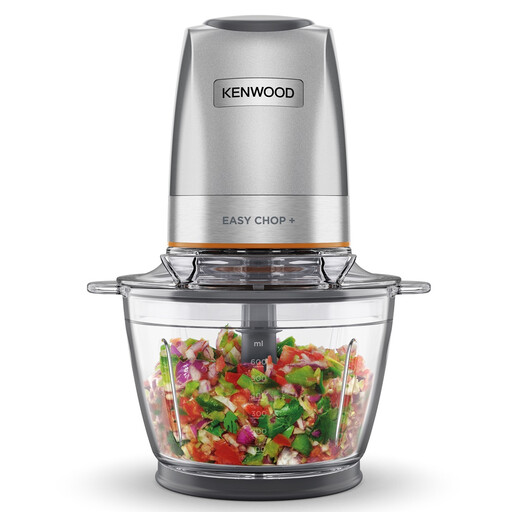
Why it suits this profile: This compact chopper is suitable for smaller portions, herbs, vegetables and dips. The glass bowl has a capacity of 600 ml and can also be used for serving.
The capacity and two speeds are clearly stated. You are not buying this model expecting it to knead dough or grate vegetables as well.
500 watts, glass bowl, non-slip ring, two speeds and a pulse function for short processing tasks.

Why it suits this profile: This model is aimed at users who mainly prepare large portions of smoothies, iced drinks and blended recipes, and want plenty of adjustment options.
The features are clearly specified: 1200 watts, a 2.1-litre jug, four programmes and fourteen manual speeds. It is primarily a blender, not a complete food processor.
2.1-litre jug, 700 ml cup, ice crusher, pulse function and BlendSense technology according to the product description.
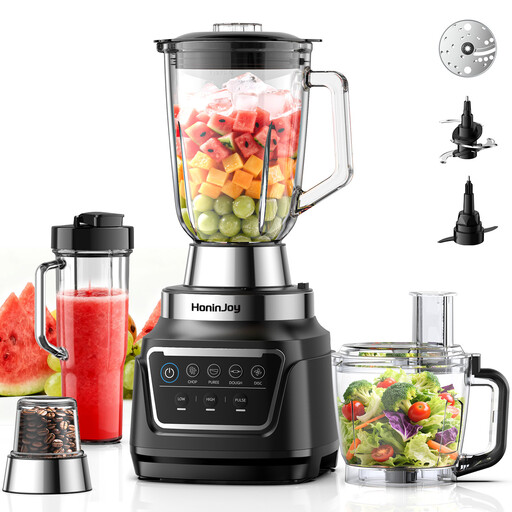
Why it suits this profile: This is an option for households that want to blend, chop, grind, slice, grate and prepare dough using one base appliance.
The set lists the individual components: a 1.5-litre glass jug, 2-litre food processor bowl, 80-gram grinder cup and 24 oz sports bottle.
Maximum power of 1300 watts, one-touch programmes for chopping, puréeing, dough and slicing, plus dishwasher-safe removable parts according to the product information.
First decide which tasks you carry out at least every week. For smoothies and iced drinks, a kitchen blender may be enough. For onions, herbs and small quantities, a chopper is more practical. If you often slice and grate vegetables and prepare ingredients, you will get more from a food processor with a vegetable slicer. For bread dough and cake batter, a stand mixer with a dough hook is the more logical choice.
When comparing models, do not look only at the price. Check the capacity, material, available accessories, dishwasher instructions, warranty and cooling time between tasks. This will help you avoid ending up with an appliance that is too small, too difficult to clean or too limited in practice.
We have put together a complete, up-to-date list of products that fully meet these strict selection criteria and the applicable European safety regulations.
That depends on the motor, maximum quantity and recommended operating time. Use the appliance only for normal household quantities and follow the instructions. Allow the motor to cool down when advised.
A blender mainly works with liquids and soft or frozen ingredients, for example for smoothies and sauces. A food processor is generally better suited to chopping, slicing, grating and mixing with little liquid. A combination appliance may offer both functions, but check which accessories are actually included.
Not necessarily for every part. Some product components may only be washed in the top rack or below a certain temperature. The motor base must not go in the dishwasher. Always consult the instructions before cleaning blades, lids or bowls.
