
Vandaag of morgen in huis

Kwaliteit gegarandeerd

Welkomstaanbiedingen ontgrendelen: GRATIS bezorging | Tot 80% korting | Gratis 30 dagen JoyPlus-proefperiode
Download de app
A multifunctional food processor can chop, mix, blend, knead, grind, and slice or grate vegetables. That sounds convenient, but a machine with lots of accessories is not automatically suitable for every kitchen. Home cooks, families and busy households should first decide which functions they will actually use.
The biggest purchasing mistakes usually come down to three pitfalls:
Do not just compare the wattage. Check the usage instructions as well. Some appliances may only be operated in short bursts and then need time to cool down. This is particularly relevant when using an electric chopper, processing nuts, frozen ingredients or heavy dough.
One example is the ochama Food Processor 750W. The product information recommends cutting ingredients into pieces of approximately 2 cm, blending for a maximum of 60 seconds per cycle and then allowing the motor to cool for two minutes under heavy load. Instructions like these give you a more realistic idea of everyday use than the wattage alone.
For one person, a compact smoothie blender with a cup of around 700 to 800 ml may be sufficient. A family will usually get more use out of a blender jug of around 1.5 litres or a food processor bowl with a capacity of 1.8 to 2 litres.
Pay attention to the material:
Also check whether only the accessories are dishwasher-safe. The motor base must not be immersed in water.
A blender and food processor combined in one appliance is particularly useful if you regularly switch between making smoothies and sauces, chopping and grating. Check that the set actually includes a chopping blade, slicing and grating discs, blender jug and, where applicable, a dough hook.
For a food processor with a meat grinder, it is important that the grinder has a secure, properly fitting attachment and that you can clean it immediately after processing raw meat. Always hold sharp blades and discs by the plastic centre section or as instructed in the manual.
Also look for:
A brand claim about speed or durability, for example, should be treated as information supplied by the manufacturer. A brand's own research may suggest that a product performs in a certain way, but you should focus particularly on the technical specifications, usage time and included parts.

Why it suits this profile: This food processor for home use combines chopping, blending, grinding, juicing, and slicing or grating vegetables in one appliance. It is practical if you want to try several kitchen functions on a limited budget.
The usage instructions specify short cycles, cooling down between heavy loads, and removing stones, bones and hard skins. This makes the appliance's limits clearer than a standalone marketing claim.
750W power, a 1.8-litre bowl, detachable parts, and functions for chopping, blending, grinding, juicing and grating.

Why it suits this profile: This food processor is designed for households that bake regularly and also want to use a blender, citrus juicer, meat grinder and vegetable slicer.
The set lists specific accessories and maximum dough quantities. However, pay attention to the power specification: the product information mentions both 900W and 450W. Check the manual and rating plate before buying.
3.9-litre stainless-steel bowl, accessories for dough, blending, grinding and grating, plus a stated capacity of up to 2.7 kg of kneaded dough.
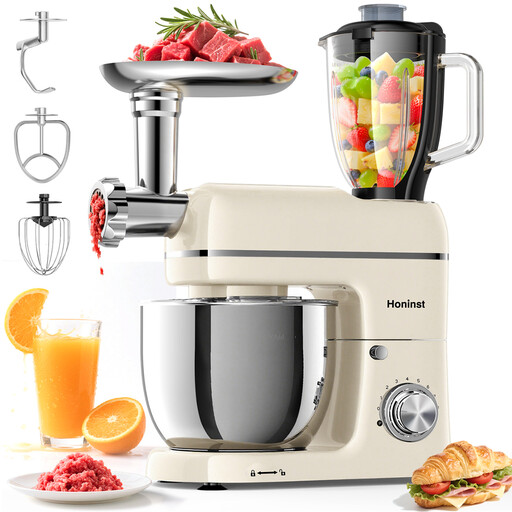
Why it suits this profile: A 6.5-quart mixing bowl, dough hook, whisk, beater, blender and meat grinder are ideal for households that regularly make bread dough, batter, mince or smoothies.
The tilting head and safety lock make changing accessories more straightforward. The stated maximum of 1300W and eight speeds are product specifications; always adjust the speed and quantity according to the manual.
6.5-quart stainless-steel bowl, eight speeds with pulse setting, dough hook, beater, whisk, blender and meat grinder.
Not every kitchen needs a large machine. If you mainly make smoothies, dips and sauces, you may be better off choosing a compact multifunctional blender. According to the product specifications, the Nutribullet Pro has 900W of power, a 700 ml cup, and a dishwasher-safe cup and drinking ring. The manufacturer states that hot or carbonated ingredients are not suitable for this model.
For onions, herbs, vegetables and smaller quantities, an electric chopper is often more practical. The Philips 3000 Series Chopper HR1501/00 has a 1-litre bowl, 450W of power, two speeds and a pulse function. According to the product information, the bowl, lid and blades are dishwasher-safe. The stated usage instructions limit continuous operation to a maximum of 30 seconds at a time.
If you want to compare different appliances, also browse the grinder blender range.
We have put together a complete, up-to-date list of products that fully meet these strict selection criteria and the applicable European safety regulations.
That depends on the bowl, dough hook, motor settings and maximum quantity. A food processor designed for dough should have a stable base and clearly state its capacity limits. Do not use a blender jug or chopping blade for dough unless the manufacturer specifically permits it.
Electricity consumption depends on the power rating and usage time. A 1,300W appliance running for a few minutes will not necessarily use more electricity than a 600W appliance that takes much longer. Consider the preparation time, recommended cycles and standby consumption. Unplug the appliance when it is not in use.
A fixed lifespan cannot be guaranteed in advance. The appliance's lifespan is affected by correct assembly, maximum quantities, cleaning and cooling breaks. Before buying, check the warranty, availability of spare parts and safety instructions. In the EU, consumers are entitled to the statutory guarantee of conformity; any additional manufacturer's warranty varies by brand and product.
