
Vandaag of morgen in huis

Kwaliteit gegarandeerd

Welkomstaanbiedingen ontgrendelen: GRATIS bezorging | Tot 80% korting | Gratis 30 dagen JoyPlus-proefperiode
Download de app
A multifunctional pull-up bar for home can be a practical foundation for strength training, calisthenics and exercises for your back, arms, shoulders and core. However, not every freestanding fitness rack is equally suitable in practice. A high maximum load rating, for example, means little if the rack slides around on your floor or its adjustable parts do not lock securely.
So don’t focus only on the number of exercises listed in the product title. Pay particular attention to the construction, dimensions, included accessories and safety instructions.
Some models advertise a very high maximum load. Check whether this refers to static load or dynamic load. Pull-ups, dips and swinging movements put more force on the frame than simply hanging still. So a frame that supports 400 kg statically may not be suitable for a dynamic load of 400 kg.
Also look at:
A home pull-up station doesn’t just take up floor space. You’ll also need enough clear space above and around the rack. Before you buy, measure the ceiling height, the width of your training area and the room you’ll need for your legs while doing pull-ups.
A freestanding model is usually more flexible than a wall-mounted one, but it needs to stand on a flat, stable surface. A smooth laminate floor may need extra protection or a fitness mat to help prevent the rack from slipping and the floor from getting damaged.
A pull-up bar with resistance bands gives you more options, but only if you understand how the resistance works. Check whether you can combine multiple bands, whether the attachments are secure and whether the material needs regular checks for cracks.
With latex bands, avoid direct sunlight, sharp edges and overstretching. According to the Capelli Sport band’s product information, the set is made from natural latex, which may cause a reaction in sensitive users. This is a product-specific warning, not a general claim about performance or health.
For a calisthenics rack, steel frame components, wide feet and non-slip foot caps are useful features. A double bar or H-shaped base may distribute pressure better than a narrow single foot. Also check the joints: the bolts, height locks and welds should be clearly described.
An adjustable pull-up bar is useful if several people will use it, but check:
If a retailer lists several load ratings, use the lowest relevant figure as your starting point. For example, the Sportsroyals dip bar lists a static capacity of 400 kg and a dynamic capacity of 200 kg. For dips and movements where you move up and down, the dynamic rating is the one that matters most.
Never exceed the product limit. Before every workout, check that the rack is stable and that all adjustable parts are securely fastened.
A fitness rack with resistance bands can offer more than just pull-ups. You could use it for assisted pull-ups, arm curls, front raises and added resistance during certain exercises. However, the bands are no substitute for a stable base construction.
A practical combination for strength training at home could include:
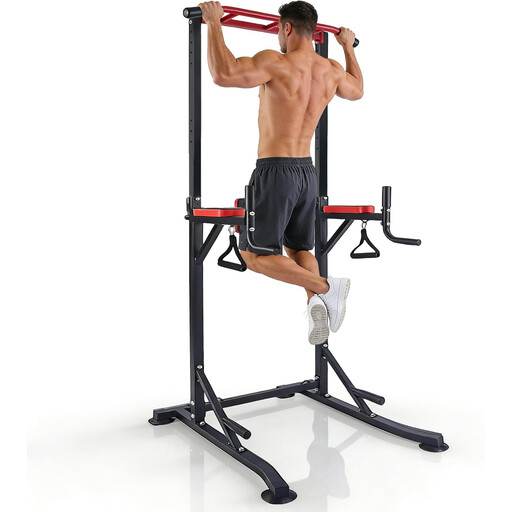
Why it suits this user: The product title describes a freestanding training rack with two fitness resistance bands. It could be an accessible way to get started with home workouts, as long as you check the height, load capacity and assembly details before buying.
The two bands mentioned in the title make it clearer what’s included than with a rack that doesn’t specify its accessories. Still, check the resistance levels and attachment points in the current product information.
Freestanding design and two resistance bands listed; a starting point for a range of exercises in a home gym.
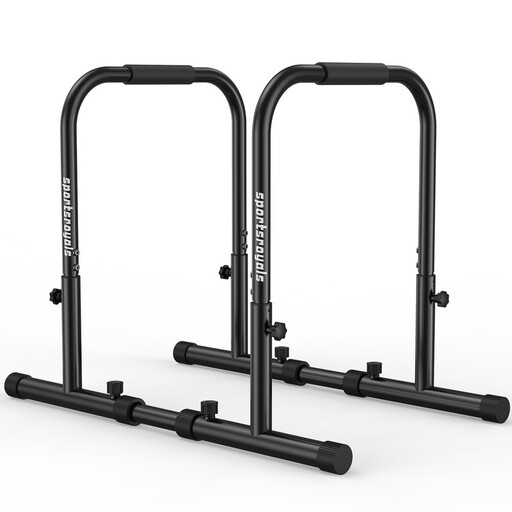
Why it suits this user: According to the product information, this model has a double bar, an H-shaped base, four height settings from 81 to 96 cm and a dynamic load capacity of 200 kg.
The specifications distinguish between static and dynamic load. That makes it easier to put the stated 200 kg rating for moving exercises into context than a single general load claim would.
Four height settings and non-slip feet; supports dips, push-ups, reverse pull-ups, squats and stretches.
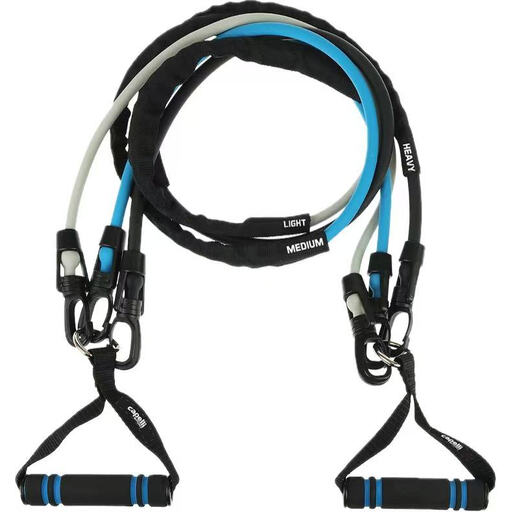
Why it suits this user: This set contains three 120 cm bands with light, medium and heavy resistance. Use the clips to add or remove bands for arm curls, triceps kickbacks and front raises.
Three separate resistance levels are more specific than a band described only as offering “strong resistance”. Check the latex before each use and don’t stretch the bands beyond their natural range.
Three interchangeable latex bands, foam handles and clips for different resistance levels.
Place each rack on a level surface and check the bolts, locks and foot caps regularly. Before every session, check resistance bands for cracks, fraying or other damage. Store latex bands in a cool, dry place away from direct sunlight. A skipping rope or push-up bar can add variety to your workout, but you’ll also need a stable, non-slip floor.
We’ve put together a complete, up-to-date list of products that meet these strict selection criteria and the applicable European safety regulations.
It can be, if you have enough ceiling space and a level floor. Check the total floor space required too, and use a suitable fitness mat if needed. During intense movements, a freestanding rack may move more than a fixed model.
Their lifespan depends on how they’re used, stored and checked. Direct sunlight, heat, sharp edges and overstretching can cause latex to deteriorate more quickly. Replace a band as soon as you notice cracks, thin patches or other damage.
No, but additional equipment can give you more variety. A set of different resistance bands, push-up bars or an adjustable skipping rope can help you train your arms, shoulders, chest, back, legs and core in different ways. Your needs and available space will determine which additions are worthwhile.
