
Vandaag of morgen in huis

Kwaliteit gegarandeerd

Welkomstaanbiedingen ontgrendelen: GRATIS bezorging | Tot 80% korting | Gratis 30 dagen JoyPlus-proefperiode
Download de app
A multifunctional kitchen machine can knead, mix, whisk, chop, grate and sometimes also blend or grind. That sounds convenient, but not every appliance is suited to the same tasks. A kitchen machine with a mixing bowl, for example, is often designed primarily for dough and batter, while a food processor excels at chopping, slicing and grating.
For home bakers, hobby cooks and families, the choice is therefore not simply about the highest wattage or the largest number of accessories. Above all, check whether the construction, capacity and functions match what you actually prepare.
A high wattage sounds appealing, but it does not tell the whole story. The transmission, bowl design, accessory type and permitted operating time also play a role. A kitchen machine for dough, for example, must be able to deliver power over a longer period without overheating quickly.
Therefore, pay attention to:
A manufacturer’s claim about “powerful performance” should be read as information from the product description, not as a universal guarantee for every recipe. According to the Philips product description, the Series 7000 HR7962/21 has a 1000-watt motor and a 5.5-litre bowl. The manufacturer also mentions ProKnead technology and a three-minute preparation time for dough. For intensive use, always check the manual and maximum quantities.
A kitchen machine with accessories may seem like good value when it includes a blender, meat grinder, citrus press and grater. In practice, loose parts take up space and need to be washed after use. Also check whether accessories are included as standard or available only as optional extras.
A kitchen machine for baking generally only needs:
If you also want to slice vegetables or make smoothies, look for a genuine blender and food processor combination. A stand mixer with only a mixing bowl does not automatically replace a food processor.
A 5.5- or 6-litre appliance may be suitable for a family, but it also takes up space on the worktop. Measure the available area and take the tilting head, cord storage and accessories into account.
Before buying, check:
A CE marking indicates that the product must comply with relevant European conformity requirements. It is not a quality ranking and does not mean that an appliance is suitable for every kitchen.
A 5- or 6-litre bowl does not mean that you can fill it completely. Different limits apply to dough, whipped cream and liquid preparations. For a household of one to three people, a food processor with a bowl of around 1.3 to 2 litres may be more practical. Families and frequent home bakers often benefit more from a stand mixer with a capacity of 5 to 6 litres.
According to the product information, the Bosch MUMS2AW00 has a 3.8-litre bowl, with specified limits of 1.7 kg of dough and 2.4 kg of batter. Such specific capacity details are more useful than the bowl volume alone.
A kitchen mixer with planetary mixing action is particularly useful for batter, cream and yeast dough. A food processor generally uses blades and discs for chopping, slicing, grating and puréeing. If you need both functions, you can choose a combination appliance or a stand mixer with expandable accessories.
Pay attention to the number of speed settings, a pulse function and the controls. Multiple settings are only useful when they suit your recipes. A pulse function helps with short processing tasks, such as coarse chopping or preventing overmixing.
A stainless-steel bowl is durable, easy to wipe clean and suitable for everyday use. Plastic bowls may be lighter and sometimes absorb less heat, but check whether they are BPA-free and dishwasher-safe.
A heavy metal housing is not automatically essential. More important are a stable base, anti-slip feet or suction cups and a well-fitting bowl. With heavy doughs, a lightweight appliance may move across the worktop, even when its stated motor power appears sufficient.

Why it fits: For anyone who mainly makes cakes, bread, pizza and batter and wants a spacious bowl without investing in an extensive system straight away.
The product description lists a 6-litre stainless-steel bowl, six speeds, a pulse function and anti-slip suction feet. Do check the maximum operating time of six minutes.
450 watts, tilting head, whisk, dough hook, beater and splash guard. Dimensions: 40.7 × 26.8 × 33.2 cm.
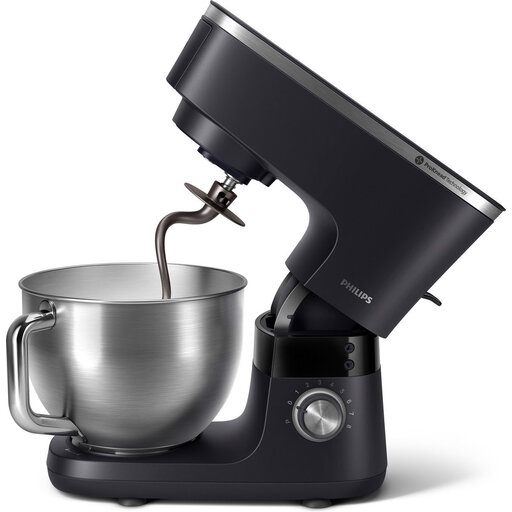
Why it fits: A logical choice for families and home bakers who want to prepare smoothies, sauces and minced meat as well as dough.
The functions are clearly separated: a 5.5-litre mixing bowl, a 1.5-litre blender attachment and a meat grinder. This makes it clearer what each component is designed for.
1000 watts, eight speeds, a timer with automatic shut-off and accessories for blending and grinding.
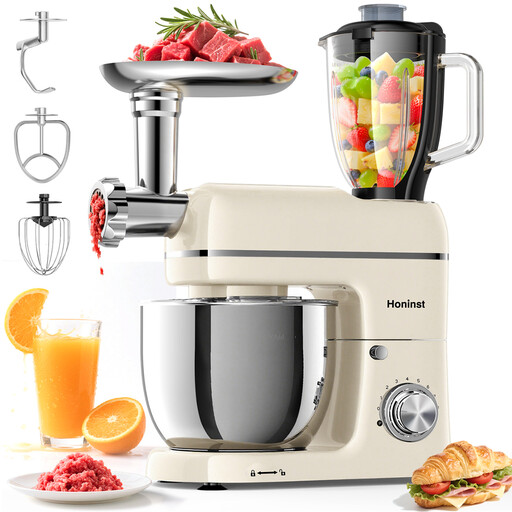
Why it fits: For hobby cooks who regularly knead, mix and blend and want to use a meat grinder without having to store multiple motor bases.
The product information mentions motor protection and a safety lock. Use only approved accessories and process ordinary household quantities.
6.5-quart bowl, maximum stated motor power of 1300 watts, eight speeds plus pulse function, blender and meat grinder.

Why it fits: Ideal for anyone who mainly prepares vegetables, sauces, dips and smoothies and has limited cupboard space.
The 1.3-litre capacity is straightforward. You should therefore not buy this model expecting it to knead large quantities of bread dough.
900 watts, seven speeds, two slicing discs, blender function, ice crushing, kneading and a 600 ml personal blender.
Browse our current selection of kitchen mixers and food processors and compare capacity, accessories and functions for your kitchen.
That depends on the motor, dough hook, bowl and maximum dough capacity. If you bake bread regularly, choose a stand mixer with a sturdy base and check the recommended dough quantity. Do not run the appliance for longer than specified in the manual.
Consumption depends on the power rating and operating time. In theory, a 1000-watt appliance uses 1 kWh when running at full power for one hour. In practice, kitchen machines are usually active for only a few minutes at a time. Actual consumption is therefore often lower, but varies by programme and preparation.
Service life is influenced by workload, cleaning, storage and compliance with the operating instructions. Do not overload the bowl, allow the motor to cool down and do not use accessories that have not been approved for the model. In the EU, statutory warranty rights also apply under the applicable consumer protection rules; when purchasing, check the specific warranty information provided by the retailer and manufacturer.
