
Vandaag of morgen in huis

Kwaliteit gegarandeerd

Welkomstaanbiedingen ontgrendelen: GRATIS bezorging | Tot 80% korting | Gratis 30 dagen JoyPlus-proefperiode
Download de app
A multifunctional kitchen machine can chop, slice, grate, knead, mix and sometimes even grind or blend. That sounds handy, but not every appliance handles all these jobs equally well. A food processor is geared towards slicing and chopping, while a kitchen mixer or stand mixer is better suited to doughs and batters.
The biggest mistake when buying a kitchen machine is relying on a long list of functions. It’s better to check which accessories actually come in the box, how much you can process in one go, and whether the machine suits your go-to recipes.
A high wattage doesn’t automatically mean a machine can sustain every task for long periods. Some product descriptions quote peak power, while the nominal power is lower. For the Monsga SM100, for example, they list 1000 W peak power alongside 600 W nominal power. That distinction matters if you regularly make heavy bread dough.
Also look at usage limits. The AUCMA 6L, for instance, states you shouldn’t run the machine for more than six minutes continuously without a break. That’s fine for typical household use, but it’s important if you plan to tackle several heavy batches of dough back to back.
A kitchen machine with accessories is only versatile if those accessories match the way you cook. A whisk, beater and dough hook make a stand mixer great for baking, but they won’t magically grate vegetables or mince meat.
So check in advance:
A food processor with a mini chopper is often more practical for vegetables, sauces and fillings. For mince or sausages you’ll need a suitable meat grinder with cutting plates.
A bowl of 6 litres can look generous, but you usually shouldn’t fill it to the brim. The Monsga SM100 lists a maximum volume of 6 litres and a recommended usable capacity of 5 litres. With blenders the gap is even clearer: the Philips HR3020/20 has a 2-litre jug but a working capacity of 1.5 litres.
Mind the dimensions, too. A powerful kitchen machine takes up worktop space and must sit stable when in use. Measure not just where it will live, but also the clearance you need to raise a tilt head or fit accessories.
For light chopping and mixing, 350 to 650 watts is often enough, depending on the design. If you make bread dough, pizza dough or larger batches of batter, you’ll be better off with a stand mixer that has a robust drive and clearly stated maximum quantities.
Alongside wattage, also compare:
According to the product description, the Bosch MCM3200W has an 800 W motor, a 2.3-litre bowl and two speeds plus a pulse mode. Based on the stated functions, this model is best suited to chopping, mixing, slicing and grating.
For households with several people, a 5 to 6-litre bowl is practical for larger amounts of batter or dough. A more compact food processor of around 2 litres takes up less space and is better for everyday meal prep, sliced veg and sauces.
For blenders, mind the max-fill marking. Only process hot liquids if the manual allows it. The Philips HR3020/20, for example, states ingredients must not be hotter than 80 °C and the motor should not run for more than three minutes at a time.
A stainless steel bowl is sturdy and easy to check for damage. Plastic bowls can be lighter but need more care to avoid staining and scratches. Handle sharp blades and grinding discs with care, always by the plastic hub.
Dishwasher-safe parts save time, but the motor base must never come into contact with water. Also check that all loose parts can dry completely after washing. That’s especially important for a kitchen machine with a meat grinder or a food processor used with raw ingredients.

Why this suits the profile: This compact food processor focuses on everyday prep and, with a 2.3-litre bowl, takes up relatively little space.
The product description names specific functions: chopping, mixing, slicing and grating. You’re not buying a vague bundle of accessories.
800 W, 2.3-litre bowl and two speeds plus a pulse mode, according to the product specifications.

Why this suits the profile: This stand mixer is built for baking, mixing and kneading, with scope to expand via optional accessories.
The included K-beater, whisk and dough hook make it immediately clear what the machine is designed for. Extra functions are clearly marked as optional accessories.
6.7-litre capacity, metal body and automatic speed control, according to the product specifications.
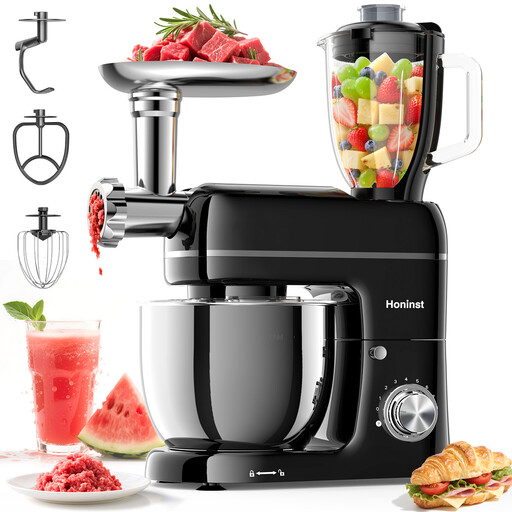
Why this suits the profile: According to the product description, this model combines mixing, kneading, blending and grinding with a large bowl.
The listed functions are tied to specific parts: a meat grinder, blender jug, dough hook, beater and whisk.
Up to 1300 W according to the product info, a 6 QT stainless steel bowl, and eight speeds plus a pulse mode.
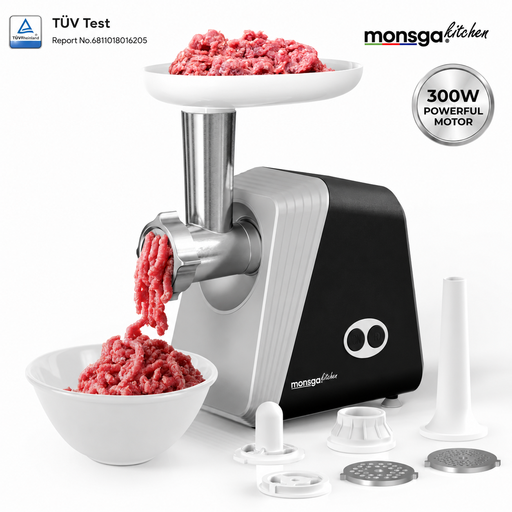
Why this suits the profile: This appliance is purpose-built for mincing, sausage stuffing and making kibbeh at home.
The set includes three grinding plates, a sausage stuffer, kibbeh attachment and biscuit maker. Its purpose is clearly defined.
300 W and up to 1200 W, as listed, with three textures and a reverse function.
Your electricity costs depend on power and run time. An 800 W machine running for ten minutes theoretically uses about 0.13 kWh. In practice, pulse modes and short prep times often matter more than the maximum wattage alone.
For a longer service life:
A food processor is usually suited to chopping, slicing, grating and mixing. A kitchen mixer or stand mixer uses a bowl with a whisk, beater and dough hook for batters, cream and dough. Some models combine both sets of functions, but always check which accessories are included as standard.
It depends on the job. For lighter prep a lower power can be enough. For heavy doughs or bigger batches, motor design, drive system, bowl capacity and recommended run time are at least as important as the wattage on the box.
It can be, but it depends on how you use it. One base unit saves space and avoids duplicate motors, but accessories can add cost and cleaning. So only choose functions you’ll genuinely use week in, week out.
We’ve put together a complete, up-to-date list of products that fully meet these strict selection criteria and current European safety regulations.
