
Vandaag of morgen in huis

Kwaliteit gegarandeerd

Welkomstaanbiedingen ontgrendelen: GRATIS bezorging | Tot 80% korting | Gratis 30 dagen JoyPlus-proefperiode
Download de app
A multifunctional food processor can chop, blend, slice, grate, grind and knead. That sounds useful, especially for families, home cooks and busy households. Yet many appliances end up in a kitchen cupboard after just a few months. The problem is often not the number of functions, but unrealistic expectations.
A food processor with lots of accessories is not automatically suitable for heavy dough. A blender, meanwhile, is not always practical for small amounts of onion or herbs. And a high wattage rating, on its own, says little about capacity, controls or operating time. So look out for these common pitfalls before you buy.
A product name featuring “5-in-1” or “10-in-1” sounds comprehensive. Always check what is actually included. A food processor with accessories might include a blender jug, chopper, dough hook or vegetable slicer, but some components may only be suitable for small portions.
Also check whether accessories are available separately and how they can be stored. An appliance with lots of separate discs and blades requires more storage space and cleaning than a compact chopper.
A powerful food processor with 1,300 watts may be suitable for more intensive tasks, but that does not mean you can fill the bowl to the brim. Manufacturers often specify maximum quantities and recommended operating cycles. This information is more important than the wattage alone.
For a family, a bowl of around 1.8 to 2.1 litres is often more practical than a small cup. For dough, the combination of bowl capacity, motor power and the presence of a dough hook is particularly relevant.
Blades, grating discs and attachments can trap food residue. So check whether the components can be removed and whether the product information states that they are dishwasher-safe. The motor base should never be submerged.
Also look for a lid lock, non-slip base and clear instructions on cooling down. Raw meat, hot liquids and hard ingredients often come with additional restrictions.
Power is measured in watts. For chopping and light mixing, a lower power rating may be sufficient. If you regularly knead dough, grind nuts or process larger portions, you will benefit more from a stand mixer or food processor with a suitable motor and bowl design.
Pay attention to the operating cycle too. The IAGREEA chopper, for example, specifies 350 watts, two speeds and pulse operation of up to 30 seconds per cycle. This is suitable for controlled chopping of vegetables or meat, but not for prolonged continuous use.
The stated capacity does not always equal the maximum usable quantity. Liquids can splash during blending, while ingredients need room to circulate properly.
According to the product information, the Kenwood MultiPro Compact FDM301 has a 2.1-litre bowl and a blender capacity of 1.2 litres. This clearly shows the difference between the food processor and blender functions. The Ninja Detect Blender Pro TB301EU has a 2.1-litre jug and a 700 ml cup, which can be useful if you want to prepare both larger and smaller portions.
Check the materials used for the bowls and blades. According to the product description, the IAGREEA uses 304 stainless steel bowls. The three bowls, measuring 2.5, 2.2 and 1.8 litres, can be stored inside one another. This is practical when cupboard space is limited.
For slicing and grating, the included discs are more important than an impressive product name. A separate vegetable slicer or four-sided grater can be a useful addition if you only occasionally prepare vegetables, cheese or potatoes.

Why it suits this profile: This model is designed for everyday chopping and grinding without the size of a full stand mixer. The three bowls give you flexibility for different ingredients and portion sizes.
The product information specifies the bowl capacities, two speeds and a maximum pulse cycle. This makes its limits clearer than those of an appliance that only gives a general number of functions.
350 watts, three stackable stainless steel bowls, two speeds and a non-slip ring according to the product description.
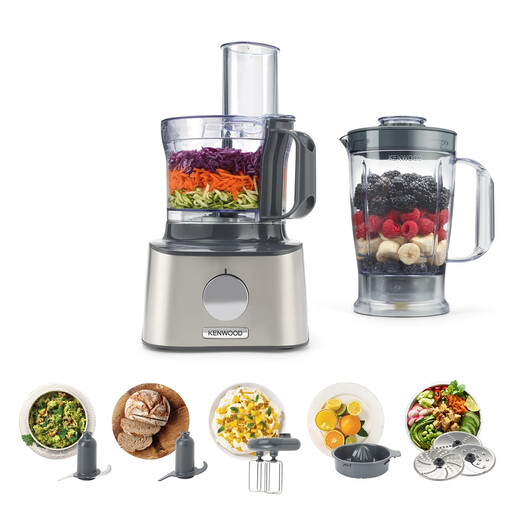
Why it suits this profile: For households that want to combine chopping, slicing, grating, blending, kneading and juicing in one base appliance.
The product details specify separate capacities, two speeds and dishwasher-safe accessories. This helps you assess everyday use and maintenance.
800 watts, 2.1-litre bowl, 1.2-litre blender capacity and several specified functions within one system.
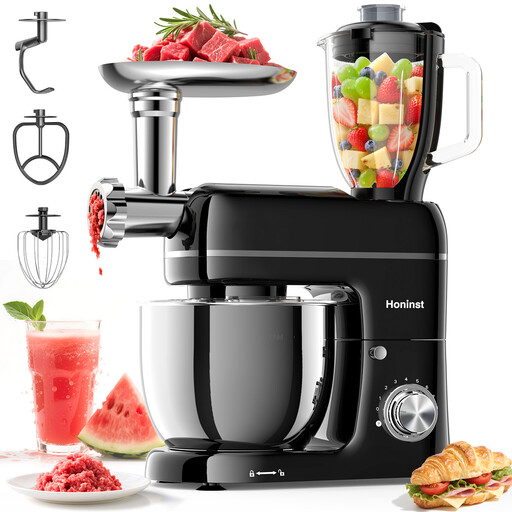
Why it suits this profile: Hobby bakers and families looking for a dough mixer, stand mixer, blender and meat grinder in one appliance get a larger bowl and multiple speeds.
The specified 6-quart stainless steel bowl, tilt-head design, safety lock and 8 speeds make the intended use clearer. However, always check the maximum quantities in the manual.
Up to 1,300 watts according to the product information, 6-quart bowl, 8 speeds plus pulse, and accessories for mixing, kneading, blending and grinding.

Why it suits this profile: Suitable for anyone who mainly makes smoothies, iced drinks, sauces and blended recipes, and wants to use a range of programmes.
The specifications state a 2.1-litre jug, 700 ml cup, 14 manual speeds and four automatic programmes. The product information also mentions fill markings and safety instructions.
1,200 watts, ice function, 2.1-litre jug and 700 ml cup according to the product details. The components must not be used beyond the indicated fill line, as stated in the instructions.
We have put together a complete, up-to-date list of products that fully meet these strict selection criteria and the applicable European safety regulations.
That depends on the tasks. For everyday chopping, blending and slicing, a food processor or chopper is practical. For regular bread or pizza dough, you need a stand mixer with a dough hook, sufficient bowl capacity and a suitable operating cycle. Check the manual before processing heavy ingredients.
Always unplug the appliance first. Then remove the blades, bowls and accessories according to the instructions. Wash the components immediately after use, especially after handling raw meat. Only components identified as dishwasher-safe in the product information may be placed in the dishwasher. Clean the motor base with a lightly damp cloth.
Consumption depends on the power rating and how long the appliance is used. An 800-watt appliance running for a few minutes uses less electricity than the same machine running for a prolonged period. Pulse functions and short operating cycles can help prevent the appliance from running for longer than necessary. So do not compare wattage alone; also consider preparation time and the amount of food you process each time.
