
Vandaag of morgen in huis

Kwaliteit gegarandeerd

Welkomstaanbiedingen ontgrendelen: GRATIS bezorging | Tot 80% korting | Gratis 30 dagen JoyPlus-proefperiode
Download de app
A multifunctional food processor can save a lot of space. With one appliance, you can make smoothies, soups, sauces, baby food and chopped vegetables, for example. However, a versatile appliance is not automatically right for every kitchen. A blender is designed for liquid preparations, while a food processor is better suited to slicing, grating and chopping. A stick blender is handy when you want to purée food directly in a pan.
The product descriptions in this guide have been checked against the specifications provided. Performance claims are not presented as guarantees. According to information from the brands or sellers, results may vary depending on the ingredients, quantity and length of use.
A higher wattage does not automatically mean an appliance will perform every task better. The shape of the blade and bowl, the speed settings and the maximum running time also matter. A compact multifunctional blender with 600 watts may be suitable for fruit, vegetables and light preparations, but it is not necessarily designed for prolonged heavy kneading.
So, check:
For example, the product information for the ochama Multifunction Blender states that the motor must not run continuously for more than one minute, followed by a rest period. This is useful information that can easily be overlooked in an attractive product title.
A 500 or 700 ml bowl is practical for one smoothie, sauce or small portion of baby food. For a family, a bowl of 1.3 litres or more and a separate blender jug are often more useful. Also check whether the stated capacity is the total capacity or the usable capacity.
A food processor for smoothies is usually built differently from a food processor for chopping and slicing. If you prepare vegetables for several people every day, you’ll get more use from a food processor with slicing and grating discs than from a smoothie maker alone.
A long list of accessories sounds appealing, but every part needs storage space and cleaning. Check whether you really need the accessories. A chopper, whisk, dough hook, blender jug and citrus press are only useful if they suit the recipes you make.
Also look for:
Blades and grating discs stay sharp. Always unplug the appliance before changing or cleaning any parts.
For smoothies, soups and soft vegetables, simple speed settings are often enough. For chopping, grating and kneading, the combination of motor, blade and accessory is especially important. A pulse setting helps you process ingredients briefly and with control.
A model with several speeds, such as the Kenwood FDP23.380GR with 900 watts and seven speed settings, offers more ways to adjust the process. A compact model with 650 watts and one speed plus pulse may make more sense for simple everyday preparations.
Measure the available space on your worktop or in a kitchen cupboard beforehand. A compact food processor is not always low: some models are narrow but relatively tall. So check the length, width and height.
Examples of stated capacities:
Stainless steel blades and a detachable blending leg are practical features in a stick blender. With a food processor, well-fitting lids, sturdy discs and dishwasher-safe parts matter more than a shiny exterior.
Always check the instructions before using hot liquids. Not every appliance is suitable for boiling soup. Keep the motor base, plug and cable out of water.

Why it suits this profile: The 1.5-litre jug and three speed settings make it a simple starting point for smoothies, juices, chopped ingredients and small batches of baby food.
The product information clearly states the maximum continuous running time of one minute. This means you know that heavy preparations need breaks.
600 watts, a 1.5-litre jug and a design that, according to the product description, is easy to take apart for cleaning.

Why it suits this profile: This model combines a food processor with a blender function, making it a good fit for households that want to prepare a range of dishes using one base unit.
The listed functions are specific: chopping, slicing, grating, puréeing, kneading, blending and crushing ice. This makes it easier to check whether the accessories suit your recipes.
900 watts, seven speeds, a 1.3-litre bowl, six accessories and a 600 ml personal blender with a drinking lid.
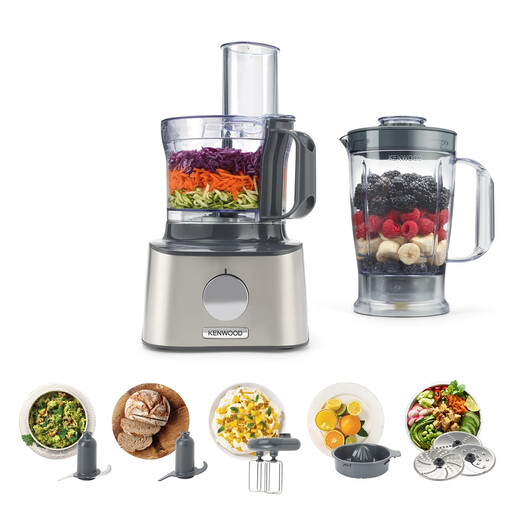
Why it suits this profile: The combination of a large bowl, several discs, a twin whisk and a juicing function suits anyone who cooks often and prepares a variety of dishes.
Its capacity and accessories make it clear that this is more than just a smoothie maker. Check beforehand that its dimensions of 20 × 23 × 36.5 cm will fit in your kitchen.
800 watts, a 2.1-litre bowl, a 1.2-litre blender capacity and dishwasher-safe accessories according to the product information.

Why it suits this profile: A stick blender takes up little space and is practical for soups, sauces, smoothies, eggs and small chopping jobs.
The set lists separate accessories and a maximum running time of one minute. This helps prevent you from using a stick blender as a heavy-duty food processor by mistake.
Up to 1200 watts, a 700 ml blending beaker, a 500 ml chopper bowl, a whisk and variable speed control.
We’ve put together a complete, up-to-date list of products that meet these strict selection criteria and the applicable European safety regulations.
A blender is mainly designed for liquid or soft preparations, such as smoothies, sauces and puréed soup. A food processor often uses blades and discs for chopping, slicing, grating and sometimes kneading. A food processor with a blender combines both functions, but usually takes up more space.
Its lifespan depends on how often you use it, how well you maintain it, whether it is overloaded and whether accessories are fitted correctly. Use the appliance within the stated time limits, let the motor cool down and check the blades and locks regularly. Many new consumer products in the European Union come with a legal guarantee of at least two years; additional terms may vary by product.
Electricity use depends on the wattage and how long the appliance runs. An 800-watt appliance running for five minutes uses less energy than the same machine used for a prolonged period. Since many preparations take only a short time, total running time is often more important than the wattage shown on the packaging.
