
Vandaag of morgen in huis

Kwaliteit gegarandeerd

Welkomstaanbiedingen ontgrendelen: GRATIS bezorging | Tot 80% korting | Gratis 30 dagen JoyPlus-proefperiode
Download de app
A multifunctional food processor can chop, slice, grate, knead, mix and blend. That sounds handy, but not every appliance performs all these tasks equally well. A blender, for example, is suited to liquid mixtures, while a food processor is better for vegetables, nuts and dough. If you only look at the number of accessories or the wattage, you could end up buying an appliance that rarely gets used.
A motor rated at, say, 1,200 or 1,300 watts sounds impressive. But wattage alone doesn’t determine how well a food processor performs. The shape of the blades, the gearing, the bowl and the recommended operating time all play a part.
So check:
Some compact models are recommended for processing heavy mixtures only briefly, followed by a break. This is worth bearing in mind if you’re looking for an appliance for everyday use.
A multifunctional blender may come with a mini chopper, grinding cup or slicing discs. This makes it versatile, but check that the accessories suit the recipes you make. A small chopper isn’t necessarily suitable for large quantities of vegetables. And a blender jug isn’t the same as a mixing bowl for bread dough.
Check the product category too:
A 2.1-litre jug or a 3-litre bowl may sound spacious. In reality, you mustn’t exceed the maximum fill line. The recommended quantity may be lower for liquids, dough and frothy mixtures.
So consider:
Smoothies and soft vegetables often need less power than ice, nuts or heavy dough. If you’re mainly looking for a smoothie maker, pay closer attention to the blade design, jug capacity and controls. For a food processor for dough, stability, the dough hook and the maximum dough capacity matter more than simply choosing the highest wattage.
Check whether the manufacturer specifies a maximum number of minutes per cycle. Taking a break during heavy-duty tasks helps prevent overheating. Always use the appliance according to the manual, and don’t process ingredients it isn’t designed for.
An appliance with lots of attachments is only useful if you can store them safely and clean them easily. Check whether the set includes:
Pay attention to the materials too. A stainless steel bowl is practical for cake mixtures and dough. Plastic parts are often lighter. A glass blender jug can feel sturdy, but it’s heavier and takes up more space.
Sharp blades and slicing discs should be easy to remove safely. Check which parts are dishwasher-safe and which need to be washed by hand. The motor base must not be submerged in water.
Important safety features include a lid lock, a stable non-slip base and automatic shut-off if a part isn’t fitted correctly. In the Netherlands, consumer purchases are covered by the statutory guarantee; some products also come with a stated two-year manufacturer’s warranty. Keep your proof of purchase and check the product terms for details.
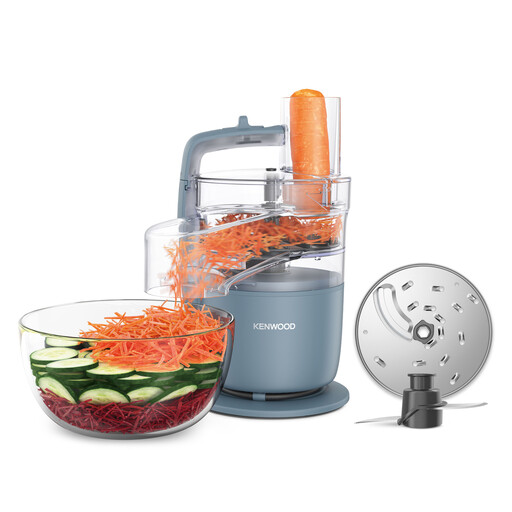
Why it suits this profile: This compact model is designed for chopping, slicing and grating. With a 1.3-litre bowl and 650 watts of power, it’s well suited to smaller households and kitchens with limited storage space.
Its functions and capacity are clearly defined. You won’t be buying a large set of accessories for tasks you may never use.
650 watts, a 1.3-litre bowl, pulse function and dishwasher-safe parts, according to the product information.
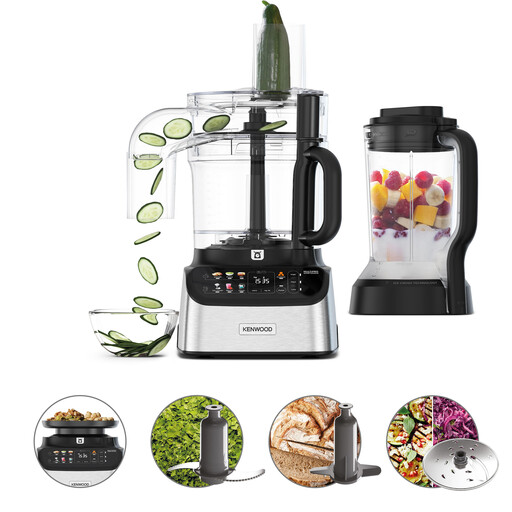
Why it suits this profile: For anyone looking for one appliance that can weigh, chop, grate, knead and blend. The combination of a food processor, 1.5-litre blender and automatic programmes is suited to a wide range of recipes.
Each function has a specific accessory: a dough hook, slicing and grating disc, and blender jug. This makes its versatility easy to assess.
1,000 watts, a 3-litre bowl, built-in scales and OneTouch programmes, according to the product specifications.

Why it suits this profile: This set is designed for households that want a blender, meat grinder, citrus press and vegetable slicer, as well as mixing and kneading functions.
The accessories are designed for specific tasks. However, check in advance that you have enough worktop and storage space for the extensive set.
3.9-litre stainless steel bowl, functions for dough, blending, chopping and grinding, plus several included attachments, according to the product description.
We’ve put together a complete, up-to-date list of products that meet these strict selection criteria and the applicable European safety requirements.
It depends on the tasks and quantities. One appliance can be handy for making smoothies and sauces, slicing vegetables and doing small chopping jobs every day. For heavy bread dough or large quantities of raw ingredients, a stand mixer or food processor with a suitable capacity is often a better choice. Always check the maximum operating time and fill capacity.
Its lifespan depends on how it’s used, maintained and loaded. An appliance may last longer if you don’t exceed its maximum capacity, handle the blades carefully and let the motor cool down after heavy-duty cycles. Clean the parts straight after use, and only use accessories designed for your model.
Energy consumption depends on the power rating and how long you use the appliance. A 1,000-watt motor uses less energy when running for one minute than it does during prolonged use. So only switch it on once all the ingredients are ready, and use the pulse setting for short bursts. That way, you’re comparing not just the wattage, but also how long you’ll actually use the machine.
