When choosing multi-seed rusks for a single-serving meal, don’t base your choice on the seeds alone. If you’re looking for wholegrain, check that this is stated explicitly; portion size determines what the nutritional values mean per rusk. Compare fibre and protein per 100 g and per rusk, and check the ingredients and allergens before choosing.
Who is this relevant to?
If you’re comparing fibre and wholegrains
You’re looking for rusks to have with one meal and want to know whether a variety is explicitly labelled wholegrain, and how much fibre the nutritional information lists. Seeds in the product name alone don’t tell you this.
If you’re checking protein per rusk
You use rusks as a base for a light lunch and want to compare nutritional values for the number of rusks you eat, rather than just the values per 100 g.
If you need to check allergens
You want to be able to check the current ingredients before buying, for example because of wheat, sesame or egg. The name ‘multi-seed rusk’ doesn’t tell you which allergens a specific variety contains.
What should you look for when choosing?
When choosing multi-seed rusks for one meal, first decide what matters most to you. Then compare nutritional values on the same basis: per 100 g and per rusk.
| What to consider |
What to check before buying |
Most relevant if |
| Fibre and wholegrains |
Look for an explicit wholegrain claim and compare fibre per 100 g and per rusk. |
I’m looking for wholegrain, so I don’t want to assume that ‘multi-seed’ means wholegrain. Around 40% of consumers prioritise fibre or a clear wholegrain claim. |
| Protein and portion size |
Compare protein per rusk and check how much one rusk weighs. |
For my light lunch, I want to know what the number of rusks I eat contributes, not just what the label says per 100 g. Around 30% of consumers prioritise protein and portion size when making this choice. |
| Allergens and storage |
Read the current ingredients and allergen information; follow the storage instructions on the packaging after opening. |
If I need to avoid an allergen, I need to be able to assess a variety before buying it. Checking ingredients and allergens is a priority for around 30% of consumers. |
Common mistakes
-
Assuming multi-seed means wholegrain
A rusk with seeds may be made with wheat flour. So the term ‘multi-seed’ doesn’t mean that the grain used is wholegrain.
If wholegrain is a must-have, look for an explicit wholegrain claim, then compare the fibre in the nutritional information.
-
Comparing values per 100 g only
The varieties we looked at don’t all list the same weight per rusk. So comparing values per 100 g doesn’t tell you what one rusk adds to your meal.
Check the weight of one rusk and compare the nutritional values for the number you plan to eat, too.
-
Assuming the seeds tell you whether it’s suitable for your allergies
The multi-seed varieties we looked at contain wheat and sesame; some also list egg. The product name is no substitute for the ingredients list.
Check the current allergen information on the packaging every time you buy, even if you’ve bought the variety before.
-
Assuming that listed salt is iodised baker’s salt
According to the Voedingscentrum, bakers don’t have to use baker’s salt. A label that simply says ‘salt’ doesn’t tell you which salt is used in a specific rusk.
Check the product-specific information or ask the manufacturer if the type of salt used matters to your choice.
Brands to consider
Bolletje
Vezelrijk Boeren Beschuit Meerzaden is worth considering if you want to assess the nutritional values of a multi-seed rusk per piece.
- Product information from Albert Heijn lists 10 g of fibre and 17 g of protein per 100 g; according to the same information, one rusk weighs around 16 g.
- Wheat flour is the first ingredient listed. The variety we looked at contains wheat and sesame, so don’t assume it’s wholegrain or suitable if you have an allergy.
AH
The range we looked at includes both a standard multi-seed rusk and an organic variety that’s explicitly labelled wholegrain.
- According to Albert Heijn’s product information, the organic wholegrain variety lists 11 g of fibre per 100 g; the standard variety lists 7 g per 100 g.
- The varieties we looked at contain wheat, egg and sesame, among other ingredients. Check the ingredients on the specific pack.
TastyBasics
The Beschuit Meerzaden we looked at provides nutritional information per 100 g and per rusk, making it easier to compare for a single meal.
- Product information from Jumbo lists 20 g of protein and 11 g of fibre per 100 g, and 4,6 g of protein and 2,6 g of fibre per 23 g rusk.
- For this variety, the listed allergens are wheat, spelt, barley, egg and sesame.
Multi-seed rusks on Joybuy
These two multi-seed rusks are worth considering for a light meal with toppings. Use the packaging to compare the portion size, nutritional values and allergens of the variety you choose.
 Image unavailable
Bolletje multi-seed rusks, 10 pieces
An option if you’re looking for multi-seed rusks to top with your favourite ingredients. The product name indicates that the pack contains 10 pieces; check the weight per piece and the latest nutritional information if you want to compare them for each meal.
If you have an allergy, read the ingredients and pay particular attention to wheat and sesame. Check for an explicit wholegrain claim if wholegrain is important to you.
View on Joybuy
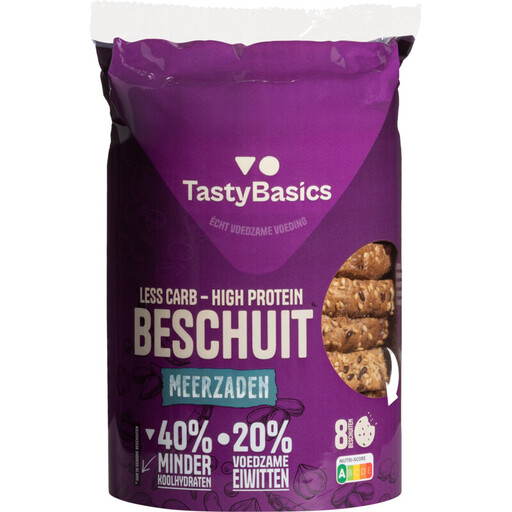 Image unavailable
TastyBasics multi-seed rusks, 184 g
Worth considering if you want to compare protein and fibre for a light meal. The product name gives the pack weight as 184 g; check how much one rusk weighs before comparing values per piece.
If you have an allergy, check the latest information about cereals containing gluten, egg and sesame. If you’re looking for a rusk explicitly labelled wholegrain, don’t rely on wholemeal ingredients alone.
View on Joybuy
Frequently asked questions
Are multi-seed rusks automatically wholegrain?
No. Seeds and wholegrain describe different characteristics. According to the Voedingscentrum, a product that isn’t made entirely from wholemeal flour can’t be called ‘wholegrain’. Look for an explicit wholegrain claim if that’s one of your criteria.
Which allergens should I check in multi-seed rusks?
Read the current allergen information for the specific variety. The products we looked at contain wheat and sesame; some also contain egg or other cereals containing gluten. If you have an allergy, don’t rely on the product name or on having bought it before.
How can I keep an opened pack of rusks crisp?
Seal the packaging tightly after opening and follow the storage instructions on the label. This is especially useful if you’re using the pack over several single-serving meals.
Does ‘salt’ on the label mean the rusks contain iodised baker’s salt?
No. The word ‘salt’ doesn’t confirm which type of salt was used in those rusks. According to the Voedingscentrum, using baker’s salt isn’t compulsory. Check the product-specific information or ask the manufacturer if you want to know.


