
Lunch shoppers keeping an eye on fibre
You want seeded rusks and are comparing the fibre content per 100 g. Even a high-fibre multi-seed rusk isn’t automatically wholegrain.


When choosing multi-seed rusks for lunch, don’t judge them by the visible seeds alone. If wholegrain is your main priority, look for an explicit wholegrain claim. If fibre, protein or carbohydrates matter more to you, compare their values per 100 g. Check the allergens for every variety: multi-seed rusks may contain cereals containing gluten, sesame and, sometimes, egg.
Seeded rusks can make a crunchy base for a topped lunch. The right variety depends mainly on what you want to see on the label; the amount of seeds alone won’t tell you.
You want seeded rusks and are comparing the fibre content per 100 g. Even a high-fibre multi-seed rusk isn’t automatically wholegrain.
You look for a wholegrain claim on the packaging rather than relying on the colour or visible seeds. You can then compare the ingredients, nutritional information and allergens in each variety.
You want to know how a particular rusk fits with those two values in your own lunch choices. Compare products on the same basis, preferably per 100 g, and also consider the portion you eat.
First decide which feature matters most for your lunch. Then compare the nutritional information for the exact variety, and always check the latest packaging if you have an allergy.
| What to consider | What to look for | Who might find this important? |
|---|---|---|
| Fibre | Compare fibre per 100 g and consider how many rusks you eat for lunch. | When I choose seeded rusks, I mainly want to compare the fibre content. For around 40% of consumers, fibre would be the first consideration. |
| Wholegrain | Look for an explicit wholegrain claim and check the ingredients list; visible seeds aren’t proof. | I want to be sure the flour base meets my wholegrain criteria, even if there are seeds on the rusks. Wholegrain would be the top priority for around 30% of consumers. |
| Protein and carbohydrates | Compare both values per 100 g on the label for the exact variety. | When choosing lunch, I look first at protein and carbohydrates, not just the name ‘multi-seed’. Around 30% of consumers would make these values their main consideration. |
‘Multi-seed’ describes the addition of seeds and kernels, not necessarily the flour used. So if you’re specifically looking for wholegrain, you could choose a variety that doesn’t meet that criterion.
Look for a wholegrain claim on the packaging and read the ingredients. According to the Voedingscentrum, a product can only be called ‘wholegrain’ if it is made entirely from wholegrain flour.
The multi-seed varieties examined contain sesame and cereals containing gluten; some also contain egg. The seeds you can see on the outside don’t tell you what other allergens are in the product.
If you have an allergy, read the allergen information on the latest packaging for the exact variety.
A variety marketed as lower in carbohydrates may not be the one that best matches your other lunch criteria. Protein, fibre, salt and allergens can vary too.
Compare the full nutritional information per 100 g and decide which value matters most to you.
The word ‘salt’ on an ingredients list doesn’t, by itself, tell you what type of salt was used or how much iodine the rusks contain.
If this distinction matters to your purchase, check whether the manufacturer specifies which salt is used in the exact variety.
Compare varieties within and across brands: a brand name alone doesn’t tell you whether a rusk is wholegrain or which allergens it contains.
The High-Fibre Multi-seed variety is worth considering if you mainly want to compare seeds and fibre for lunch.
This own-brand range lets you compare regular multi-seed rusks with an organic wholegrain multi-seed variety.
TastyBasics Multi-seed Rusks are worth a look if you mainly compare protein and carbohydrates per 100 g.
This Joybuy selection includes a dark wholegrain rusk and two multi-seed varieties. Use the product name as a starting point, then check the nutritional information and allergens on the exact pack before choosing.
 Image unavailable
An option if you’re specifically looking for wholegrain rusks for lunch. If seeds or particular allergens are also important to your choice, check the latest packaging.
 Image unavailable
An option if you’re looking for rusks with a variety of seeds for lunch. If wholegrain is a must, check the explicit claim and ingredients on this pack; if you have an allergy, read the allergen information too.
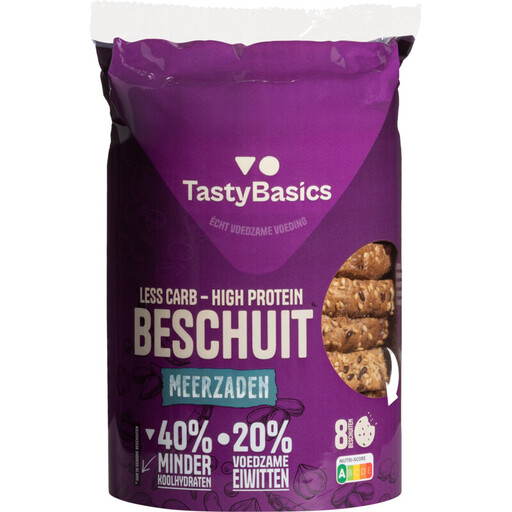 Image unavailable
A variety to compare if protein and carbohydrates matter to your lunch choices. Albert Heijn lists 20 g of protein, 43 g of carbohydrates and 11 g of fibre per 100 g for TastyBasics Multi-seed Rusks. If you have an allergy, check the latest packaging for cereals containing gluten, egg and sesame, among other allergens.
No. Seeds and kernels don’t necessarily tell you anything about the flour base as a whole. Look for a wholegrain claim and check the ingredients; according to the Voedingscentrum, a product can only be called ‘wholegrain’ if it is made entirely from wholegrain flour.
Read the allergen information on the exact pack, especially if sesame, cereals containing gluten or egg are relevant to you. These ingredients occur in the varieties examined, but not every variety has the same ingredients.
No. The word ‘salt’ alone doesn’t tell you what type of salt was used or how much iodine it contains. Ask the manufacturer about the exact variety if this distinction affects your choice.
Seal the pack well after use and store the rusks somewhere cool, dark and dry. These are the storage recommendations Albert Heijn gives for the AH multi-seed varieties examined; for another product, follow the instructions on its packaging.