
If you’re serving Christmas nibbles
You’ll want seed-packed rusks as a crunchy base for toppings. Check the size, as descriptions such as large or robust don’t tell you how well the rusk will hold up under different toppings.


When choosing multi-seed rusks for Christmas dinner, start by thinking about how you plan to serve them. For topped bites, size and seed mix matter, while nutritional choices depend on the figures per 100 g and per rusk. If you’re serving guests, always check the latest ingredients and allergen information on the packaging. Don’t assume the rusks contain iodised baker’s salt unless this has been confirmed for that specific product.
You’ll want seed-packed rusks as a crunchy base for toppings. Check the size, as descriptions such as large or robust don’t tell you how well the rusk will hold up under different toppings.
Compare fibre, protein and carbohydrates using the nutritional information, rather than relying on the name ‘multi-seed rusk’ alone.
Before serving, check the packaging for ingredients such as sesame, cereals containing gluten and, in some varieties, egg.
First decide whether the rusks will mainly be a base for nibbles or whether particular nutritional values will guide your choice. Then check the ingredients and allergen information on the packaging of the product you’ll actually be serving.
| What to consider | What to check when buying | Who is this important to? |
|---|---|---|
| Size and seeds | Check the size of each rusk and which seeds and kernels are listed. If you’re using rich or moist toppings, try them out to see whether the rusks stay firm enough. | For topped Christmas nibbles, I want a crunchy base that suits my portions; around 24% of consumers prioritise this as a serving base. |
| Fibre | Compare fibre per 100 g and per rusk, taking the serving weight into account. | I want to compare varieties by their fibre content, not their name; around 29% of consumers prioritise fibre. |
| Protein and carbohydrates | Check both values per 100 g and per serving. If a comparative claim is made, see what it is based on. | If you’re looking for a particular nutritional profile, you’ll want to compare the values for the varieties you’re considering; for around 18% of consumers, protein or carbohydrates are the deciding factor. |
| Ingredients and allergens | Check the latest packaging for cereals containing gluten, sesame, egg and any warnings about traces. | When serving guests, I want to know which ingredients matter to them; for around 29% of consumers, checking this is the main priority. |
The varieties reviewed have different fibre levels. Albert Heijn lists 10 g of fibre per 100 g for Bolletje and 7 g per 100 g for AH Multi-Seed Rusks.
If fibre, protein or carbohydrates are important to your choice, compare the nutritional information per 100 g and per rusk.
The varieties discussed list sesame and cereals containing gluten; some also contain egg. That makes the ingredients list important when guests need to avoid allergens.
Check the allergen information on the latest packaging before buying, and again before serving.
According to the Netherlands Nutrition Centre, the use of baker’s salt is not compulsory. A listing for salt alone doesn’t confirm which type of salt was used in a specific rusk.
Don’t count rusks as a source of iodine unless this has been confirmed for the specific product.
Bolletje lists sunflower seeds, linseed, sesame seeds and pumpkin seeds in its Vezelrijk Meerzaden Beschuit.
AH Multi-Seed Rusks are described as rusks with over 16% seeds and kernels.
TastyBasics offers multi-seed rusks that may be worth considering for their nutritional values.
These multi-seed rusks are for anyone looking for a seed-packed base for Christmas nibbles or wanting to compare nutritional values. Check the latest packaging before choosing, especially if you’re serving guests with allergies.
 Image unavailable
A seed-packed rusk to consider as a base for Christmas nibbles; check that the size suits your planned toppings.
If you’re serving guests, check the latest packaging for wheat, sesame and any other relevant allergens.
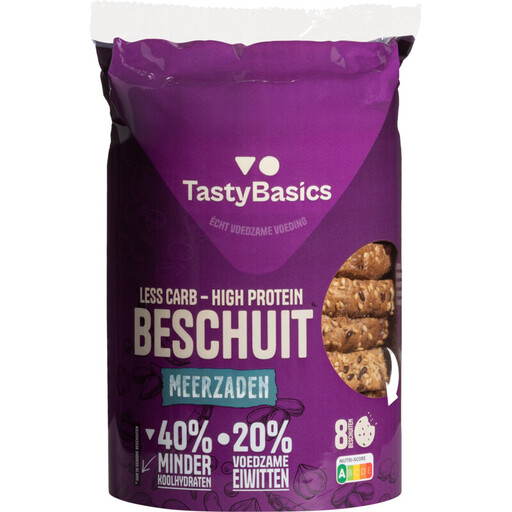 Image unavailable
A multi-seed rusk to compare if protein, fibre and carbohydrates are guiding your choice; check the nutritional information on the packaging.
When serving, also check the information about egg, sesame and cereals containing gluten.
Don’t assume they are without checking the latest packaging: the varieties discussed list sesame and cereals containing gluten. Also check for warnings about traces, and choose a product that avoids the ingredients your guest needs to steer clear of.
Not automatically: according to the Netherlands Nutrition Centre, the use of baker’s salt is not compulsory. Only assume the rusks contain iodised baker’s salt if this is stated on the packaging for that specific product or confirmed by the manufacturer.
No. The presence of seeds alone doesn’t tell you whether the overall nutritional value is better. Compare the ingredients and nutritional information to suit your needs, including fibre, sugars, fat and salt per 100 g and per serving.
Keep opened rusks in a well-sealed container and follow the storage advice on the packaging. The varieties discussed are described as best stored in a dry place; check the instructions for the product you buy.