
Travellers comparing fibre content
You’re looking for seeded rusks as a dry snack base for a long journey. Fibre per 100 g and the grain base can help you compare varieties.


Choose multi-seed rusks for a car journey based on what matters most to you: fibre content and an explicitly wholegrain base, or the stated protein and carbohydrate values. Visible seeds alone tell you nothing about the grain base or allergens. Transport rusks dry and protected from breakage, and keep perishable toppings chilled.
You’re looking for seeded rusks as a dry snack base for a long journey. Fibre per 100 g and the grain base can help you compare varieties.
You want to be able to check protein, carbohydrates and fibre, rather than basing your choice solely on the visible seeds.
You read the label because of ingredients such as sesame, egg or gluten-containing cereals, or you’re taking toppings that need to stay chilled during the journey.
First decide whether the grain base, nutritional values or safe transport matters most to you. Then compare the labels of the varieties that meet your needs.
| What to consider | What should you check? | Who is it important for? |
|---|---|---|
| Fibre and wholegrain | Look for the wholegrain label and compare fibre per 100 g; seeds alone don’t tell you what the grain base is. | If I’m choosing mainly based on the grain base and fibre, I want to know what the label says; around 44% of consumers make this their priority. |
| Nutritional values | Compare protein, carbohydrates and fibre on the same basis, for example per 100 g. | I want to compare the nutritional values of different rusks, rather than just looking at the seeds; this is the main consideration for around 33% of consumers. |
| Allergens and transport | Read the current label and storage instructions; keep perishable toppings chilled. | If I have an allergy or am taking perishable toppings, I want to know what I can take and how to transport it before setting off; around 23% of consumers give this priority. |
Seeds on a rusk don’t tell you whether the flour used is wholemeal. According to the Netherlands Nutrition Centre, the wholegrain label tells you about the grain base.
Look for that label on the packaging and read the ingredients if wholegrain is one of your buying criteria.
Ingredients vary between varieties. The Bolletje and TastyBasics rusks described here list wheat and sesame, among other ingredients; TastyBasics also lists egg, spelt and barley.
Check the current label each time you buy, even if you already know the variety.
For toppings that spoil quickly, it’s important to know how long they can stay out of the fridge. The Netherlands Nutrition Centre advises against leaving highly perishable food out of the fridge for more than two hours.
Keep the rusks and toppings separate, and transport perishable toppings chilled.
Rusks are brittle and can break during transport; once opened, the packaging also needs to be kept dry and properly sealed.
Carry opened rusks in a properly sealed pack or a sturdy, dry storage container.
The Vezelrijk Boeren Beschuit Meerzaden variety is worth considering if you want to compare seeds and the stated fibre content.
AH Meerzadenbeschuit is a variety you can compare based on its seed content and nutritional information.
Beschuit Meerzaden has stated nutritional values that let you compare protein, carbohydrates and fibre per 100 g.
These rusks suit different starting points for the same choice: multi-seed rusks, a wholegrain variety or multi-seed rusks whose nutritional values you want to compare. Always check the label of the specific product before you choose.
 Image unavailable
An option if you’re looking for multi-seed rusks for your journey. Compare the fibre per 100 g on the label and protect the rusks from moisture and breakage while you travel.
 Image unavailable
An option if a wholegrain base is your priority. Check the label to see which seeds and allergens are listed for this variety, and protect the rusks from breakage while you travel.
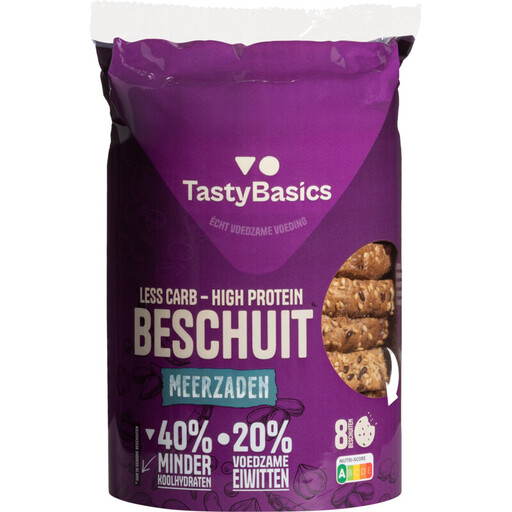 Image unavailable
An option if you want to compare multi-seed rusks based on their nutritional values. Check the values per 100 g and the allergens on the current label; transport the rusks dry and protected from breakage.
No, seeds don’t tell you whether the grain base is wholegrain. Check the label and ingredients; according to the Netherlands Nutrition Centre, wholegrain refers to the wholemeal flour used.
Check the allergens in the variety you’re buying, as the ingredients differ. The Bolletje variety described here lists wheat and sesame; TastyBasics Beschuit Meerzaden also lists spelt, barley and egg. The current label is the one to rely on.
Transport rusks dry and protected from breakage, and keep perishable toppings chilled. The Netherlands Nutrition Centre advises against leaving highly perishable food out of the fridge for more than two hours.
No, permission to use iodine compounds in baker’s salt doesn’t mean that every rusk contains iodine. The Netherlands Food and Consumer Product Safety Authority sets a maximum of 65 mg of iodine per kg of salt for bread, bread substitutes and other bakery products. Check the ingredients list if this matters to your choice.