
Bakers looking to limit sugar
If reducing sugar in the topping is your priority, ordinary Muisjes aren’t a good fit. Leave them out or compare another topping by its sugar content per 100 g.


Want to make homemade oliebollen with less sugar? Don’t choose ordinary Muisjes as a low-sugar topping: according to Albert Heijn’s product information, De Ruijter Feestmuisjes contain 79 g of sugars per 100 g. You can use them as a finishing touch after frying for colour and an aniseed flavour, but the amount still counts; Jumbo lists 12 g of sugars per 15 g serving of the same Feestmuisjes. If you’re also keeping an eye on carbohydrates, check the batter and filling too, rather than just the topping.
If reducing sugar in the topping is your priority, ordinary Muisjes aren’t a good fit. Leave them out or compare another topping by its sugar content per 100 g.
You could use Muisjes as a finishing touch after frying for colour and an aniseed flavour. Using a small amount limits how much topping you add, but it doesn’t make the product itself low in sugar.
Check the latest allergen information before buying. Albert Heijn lists wheat among the ingredients in the De Ruijter Feestmuisjes reviewed here.
First decide whether less sugar, decoration or an allergen check is the main factor in your choice. Then compare only toppings that are suitable for the same use; according to the Voedingscentrum, comparing nutritional values per 100 g helps you assess products side by side.
| What to consider | What to check when buying | Who it matters to |
|---|---|---|
| Sugar in the topping | Compare similar toppings by their sugar content per 100 g and read the ingredients list. Albert Heijn lists 79 g of sugars per 100 g for De Ruijter Feestmuisjes. | If my main aim is to have less sugar on my oliebol, I’d rather leave ordinary Muisjes out. Around 36% of consumers make limiting sugar their priority. |
| Decoration and portion size | Decide how much you want to sprinkle on and check the sugars per stated serving. Jumbo lists 12 g of sugars per 15 g for De Ruijter Feestmuisjes. | For a festive finish, I want colour and an aniseed flavour, but I also want to choose how much I use. Around 29% of consumers prioritise this decorative touch. |
| Wheat and gluten | Check the latest ingredients and allergen information on the packaging; don’t judge by the colour of the Muisjes. | If someone eating with me needs to avoid wheat or gluten, I need to know whether this variety is suitable. For around 21% of consumers, checking allergens is their first concern. |
| Variety and packaging | Check which variety and pack size you’re buying. Compare the nutritional values per 100 g if you’re choosing between varieties. | I want to find a variety that suits how I plan to decorate my oliebollen, without assuming the packaging proves it contains less sugar. Around 14% of consumers give priority to this practical product choice. |
Sprinkling on less limits the amount of Muisjes you use, but it doesn’t change what they’re made of. Jumbo says a 15 g serving of De Ruijter Feestmuisjes contains 12 g of sugars.
Decide whether you simply want to limit the portion or find a topping with less sugar. For the latter, compare similar products per 100 g.
The topping isn’t the only source of carbohydrates. Diabetes.nl lists around 27 g of carbohydrates per oliebol and points out that raisins, dried fruit and candied citrus peel add extra carbohydrates.
When putting together your oliebollen, consider the batter, filling and portion size too.
Albert Heijn lists wheat in the De Ruijter Feestmuisjes reviewed here. If ingredients can change, the packaging of the product you’re actually using is what matters.
Check the latest packaging before use. If the information is unclear for a relevant allergy, don’t use the product for that person.
PLUS lists decorating baked goods as one use for Muisjes. That doesn’t tell you how they behave in frying batter.
Don’t assume that a description of their use as a decoration means they’re suitable for batter. If you want to decorate your oliebollen, consider using the Muisjes as a finishing touch after frying.
The brand behind the Feestmuisjes and Gestampte Muisjes reviewed here: varieties of sweet aniseed-flavoured sprinkles.
A retailer with online product information for several varieties of De Ruijter Muisjes.
A retailer whose product information for De Ruijter Feestmuisjes also gives a serving size.
A retailer that stocks De Ruijter Muisjes and lists decorating baked goods as one way to use them.
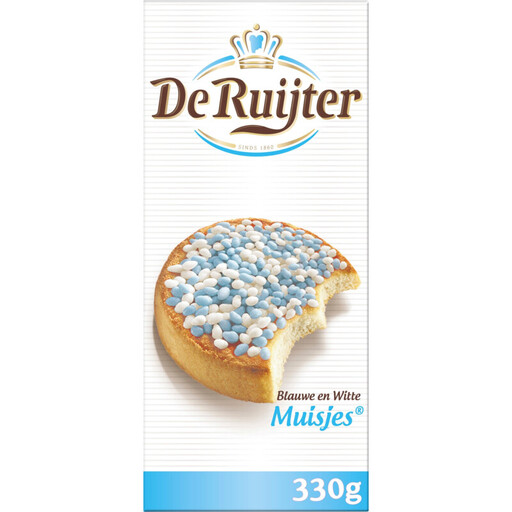
These blue and white Muisjes suit a decorative finish after frying. Check the nutritional information if reducing sugar is your main priority.
 No image available
Worth considering if you want to decorate oliebollen after frying, but not as a low-sugar topping by default.
Blue and white variety in a 330 g pack. Check the latest information on sugars, ingredients and allergens before use.
No. Don’t treat the De Ruijter Feestmuisjes reviewed here as a low-sugar topping: Albert Heijn lists 79 g of sugars per 100 g. If you want to choose a different topping, compare similar products by their sugar content per 100 g.
No. Leaving out the Muisjes only removes the carbohydrates from that topping. Diabetes.nl lists around 27 g of carbohydrates per oliebol; also consider the batter, portion size and any filling.
Check the ingredients and allergen information on the latest packaging before using Muisjes. Albert Heijn lists wheat in the De Ruijter Feestmuisjes reviewed here; don’t assume another colour variety has the same ingredients.