Don’t automatically choose muisjes for the savoury dishes in an Indonesian rice table: they’re sugar-coated aniseed. If you’d like to use them to decorate a separate sweet dish, crushed muisjes make a finer topping, while whole ones are more visible. The finer texture doesn’t change their sweet flavour; check the label of your chosen variety for allergens too.
Who is this relevant to?
The cook keeping an eye on the balance of flavours
You’re serving rice with a range of savoury dishes and want to decide whether a sweet aniseed topping has a place on the menu. 24Kitchen describes sweet and sour flavours as possible contrasts in a rice table; that doesn’t make muisjes an obvious garnish for the savoury dishes.
The host planning a separate dessert
You’re looking for a visible sweet accent for a cake or another dish served alongside the rice table. In that case, the main choice is between whole and crushed muisjes.
The shopper looking for a finer topping
You want a finer topping than whole muisjes, without assuming the pack contains individual mini portions. For the De Ruijter varieties reviewed, it’s also worth checking the ingredients and allergens on the label.
What should you look for when choosing?
First decide whether the muisjes are intended for a separate sweet dish. Then compare the texture and the information on the packaging.
| What to consider |
What to check before buying |
Who it matters to |
| Where it fits on the menu |
Decide whether the topping is for a separate sweet dish, rather than a savoury one. |
For my rice table, I don’t want to sprinkle sweet aniseed over the savoury dishes; around 46% of consumers prioritise how well it pairs with the menu. |
| Texture |
Compare crushed muisjes for a finer topping with whole muisjes for a more visible decoration. |
For a small dessert accent, I want to be able to scatter the muisjes finely; around 27% of consumers prioritise this texture. |
| Ingredients and allergens |
Read the label of the variety you choose. For the crushed and pink-and-white De Ruijter muisjes reviewed, Jumbo lists wheat and 79 g of sugars per 100 g. |
When serving guests something sweet, I want to know what ingredients and allergens it contains; around 27% of consumers prioritise checking the label. |
Common mistakes
-
Assuming ‘crushed’ means individual portions
Crushed muisjes are finer than whole ones, but that doesn’t mean the pack contains a collection of mini portions.
Choose the crushed variety if you’re looking for a finer topping. Check the pack size if you only need a small amount.
-
Treating muisjes as a standard garnish for a rice table
The muisjes reviewed are sugar-coated aniseed. Delicious describes a rice table as a meal of rice and several small meat, fish and vegetable dishes; a sweet topping isn’t a neutral substitute for a savoury accompaniment.
If you do want to serve muisjes, keep them for a separate dessert or cake.
-
Relying on a retailer’s listing for allergen information
The whole and crushed De Ruijter varieties reviewed at Jumbo list wheat and gluten. If your guests need to avoid these ingredients, the information on the pack you buy is what matters.
Read the current label before buying and serving; don’t choose that variety if wheat or gluten needs to be avoided.
-
Buying a pack without a plan for the rest
The crushed variety reviewed contains 270 g, while the whole variety contains 330 g. You may only need part of a pack for one small dessert decoration.
Think ahead about whether you’ll use the rest later, and follow the storage advice on the pack.
Once opened, the pack also needs to be stored in a dry place after the rice table.
Relevant brands and retailers to explore
De Ruijter
The product range reviewed includes whole and crushed muisjes: two types of sweet aniseed topping for anyone looking for a separate sweet accent.
- Crushed muisjes make a finer topping, while whole muisjes are more clearly visible.
- The varieties reviewed at Jumbo list wheat and gluten. Choosing a different texture doesn’t change the fact that they’re a sweet product.
Albert Heijn
Albert Heijn’s muisjes range includes De Ruijter Celebration Muisjes, Crushed Muisjes, and Pink and White Muisjes.
- The different varieties let you compare textures and styles.
- Check the label on the individual pack you choose for its ingredients and allergens.
Jumbo
Jumbo lists De Ruijter Crushed Muisjes in a 270 g pack and Pink and White Muisjes in a 330 g pack as separate products.
- The product information helps you compare the texture, pack size, ingredients and nutritional information of these two varieties.
- Check the information on the pack you actually buy.
PLUS
PLUS lists De Ruijter Crushed Muisjes as a separate 270 g variety.
- The product listing distinguishes the crushed variety from whole muisjes.
- Check the current product label for ingredients and allergens.
Muisjes for a separate sweet dish
These whole muisjes are a good choice if you want a visible, sweet decorative accent for a separate dessert or cake. If you’re looking for a finer topping, compare them with crushed muisjes.
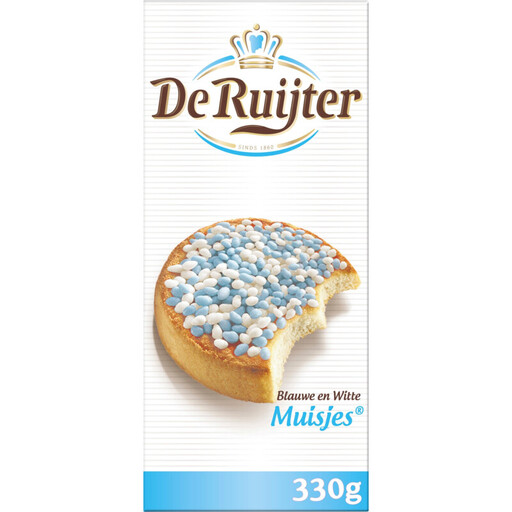 Image unavailable
De Ruijter Blue & White Muisjes 330 g
For a separate sweet dish when you want to use whole, visible muisjes as decoration.
The pack contains 330 g. If you’re serving guests with allergies, check the ingredients and allergens on the current label.
View at Joybuy
Frequently asked questions
Are crushed muisjes the same as mini portions?
No. ‘Crushed’ describes a finer texture, not individually packaged portions. Check the pack size if you only want to decorate a small dessert.
Can I sprinkle muisjes over nasi, rendang or satay?
Muisjes aren’t a neutral choice for these savoury rice table dishes: they’re sugar-coated aniseed. If you want to use that flavour deliberately, keep the muisjes for a separate sweet dish or cake.
Which allergens should I check in muisjes?
The whole and crushed De Ruijter muisjes reviewed at Jumbo list wheat and gluten. Always read the label of the variety you buy, especially if a guest needs to avoid these ingredients.
How should I store muisjes after opening?
Store them in a dry place and follow the instructions and use-by information on the pack. For the De Ruijter varieties reviewed, Jumbo advises storing them in a dry place.


