
Working with wide-ranging weather data
You often navigate long or wide data tables and want to reach values and chart elements easily.


For wide spreadsheets and long time series, a standard mouse with horizontal scrolling is a sensible starting point; you don’t automatically need a high DPI. If you use a mouse for long periods, a suitable shape and regular changes of activity matter too. A trackball may be a good fit if you have little room to move a mouse around. Also check the handedness, connection type and any software requirements.
You often navigate long or wide data tables and want to reach values and chart elements easily.
You use a mouse a lot in one go and are looking for a shape that suits your hand, as well as a varied working routine.
You have little room beside your keyboard and papers and want to control the cursor without having to move the device around much.
A good fit if: you work through wide spreadsheets or long time series using a familiar mouse movement.
Bear in mind: check that your charting software uses the scroll wheel or additional controls in the way you want.
A good fit if: you want to try a different hand position and the shape and handedness suit you.
Bear in mind: it may take time to get used to the shape, and a manufacturer’s comfort claim doesn’t guarantee that discomfort will go away.
A good fit if: you have little room to move a mouse across your desk.
Bear in mind: it may take time to get used to controlling the ball; check that you can select items accurately enough.
| What to consider | What to look for | Who should prioritise this? |
|---|---|---|
| Navigating wide datasets | Test horizontal scrolling in your own spreadsheet or charting software; check whether the mouse has a tilting scroll wheel, thumb wheel or customisable button. | If you often work through long series or wide tables, you’ll want to move quickly between data. Around 31% of consumers say navigation is their main priority. |
| Hand position when using a mouse repeatedly | Check the hand size and whether the model is for left- or right-handed use; alternate mouse work with other activities. Arboportaal recommends varying your activities and taking microbreaks when working at a screen. | If you use a mouse for long periods, you’ll want a shape that suits your hand and a working routine that doesn’t rely solely on the mouse. Around 31% of consumers put hand comfort first. |
| Cursor control when plotting | Try the cursor speed on your own screen and see whether you can change the settings without extra software. A stated DPI value doesn’t tell you how accurately you can plot. | If you often point to or select chart points, you’ll want to guide the cursor comfortably. Around 23% of consumers give cursor control top priority. |
| Desk space and connection | Measure the space available and check whether your computer supports USB-A, Bluetooth or a receiver. | On a small desk, a device that stays in place can save space; the connection also needs to work with your computer. Around 15% of consumers choose mainly based on desk space or connection. |
DPI describes a product specification, but it doesn’t show how comfortably or accurately you can select points in your charting software.
Try the cursor on your own screen and test selecting points in the software you use.
A model may have separate versions for left- and right-handed use. If the shape doesn’t suit your hand, you may need to exchange the mouse.
Check the exact version and stated hand size before ordering; don’t assume the handedness from the model name alone.
According to the Dutch government, the Netherlands has no fixed statutory guarantee period. An additional guarantee doesn’t replace your existing rights.
Check what an extra guarantee service covers, and remember that the retailer is your point of contact if something goes wrong.
The MX Master 4 offers scrolling and customisable controls; the Lift is a family of vertical mice available in different handed versions.
The MC 2000 is a wired, ambidextrous mouse with a tilting scroll wheel for horizontal and vertical scrolling.
The Expert Mouse Wireless is a trackball with a scroll ring, designed for anyone with little room to move a mouse around.
The Bayo II is a vertical mouse with adjustable cursor speed.
These mouse options focus on horizontal scrolling for wide datasets and vertical control for extended mouse use.
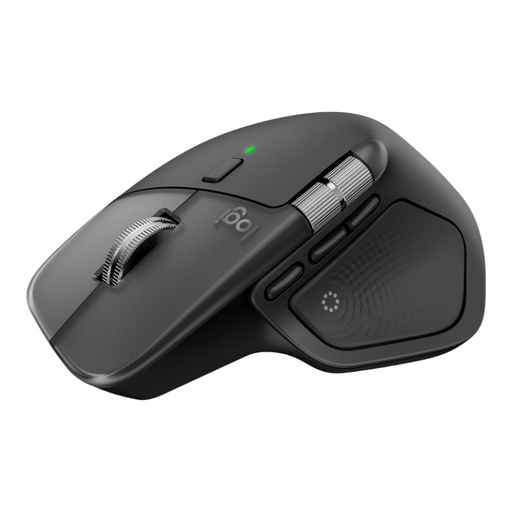 Image unavailable
The thumb wheel is designed for horizontal scrolling through wide spreadsheets; MagSpeed also offers free-spin and ratchet modes.
The product description lists Bluetooth or a Logi Bolt USB-C receiver. According to Logitech, Logi Options+ is required for the MX Master 4’s customisable features.
 Image unavailable
The vertical shape may suit you if you want to try a different hand position; this version is for right-handed use.
The product description lists a detachable wrist rest and connection via Bluetooth or an HP receiver.
 Image unavailable
This vertical mouse may suit you if you want to adjust the cursor speed; this version is for right-handed use.
The specifications list a 57-degree angle, an adjustable 4000-DPI sensor and a cursor-speed switch. Connect via Bluetooth or 2.4 GHz using a Unifying USB receiver.
 Image unavailable
The vertical shape and adjustable cursor speed may suit you if you use a fixed workstation with a USB connection; this version is for right-handed use.
The stated DPI settings range from 800 to 2400. The mouse has a wired USB connection.
 Image unavailable
The vertical shape is designed for small to medium hands; this version is for right-handed use.
The product description lists SmartWheel scrolling and connection via Bluetooth or a USB receiver.
No, don’t choose based on DPI alone. Test whether you can set the cursor speed comfortably on your screen, then try selecting points in your own software; the stated DPI isn’t a test of how well you can plot.
Choose a Bluetooth version if your computer supports that connection, or check in advance which receiver and port you’ll need. According to Kensington, the Kensington Expert Mouse Wireless offers Bluetooth LE or a USB nano receiver; the CHERRY MC 2000 uses USB-A.
Don’t assume so: a different mouse shape is no substitute for varying your activities or setting up your workstation properly. Arboportaal recommends varying your activities and taking microbreaks when working at a screen; if discomfort persists, consider discussing it with an appropriate healthcare or workplace professional.
Check the stated hand size and whether the model is for left- or right-handed use. The Logitech Lift is described as suitable for small to medium hands and is available in separate handed versions; check which version you’re looking at when considering a specific model.
No. According to the Dutch government, the Netherlands has no fixed statutory guarantee period; you can expect a product to work properly for a reasonable time. An additional guarantee is on top of your existing rights.