
Desk worker with barely any room for a mouse
You have little space alongside your keyboard and data to move a mouse around, so you’re considering a stationary pointing device.


A stationary trackball is a good fit if there’s barely room on your small desk to move a mouse around. Choose a compact conventional mouse if you can make short movements and prefer a familiar way of working. When selecting data points, adjust the cursor speed to suit your software, and consider hand fit and connectivity rather than looking only at the maximum DPI. A vertical mouse is an alternative if you’re looking for a different hand position, but it still needs room to move.
You have little space alongside your keyboard and data to move a mouse around, so you’re considering a stationary pointing device.
You select points or cells in weather data series and want to tailor pointer speed and scrolling to your work. Microsoft explains how to adjust pointer and scroll speed; Logitech lists different scroll modes for the MX Anywhere 3S.
You use a mouse for extended periods and want to compare how different shapes fit your hand and affect your posture. A particular mouse shape doesn’t guarantee that you’ll avoid discomfort.
First, measure how much room you actually have to move a mouse. Then compare the controls, hand fit and connectivity with the way you point to data and scroll through weather data series.
| Consideration | What to look for when buying | Who will find this most important? |
|---|---|---|
| Room to move | Measure the clear space beside your keyboard. A trackball stays in place; a compact mouse still needs room to move. | If I have barely any room left on my desk, I want to move the cursor without shifting the mouse. Around 36% of consumers put room to move first. |
| Pointing and scrolling | Check whether you can adjust the cursor speed and whether the scroll mechanism works well with your charting or spreadsheet software. | When selecting data points, I want to control the pointer precisely and move quickly through long data series. Around 29% of consumers prioritise chart controls. |
| Hand fit | Consider your hand preference and the fit; try the grip if possible. A vertical mouse still needs to move across the desk. | If I work for extended periods, I mainly want a grip and hand position that suit me. Around 21% of consumers put hand fit and posture first. |
| Connectivity and use | Check your computer’s ports, what’s included in the box, and whether you’ll need a receiver, cable or battery. | When I want to connect the mouse to my computer, I need to know which connection and power options my workspace can support. Around 14% of consumers put connectivity and use first. |
Even a compact conventional mouse needs a clear surface so you can move the cursor.
Measure the space beside your keyboard and compare it with the movements you can make. Also consider whether a stationary trackball would suit your hand.
A high maximum DPI figure doesn’t, by itself, tell you how comfortable it is to point to data points. The settings and the type of task matter too.
Check whether you can adjust the pointer speed, and try both pointing and scrolling in the software you use.
Logitech states that the compatible Logi Bolt receiver isn’t included with the standard MX Anywhere 3S.
Check the box contents and connectivity for the exact version. Consider any extra warranty separately from your statutory rights.
Logitech offers a stationary trackball as well as compact and vertical mice for this type of setup.
The Orbit Trackball with Scroll Ring K72337EU is a wired, stationary and ambidextrous option.
The Trust Yvi+ is a compact conventional mouse for anyone considering a wireless connection and switching between devices.
The Dell MS7421W is a compact mouse with several DPI settings and a rechargeable battery.
This Joybuy selection includes mice that need to be moved, including vertical models. If you have barely any room to move a mouse, you could also consider a stationary trackball.
 Image unavailable
Suitable if you want a vertical grip and adjustable pointer speed; the mouse still needs room to move the cursor.
The product name lists 2.4GHz wireless and 800–1600 DPI; the description lists settings of 800, 1200 and 1600 DPI.
 Image unavailable
Suitable if you want adjustable DPI settings and several connectivity options; as a conventional mouse, this model needs room to move.
The product name lists 26K DPI, 2.4G, USB-C and Bluetooth, a 400 mAh battery and a magnetic base.
The product warning says to keep the magnetic charging base away from pacemakers, medical implants, and payment or identity cards.
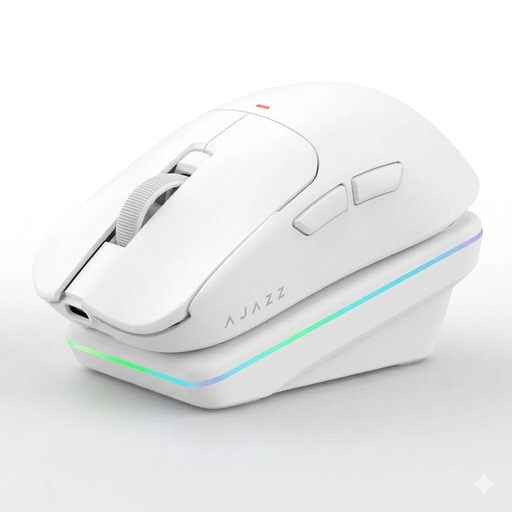 Image unavailable
Suitable if you want a mouse with several connectivity options and adjustable DPI; it needs room to move across the desk.
The product name lists Bluetooth, 2.4GHz and USB-C, up to 24,000 DPI and a weight of 63 g.
 Image unavailable
Suitable if you’re considering a vertical grip for the right hand and a detachable wrist rest; the mouse still needs room to move.
The product description lists connections to up to three devices via Bluetooth or a dongle.
 Image unavailable
Suitable if you’re looking for a wired vertical mouse for the right hand; allow room for both the mouse and the cable.
The product description lists 800–2400 DPI and two thumb buttons.
No, it shouldn’t be your only buying consideration. Choose a mouse whose pointer speed you can adjust to suit you, and try it with the software you use. Windows also lets you adjust pointer speed; maximum DPI isn’t a measure of your accuracy.
If the movement becomes stiff or jerky, clean the ball and socket according to the instructions for your model. Kensington explains that dirt build-up can interfere with a trackball’s movement.
It depends on the version and your computer. Logitech says the compatible Logi Bolt receiver isn’t included with the standard MX Anywhere 3S; Bluetooth is another way to connect. Before buying, check what’s in the box, the available ports and the power requirements.
For eligible online distance purchases, you’ll often have a 14-day cooling-off period, according to the Dutch government. It also states that there’s no fixed statutory warranty period in the Netherlands; if a product is faulty, the seller must offer an appropriate solution. So consider any extra warranty as additional to your statutory rights.
Take a flat battery to a collection point, such as a shop or supermarket that sells batteries. The Dutch government advises against putting batteries in your general waste.