At a small desk, start by choosing between a compact mouse, which you can put away but need to move while using, and a trackball, which stays in place. If you work for long stretches, consider how the mouse fits your hand and your posture, rather than focusing on size alone. Also check the connection, scrolling behaviour and power supply.
Which type of mouse is right for you?
If you have very little room for a mouse
Do you keep your teaching materials next to your computer and want to control the pointer without moving your papers? A compact mouse and a stationary trackball offer different ways to make the most of limited space.
If you work on handouts for long periods
During longer sessions working with documents, a comfortable fit and a practical scroll wheel may matter more than choosing the smallest possible mouse.
If you share a workspace
If you want quieter clicks or need to switch between devices, consider the click noise, connection options and any cables or receivers on your desk.
What should you consider when choosing?
Compact wireless mouse
Best for: limited desk space and a mouse you want to put away between uses.
Keep in mind: compact doesn’t necessarily mean comfortable for long sessions. Check the connection and power supply, too.
Vertical mouse
Best for: anyone who wants to try a different hand position when working with documents for long periods.
Keep in mind: a vertical shape doesn’t guarantee relief from discomfort, and it won’t necessarily take up less desk space.
Stationary trackball
Best for: desks where there’s little room to move a conventional mouse.
Keep in mind: you control the pointer differently from a conventional mouse. Check whether using your thumb or fingers feels right for you.
| What to consider |
What to look for |
Who is this important for? |
| Room to move the mouse on your desk |
Compare how much room you need to move the mouse, not just its dimensions. With a trackball, try using your thumb or fingers to see whether it feels comfortable. |
If I put papers next to my computer, I want enough room to move my mouse. That’s why around 40% of consumers make desk space their top priority. |
| Fit and working posture |
Check the hand size the mouse is suited to and whether it’s designed for left- or right-handed use. Also consider arm support and varying your activities. |
For long sessions, I want a hand position and mouse size that suit me. Around 30% of consumers prioritise fit and working posture. |
| Connection and switching between devices |
Check whether your computer supports Bluetooth and whether the mouse uses a USB receiver. Check each model to see if it can switch between devices. |
If I use several devices or want to keep a USB port free, I check the connection options. Around 20% of consumers make connection and device switching their main consideration. |
| Click noise |
Check whether the specific version you’re considering has quiet buttons; quiet doesn’t mean clicks are completely inaudible. |
In a shared workspace, I want to minimise the noise I make when clicking. Around 10% of consumers prioritise quieter clicks. |
Common mistakes
-
Looking only at the mouse’s dimensions
You still need room to move a conventional compact mouse while controlling the pointer; a trackball stays in place.
Measure how much clear space you have next to your teaching materials, then compare the two ways of controlling the pointer.
-
Assuming a vertical mouse will solve discomfort
Fit, how long you work and the way your workspace is set up all matter. A product’s comfort claim doesn’t tell you what your personal experience will be.
Check that the mouse suits your hand size and that you’ve chosen the right left- or right-handed version. Take regular breaks from screen work, and don’t base a purchase solely on the mouse’s shape if discomfort persists.
-
Forgetting about the receiver or power supply
A USB receiver takes up a port, Bluetooth requires your computer to support it, and wireless models can differ in how they’re powered.
Check the connection options, what’s included in the box, and whether the model uses batteries or is rechargeable.
Battery-powered models may need replacement batteries.
Brands to consider
Logitech
The models mentioned range from compact Pebble and MX Anywhere mice to the vertical Lift and stationary ERGO M575 trackball.
- According to Logitech, the Pebble Mouse 2 M350s has quiet clicks and device switching, while the MX Anywhere 3S has a two-mode scroll wheel.
- The Lift is available in separate versions for different hands. These models’ features don’t mean that every Logitech mouse has the same fit or functions.
Trust
The Yvi+ is a compact wireless option, while the TM-101 is a wired mouse.
- According to Trust, the Yvi+ combines quiet buttons with Bluetooth and a 2.4GHz receiver.
- Trust says the Yvi+ uses a battery. The wired TM-101 needs room for its cable; these features apply to individual models.
Kensington
The Orbit Optical Trackball is a stationary, wired option for desks with little room to move a mouse.
- Kensington describes this model as symmetrical and designed to control the pointer without moving the device.
- The model has a USB cable. Whether it fits your hand and how easily you adapt to using a trackball are personal considerations.
HP
The HP 280 Silent Wireless Mouse is a conventional wireless office option for anyone looking for quiet clicks.
- HP states that this model has quiet clicks and a battery life of up to 18 months; this is the manufacturer’s claim.
- Check that the connection on the version you choose is compatible with your computer.
Mouse options at Joybuy
This selection includes a stationary trackball, vertical mice and compact wireless mice for working at a small desk.
 No image available
Logitech ERGO M575S - Graphite
The trackball stays in place, making it a good option if you have little room to move a mouse.
You control the pointer with your thumb. The listed connection options are Bluetooth and a Logi Bolt receiver; this version is designed for right-handed use.
View at Joybuy
 No image available
HP 925 Ergonomic Vertical Mouse
This vertical mouse is suited to anyone who wants to try a different hand position when working at a computer. You’ll still need room to move it across your desk.
The description says it can connect to up to three devices via Bluetooth or a receiver. This version is designed for right-handed use.
View at Joybuy
 No image available
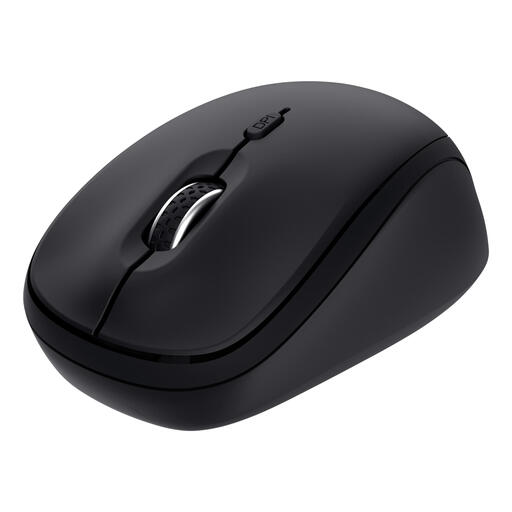
Trust Yvi+ wireless multi-device mouse
This compact mouse is a good option if you want to put it away between uses; you’ll still need room to move it while using it.
The description mentions quiet buttons and connection to up to three devices via a receiver or Bluetooth. The mouse uses an AA battery.
View at Joybuy
 No image available
Logitech Lift Vertical Ergonomic Mouse Graphite
This vertical mouse is designed for small to medium-sized right hands. Check that it feels comfortable for you.
The description lists Bluetooth or a USB receiver, quiet clicks and SmartWheel. You’ll need room to move the mouse across your desk while using it.
View at Joybuy
 No image available
Trust Bayo II vertical wired mouse, black
This vertical mouse offers a different hand position, but, like a conventional mouse, it needs room to move.
The description lists a 57-degree angle, adjustable DPI and a USB cable. This version is designed for right-handed use.
View at Joybuy
Frequently asked questions
Do I need Bluetooth to use a wireless mouse?
Not always. Trust lists both Bluetooth and a 2.4GHz USB receiver for the Yvi+. Check which connections each model supports and what connection options or Bluetooth support your computer has.
How should I set up my workspace if I’m working on a handout for a long time?
Take regular breaks from screen work to do something else or have a rest. Arboportaal recommends this for screen work; workplace regulations for employees don’t determine which type of mouse a consumer should buy.
What should I do with flat mouse batteries or a mouse I no longer need?
Take flat batteries to a collection point; according to the Rijksoverheid, they shouldn’t go in the bin. When you buy a new, similar electrical device, you can return the old one to the shop under the old-for-new scheme.
What are my rights when I buy a mouse online?
For online consumer purchases from a business, a 14-day cooling-off period applies in many cases, according to the Rijksoverheid. The Netherlands has no fixed statutory guarantee period, so check the terms that apply to your order.


