
Vandaag of morgen in huis

Kwaliteit gegarandeerd

Welkomstaanbiedingen ontgrendelen: GRATIS bezorging | Tot 80% korting | Gratis 30 dagen JoyPlus-proefperiode
Download de app
A light that only comes on when someone walks past is useful by the front door, garage, driveway or in the back garden. However, not every piece of outdoor lighting with a motion sensor is suitable for every location. For example, a high light output tells you little if the solar panel is positioned in the shade. And a light with a “waterproof” appearance may still be too lightly constructed for an exposed exterior wall.
Before buying, look out for these common pitfalls:
Light output is measured in lumens. For a small entrance or balcony, a compact LED light of around 300 to 500 lumens may be enough. For a driveway, garage or large patio, models with 1,000 lumens or more are more practical.
Colour temperature is measured in Kelvin (K):
Also pay attention to the detection angle. A light with several adjustable heads can cover a larger area than a fixed wall light. The stated sensor distance is a product specification; actual detection also depends on the direction of movement, mounting height and ambient temperature.
The IP rating consists of two digits. The first indicates protection against solid particles, while the second refers to water protection.
Also check the installation instructions. Even a waterproof outdoor light can be affected by incorrectly fitted seals, open charging ports or an unstable mounting.
A solar-powered light with a motion sensor does not require a fixed electrical connection. This makes installation easier, but operating time depends on hours of sunlight, panel direction, the season and battery capacity. Clean the solar panel regularly with a soft cloth and position it in direct sunlight as much as possible.
A USB-rechargeable model is more flexible for a balcony, storage area or indoor space. When choosing one, check:
A suitable wiring diagram is required for a fixed electrical installation. If you are unsure about wiring or mains voltage, it is best to have the installation carried out in accordance with the instructions.
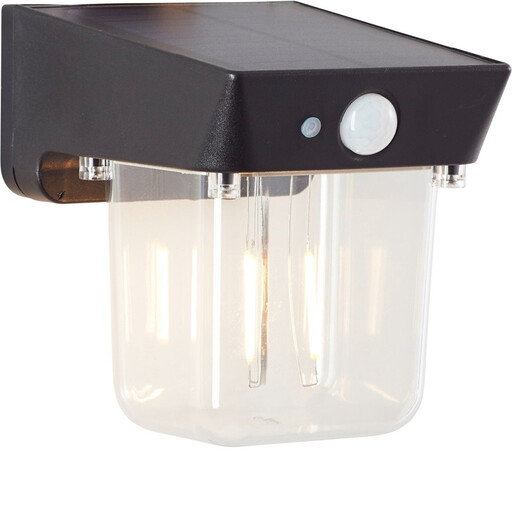
Why it suits this profile: This compact solar outdoor light is designed for an exterior wall, balcony, garden or entrance where no wiring is available. Its 180-lumen output and warm 2700 K light colour are well suited to accent and orientation lighting.
The specifications clearly state the light output, IP44 rating and integrated battery. This makes it clear in advance that the model is mainly intended for sheltered locations rather than exposure to heavy water.
Solar-powered, with a motion sensor and dimmable lighting without a fixed power cable.

Why it suits this profile: With 4000 lumens, an IP65 rating and an adjustable light head, this model is designed for larger outdoor areas such as a driveway, garage or broad section of garden.
The combination of IP65, a stated detection range and two lighting modes makes the intended use clearer than a general claim of weather resistance.
4000 lumens, IP65, a dusk sensor and a sensor range of up to 8 metres with direct approach, according to the product information.

Why it suits this profile: The three light heads and broad coverage are designed for a large garden, driveway, patio or garage area where several directions need to be illuminated at the same time.
The stated IP65 rating, 270° light coverage and three modes provide more guidance for positioning than a high lumen value alone.
302 LEDs, 3000 lumens, a sensor range of 60 feet according to the product information, and three adjustable light heads.
Not every lighting requirement is outdoors. For a dark kitchen cupboard, wardrobe, storage area or under-stairs cupboard, rechargeable cupboard lighting is often more practical than a solar outdoor light. An LED cupboard light with a motion sensor runs on an internal battery and can be fitted without drilling.
The 30 cm version in the two-piece set has 41 LEDs, a PIR range of 3 to 5 metres and three colour temperatures. The 40 cm version has 61 LEDs and the same adjustment options. Both models use a rechargeable 1100 mAh battery and charge via USB. Do not use these lights in a damp outdoor location: the product information states that they must be kept away from water and moisture.
We have put together a complete, up-to-date list of products that fully meet these strict selection criteria and the applicable European safety regulations.
Choose a location where the solar panel receives as much direct sunlight as possible during the day. Avoid shade from roof edges, trees and walls. Point the sensor towards the route people use and check that the light is not constantly detecting traffic or moving branches.
Operating time depends on the LED light source, battery, charging conditions and number of activations. With solar lighting, cloudy winter weather and shorter days also have an impact. An integrated LED is not automatically replaceable, so check the warranty and maintenance instructions before buying.
A solar light does not use mains electricity, but depends on stored solar energy. A rechargeable light uses electricity while charging. With fixed LED outdoor lighting, a motion sensor and short activation time limit the number of hours the light is on, but actual consumption still depends on wattage and usage.
