
Vandaag of morgen in huis

Kwaliteit gegarandeerd

Welkomstaanbiedingen ontgrendelen: GRATIS bezorging | Tot 80% korting | Gratis 30 dagen JoyPlus-proefperiode
Download de app
An outdoor light with a sensor sounds simple: detect movement, switch on the light. Yet many homeowners, tenants and garden owners in the Netherlands buy a model that is not suitable for the location or intended use. A light may have a high lumen output on paper, but be poorly positioned in practice. Similarly, “water-resistant” does not automatically mean that a fitting is suitable for an exposed exterior wall.
This guide helps you compare outdoor lighting with a motion sensor based on verifiable factors such as light output, detection range, IP rating, power source and installation. That way, you can avoid buying the wrong light for your entrance, patio, balcony, garden or driveway.
Lumens indicate the total amount of light produced by a lamp. Light distribution is at least as important. A compact LED outdoor light with 300 lumens may be sufficient by a front door, while a driveway or large garden may need more light and an adjustable light head.
Also pay attention to the colour temperature:
The IP code indicates how well a product is protected against solid particles and water. IP44 means protection against splashing water and is often suitable for sheltered or normally exposed outdoor locations. It does not mean that the light can be immersed in water or withstand direct jets of water.
For an exterior wall, garage or open driveway, IP65 may be more practical. Always check the installation instructions as well. Even a water-resistant outdoor light must be securely fitted and must not be placed under water.
A motion sensor does not respond in the same way in every situation. The stated range depends on the direction of movement, installation height, temperature and obstacles. A sensor will generally detect movement across the detection area more effectively than someone walking directly towards the light.
An overly sensitive sensor may also be triggered by passing cars, moving branches or pets. Check whether the sensor can be adjusted and whether several lighting modes are available.
For a front door or balcony, around 180 to 500 lumens is often suitable for orientation and ambience. A driveway, back garden or garage may benefit from a higher output. In addition to lumens, look at:
A motion-sensor light should not only be bright, but should illuminate the relevant area evenly.
Solar outdoor lighting uses a built-in battery that is charged via a solar panel during the day. No fixed electrical connection is needed, which is useful for a garden path, shed or rented property. However, the actual operating time depends on sunlight, the season, shade and battery capacity.
With a solar-powered outdoor light, the installation location is therefore more important than many buyers expect. Position the panel away from roof edges, trees and walls that create prolonged shade. Clean the panel regularly with a soft, damp cloth.
A fixed outdoor wall light with a motion sensor connected to 230 volts does not need time to charge in the sun, but it does require wiring. With models featuring an E27 fitting, you will also need to buy a suitable light source separately.
Check that the range in metres and the detection angle are clearly stated. A wide angle is useful for a driveway or garden path, while a shorter range may be sufficient beside a door. Install the light on a stable surface and do not point the sensor directly at a busy road.

Why it suits this profile: A wireless solar outdoor wall light for an entrance, balcony or small patio, with no connection to the mains required.
The product information states 1000 lumens, two lighting modes, a motion sensor and IP44 protection. However, check that the chosen location receives enough direct sunlight.
Solar power, integrated LED, 3000 K and installation without wiring.
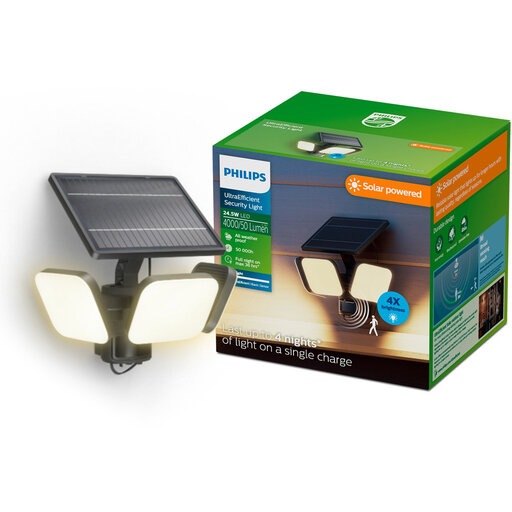
Why it suits this profile: For anyone looking for a broad, powerful beam to illuminate a larger driveway, exterior wall or back garden.
The stated specifications include 4000 lumens, IP65 protection and a detection range of 8 metres for direct approach and 16 metres for sideways movement. The light head is adjustable.
Solar power, two lighting modes, dusk sensor and a choice of 3000 K or 5000 K.

Why it suits this profile: Designed to provide broad-area lighting around a garage, driveway, patio or spacious garden.
The stated specifications include IP65 protection, three lighting modes, three adjustable heads, a detection angle of 180 degrees and a range of 60 feet.
3000 lumens, broad light coverage and solar power without fixed wiring.

Why it suits this profile: A compact, rechargeable light for anyone who does not want to drill holes or install permanent wiring.
The light uses a motion sensor and magnetic attachment. IP44 means protection against splashing water, so do not place it where it will be exposed to direct jets of water.
300 lumens, 3000 K, USB-C charging and a removable light with magnetic mounting.
We have compiled a complete, up-to-date list of products that fully meet these strict selection criteria and the applicable European safety regulations.
Position a solar outdoor wall light in a place that receives as much direct daylight as possible. Before drilling, check that the wall is suitable and use the supplied mounting materials. A fixed light connected to 230 volts should be installed by a qualified electrician.
Clean the solar panel and sensor opening regularly with a soft cloth. Do not use abrasive products. After a storm or frost, check that the fitting is still secure. An integrated LED light source cannot be replaced on many models, so check the warranty terms and product information in advance.
A solar outdoor light does not use electricity from the mains while it is illuminated. The battery charges during the day, and operating time varies depending on the model and weather conditions. A fixed LED light only uses energy when it switches on, but consumption depends on the wattage and operating time.
IP44 provides protection against splashing water and is suitable for many exterior walls, balconies and sheltered garden locations. For a light exposed to heavy rain, dust or changing weather conditions, IP65 may be a suitable choice. Neither rating means that the light can be immersed in water.
Mount the light on a stable wall, facing the route people use and not directly towards a busy road. Take the detection angle, installation height, shade and possible obstacles into account. With solar models, the panel must also receive enough direct sunlight.
