
Vandaag of morgen in huis

Kwaliteit gegarandeerd

Welkomstaanbiedingen ontgrendelen: GRATIS bezorging | Tot 80% korting | Gratis 30 dagen JoyPlus-proefperiode
Download de app
A light that only comes on when someone walks past is useful by the front door, on the drive, in the shed, garden or side passage. However, outdoor lighting with a motion sensor can be disappointing in practice. For example, a light may claim a high lumen output but distribute the light poorly. Or a solar outdoor light may barely charge because the panel is positioned in the shade during the day.
So don’t just focus on appearance or a low price. Pay particular attention to the sensor, protection against water and dust, light output and installation. Below, you’ll find the most important points to consider, along with some options for different uses.
Lumens indicate the total amount of light, but not how widely or evenly that light is distributed. A compact LED outdoor light with a high lumen output can create a bright spot while parts of the drive remain dark. So also look at:
Warm white light is often a better fit for creating ambience on a patio. Brighter light can be more practical for a drive or side path.
A solar-powered outdoor light doesn’t need a fixed mains connection, but the solar panel must receive enough direct light during the day. So don’t place a solar wall light beneath a canopy, balcony edge or dense tree if the panel receives very little sunlight there.
In winter and on overcast days, the operating time may be shorter. Clean the panel regularly with a soft, slightly damp cloth. Also check whether the light has different modes. A short activation when movement is detected generally uses less energy than continuous lighting.
The IP code indicates how well a product is protected against solid particles and water. An IP44 outdoor light is protected against splashing water and is mainly suitable for sheltered locations, such as a covered entrance or balcony. IP44 does not mean that the light can withstand direct jets of water or immersion.
An IP65 outdoor light offers a higher level of protection against dust and water jets. This classification is better suited to an exposed façade, garage, garden wall or drive that regularly gets rained on. Also always check the installation instructions and make sure that connections are properly sealed.
A sensor with a range of, for example, 8 metres isn’t automatically suitable for every situation. Actual detection depends on the direction of movement, mounting height and any obstacles. Someone walking directly towards the sensor may be detected at a different distance from someone walking past it sideways.
A wide angle is useful for a narrow entrance. For a long drive, a greater range or adjustable light head may be more important. Also check whether the activation time and sensitivity can be adjusted. This helps prevent unnecessary activation caused by pets or moving branches.
An integrated LED outdoor light usually doesn’t require a separate bulb. This makes installation easier, but the light source cannot be replaced by the user on many models. So check the stated lifespan, light output and warranty.
Make sure the product description clearly states the colour temperature. The term “warm white” can be used differently from one brand to another; the value in kelvin makes comparisons easier.
A solar outdoor light is generally suitable for installation without an electrician. A wired outdoor wall light running at 230 volts must be connected by a qualified electrician in accordance with the product specifications. A light with a USB-rechargeable battery offers different flexibility, but will need to be recharged periodically.
Before installation, check:
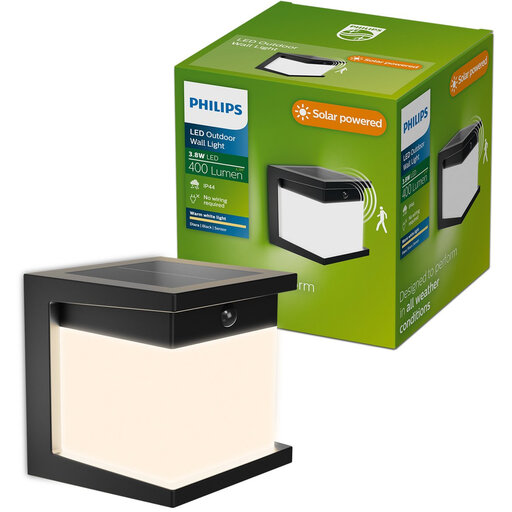
Why it suits this profile: This compact solar wall light works without wiring and has two light modes, a motion sensor and 400 lumens at 2700 K.
The product specifications clearly state the light output, colour temperature and IP44 classification. However, install the light in a sheltered position with sufficient sunlight.
Solar power, integrated LED, two modes, 400 lm and a compact size of 12 × 11 × 12 cm.

Why it suits this profile: For a drive, broad façade or large patio, this solar model offers a high stated light output and an adjustable light head.
The specifications state the sensor range separately: 8 metres for direct approach and 16 metres for sideways approach. This makes comparisons easier.
4000 lm, IP65, 5000 K, adjustable head and a stated battery life of up to four nights after a full charge.

Why it suits this profile: This model is designed to provide broad illumination for a garden, garage, patio or drive, thanks to its three adjustable light heads.
Alongside the light output, the lamp states a 180° detection angle, a range of 60 feet and three light modes. Before buying, check which units are most practical for you locally.
302 LEDs, a stated 3000 lm, three heads, a 270° adjustment range and IP65 protection.
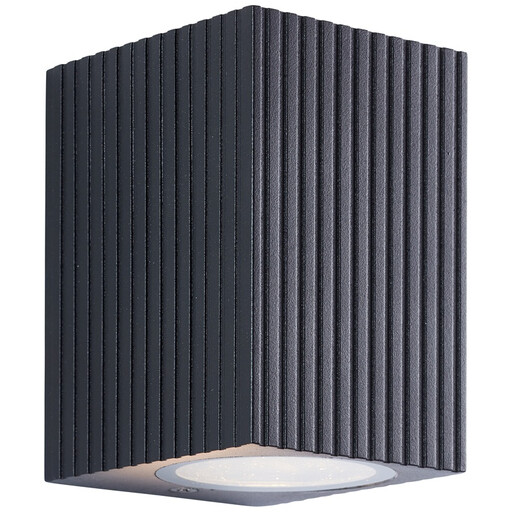
Why it suits this profile: This wired outdoor wall light is ideal if you want to choose your own GU10 LED bulb for an entrance, patio or sheltered façade.
The light is supplied without a bulb. This means you can choose the light colour and type of LED bulb yourself, but professional installation should be taken into account.
GU10 fitting up to 10 W, aluminium/plastic/glass housing and IP44 for sheltered outdoor locations.
We’ve compiled a complete, up-to-date list of products that fully meet these strict selection criteria and the applicable European safety regulations.
Yes, but placement and IP classification are crucial. A solar wall light with IP44 is suitable for splashing water and sheltered locations. For a completely exposed wall or a location that receives a lot of rain, an IP65 model is the more sensible choice. During dark winter periods, the operating time may decrease because the panel stores less energy.
Always follow the model’s installation instructions. In practice, stable mounting is more important than a fixed universal height. Hang the light so that the sensor has a clear view of the route, without being constantly triggered by traffic, moving branches or pets. After installation, test the detection angle and activation time.
A solar outdoor light doesn’t use mains electricity. A wired LED outdoor light mainly uses energy while it is switched on. A motion sensor limits the lighting time by only activating the light when movement is detected. Before choosing, compare the stated wattage, lighting duration per activation and any standby information.
