
Vandaag of morgen in huis

Kwaliteit gegarandeerd

Welkomstaanbiedingen ontgrendelen: GRATIS bezorging | Tot 80% korting | Gratis 30 dagen JoyPlus-proefperiode
Download de app
A light that only comes on when someone walks past is practical for a driveway, entrance, garage, garden or back door. However, not every outdoor light with a motion sensor is suitable for every situation. A high light output, for example, says little about the quality of the sensor, while a product labelled “waterproof” is not automatically resistant to direct water jets.
As a Joybuy Product Recommendation Officer, I therefore focus mainly on verifiable specifications: brightness, ingress protection, power supply, detection range and installation. This helps you avoid situations where a solar outdoor light provides very little light after a few overcast days, or where a wall light repeatedly switches on unnecessarily because it is installed in the wrong place.
Lumens indicate how much light a lamp produces according to its product specification. For a balcony or path, 300 to 500 lumens may be sufficient. For a wide driveway or security light, more light is more practical. However, a 4000-lumen lamp may feel harsh and uncomfortable on a small patio.
Also consider the colour temperature:
Calling an outdoor light waterproof is too vague. Check the IP rating shown for the product:
Neither classification means that you can place the light underwater. Also check that the installation location does not allow water to collect.
A motion sensor does not work in exactly the same way everywhere. Detection depends on the angle, distance, direction of movement and height at which you install the light. A sensor that detects movement directly in front of it may respond differently when someone walks past from the side.
Therefore, check:
A solar-powered light does not require permanent wiring and can be useful for a rented property, garden shed or location without a power point. However, its performance depends on the amount of direct daylight available. Do not therefore position the solar panel permanently beneath a canopy, tree or balcony edge.
An electric outdoor light with a motion sensor works independently of sunlight, but it must be connected correctly to the mains. For a fixed 230V wall light, such as some models with an E27 fitting, installation by a qualified installer is required.
Integrated LED lighting generally has a low stated wattage and does not need a separate bulb. However, check whether the LED light source is replaceable. This is often not possible with integrated LEDs.
For a practical choice, you can use the following as a guide:
These ranges are guidelines. The final light distribution is also affected by the beam angle, installation height and shielding.

Why it suits this profile: This compact solar wall light is suitable for an entrance, balcony or small patio where no wiring is available. The light has two modes, a motion sensor and a stated output of 400 lumens per light point.
The product specification clearly states IP44 and 400 lumens. This allows you to match the light more realistically to a sheltered outdoor location rather than relying solely on marketing terms.
Solar power, integrated LED, warm white light at 2700K and two modes.
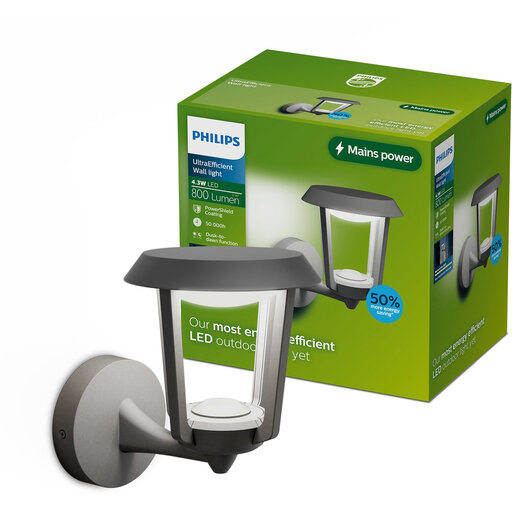
Why it suits this profile: This fixed LED wall light is suitable for a façade, balcony or garden where a 230V connection is available. The combination of aluminium, integrated LED and a stated output of 800 lumens is designed to provide both practical and atmospheric lighting.
The IP44 classification makes it clear that this light is splash-resistant, but not suitable for immersion or direct water jets. The product specification also states 4.3 W and 800 lumens.
Aluminium housing, integrated LED, 2700K warm white light and a stated lifespan of 50,000 operating hours.

Why it suits this profile: For a wide driveway, garage, garden or commercial site, the combination of three adjustable light heads, 3000 lumens and a stated detection distance of 60 feet is particularly useful. According to the product information, the light offers a detection angle of 180 degrees.
The stated IP65 classification is more specific than simply describing the product as “waterproof”. Positioning remains important: this light must not be immersed either.
302 LEDs, three light modes, 3000 lumens, IP65 and three adjustable light heads.
We have put together a complete, up-to-date list of products that fully meet these strict selection criteria and the applicable European safety regulations.
Mount the light on a stable wall and use the fixings according to the instructions. With solar outdoor lighting, the panel should receive as much direct sunlight as possible. Also check that the sensor is not pointed directly at a busy road, moving branches or a reflective surface.
Clean the solar panel and sensor window regularly with a soft, slightly damp cloth. Do not use abrasive products. If the light has a built-in lithium-ion battery, do not open or modify the battery yourself. After stormy weather, check that the fixings are still secure.
A solar outdoor light does not use mains electricity, but its battery must be charged by sunlight during the day. With an electric LED light, consumption depends on the wattage and operating time. A sensor can limit the number of hours the light is on, but exact consumption varies by model and setting.
IP44 is suitable for splashing water and general outdoor locations, for example beneath an overhang or on a sheltered façade. For a completely exposed location with heavy rain and dust, IP65 provides a higher level of protection according to the classification. Neither rating makes a light suitable for immersion.
The operating time per night depends on sunlight, battery capacity, temperature, light mode and sensor activity. Manufacturers may state a lifespan for the LED, but this is not the same as a guarantee of the same light output throughout that entire period. Cleaning and a sunny installation location help you make better use of the available charging capacity.
