
Vandaag of morgen in huis

Kwaliteit gegarandeerd

Welkomstaanbiedingen ontgrendelen: GRATIS bezorging | Tot 80% korting | Gratis 30 dagen JoyPlus-proefperiode
Download de app
An outdoor light with a motion sensor may seem straightforward to choose, until you discover how much the different models vary. A solar outdoor light may work well in one location, but barely charge on a shady wall. A high lumen output does not automatically mean that the light will be comfortable for an entrance or balcony either.
As a Joybuy Product Recommendation Officer, I mainly filter products by verifiable features: light output, colour temperature, IP rating, power supply and installation. This helps you avoid paying for features that are not suited to your garden, wall, patio or shed.
A solar-powered outdoor light needs direct daylight to charge its battery. If you install the light under a canopy, behind a high fence or on a north-facing wall, its operating time may be disappointing. Cloudy weather and short winter days also affect charging performance.
Before buying, check where the solar panel will be positioned. Wireless outdoor lighting without a connecting cable is convenient, but it is not completely independent of the installation conditions.
A light with 4,000 lumens is intended to provide powerful illumination over a larger area. For a front door, balcony or footpath, 300 to 1,000 lumens may be more practical. Light that is too bright can be disruptive for residents and neighbours, particularly when the sensor is triggered frequently.
Also consider the colour temperature. 2,700 to 3,000 K produces warm white light for a welcoming outdoor wall light. 5,000 K looks cooler and brighter, making it more suitable for a driveway, shed or location where you want to illuminate a large area.
An IP44 outdoor light is protected against solid particles larger than 1 millimetre and splashing water from various directions. This makes the rating suitable for many sheltered walls, entrances, balconies and patios. IP44 does not mean that the light can be submerged or withstand powerful jets of water.
An IP65 outdoor light offers greater protection against dust and water jets. However, an IP65 model must not be submerged either. Also check the installation instructions and avoid positioning the light where rainwater could remain in the housing for a prolonged period.
Lumens indicate the total amount of light produced. For finding your way by a door, around 180 to 500 lumens is often sufficient. For a larger garden, driveway or wall, 800 to 1,000 lumens may be more appropriate. Models such as the Philips Zyren are specified as producing up to 4,000 lumens, making them more suitable for powerful area lighting.
Also check the sensor range and detection direction. According to Philips’ own product information, the Philips Zyren has a range of up to 8 metres when approached directly and 16 metres when approached from the side. In practice, the results depend on the installation height, temperature and obstacles.
A solar wall light does not require fixed wiring. This is useful for rented homes, garden paths and locations without a power point. However, the battery must be able to charge sufficiently. Clean the panel regularly with a soft cloth and keep it free from leaves and dirt.
A fixed LED outdoor light connected to 230 volts works independently of sunlight, but must be connected by a qualified installer. A battery- or USB-powered model is flexible, but needs to be recharged regularly.
Check that the wall is stable enough and that the supplied fixings are suitable for the surface. Pay attention to the dimensions if you have a narrow wall, balcony wall or shed. A compact light measuring approximately 10 to 15 centimetres is discreet; a larger outdoor wall light will generally spread more light.
With integrated LED lighting, you usually cannot replace the light source yourself. This keeps maintenance to a minimum, but it also means that the entire fitting must be replaced if it develops a fault. A fitting with an E27 socket, on the other hand, allows you to choose a suitable light source yourself.
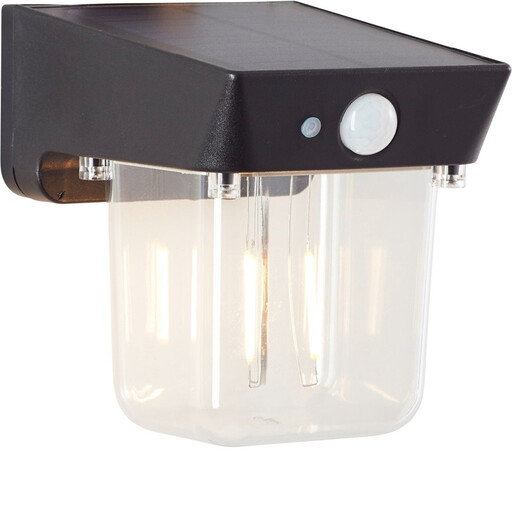
Why it suits this profile: This compact solar wall light is designed for an entrance, garden path or patio where no wiring is available.
The specifications clearly state 180 lumens, 2 W, IP44 and an integrated battery. This makes it less suitable for a large area, but well suited to targeted orientation lighting.
Solar power, motion sensor, dimming function and a compact size of 11.5 × 10 × 11 cm.
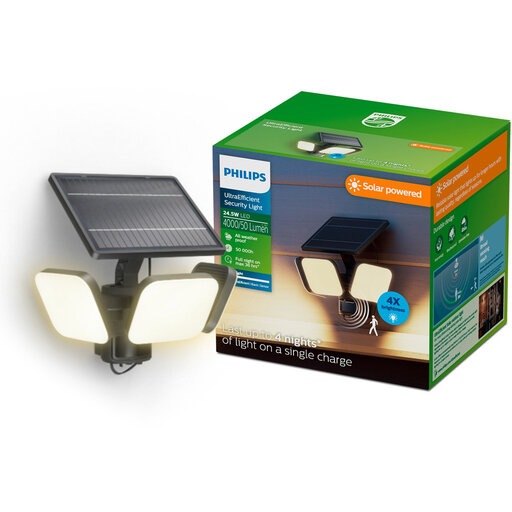
Why it suits this profile: This model is suitable for anyone wanting to illuminate a large area around a driveway, shed or wall with powerful outdoor lighting with a sensor.
The IP65 rating is higher than IP44, and the product information states that the light head is adjustable. However, check that 4,000 lumens will not be too bright for your location.
4,000 lumens, IP65, motion and dusk sensors and, according to Philips’ own product information, up to four nights of lighting after a full charge.

Why it suits this profile: For an entrance, driveway or shed where more light is needed than a small atmospheric lamp can provide, without a fixed connection.
The stated output of 1,000 lumens makes the light intensity clear. With IP44, positioning remains important: preferably choose a location that is not completely exposed.
1,000 lumens, 3,000 K warm white light, two light modes, motion sensor and solar power.
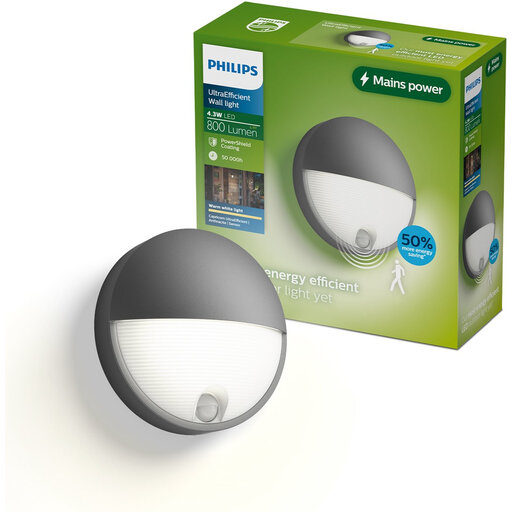
Why it suits this profile: This fixed outdoor wall light is suitable for homeowners who prefer a constant mains connection rather than relying on sunlight.
The product specification states 230 V, IP44 and integrated LED. Allow for professional installation and choose a sheltered mounting location.
800 lumens, 2,700 K warm white light, aluminium housing and motion and dusk sensors.
We have put together a complete, up-to-date list of products that fully meet these strict selection criteria and the applicable European safety regulations.
This depends on the sensor range and the desired detection direction. Install the light according to the instructions and point the sensor towards the area where movement is expected. If it is mounted too high, nearby movement may not be detected as effectively.
A solar outdoor light does not use electricity from the mains during normal operation. Its internal battery is charged by the solar panel during the day. Performance depends on sunlight, the season, the direction of the panel, battery capacity and the selected light mode.
Lifespan varies depending on the model and operating conditions. Some product pages, for example, state 20,000, 25,000 or 50,000 operating hours. These are manufacturer specifications and do not guarantee an exact number of years. With integrated LED lighting, the light source usually cannot be replaced separately.
