
Vandaag of morgen in huis

Kwaliteit gegarandeerd

Welkomstaanbiedingen ontgrendelen: GRATIS bezorging | Tot 80% korting | Gratis 30 dagen JoyPlus-proefperiode
Download de app
A motion-sensor outdoor light may seem easy to choose, but the differences between models can be significant. A light may produce plenty of light on paper, while the sensor is positioned incorrectly. Terms such as “weather-resistant” are also sometimes used without clearly stating the product’s IP rating.
For an entrance, façade, balcony, patio, garden or driveway, three things are particularly important: the right light output, suitable protection against moisture and a mounting method that works for your home. Below, you can find out what to look for and which popular options suit different situations.
Lumens indicate how much light a lamp produces according to its product specification. However, this does not tell you everything about how practical it will be. A narrow beam can illuminate a driveway precisely, while a wide wall light may be better suited to an entrance or patio.
A small outdoor solar wall light with around 180 to 400 lumens is often suitable for orientation lighting. For a dark driveway or as a security light with a motion sensor, a higher light output may be more appropriate. For example, the Philips Zyren models specify 4000 lumens and a sensor range of 8 metres for direct approach and 16 metres for sideways movement. However, check whether the area actually needs this much light.
Always check the IP code. The first digit relates to protection against solid particles, while the second refers to moisture.
An IP rating does not automatically make a light suitable for every position. Follow the mounting instructions and position a solar outdoor light with a motion sensor so that the panel receives enough daylight.
Solar-powered garden lighting works without a permanent mains connection, but the battery must be able to charge during the day. A north-facing façade, a position beneath a balcony or a wall with heavy shade can limit the operating time. Charging conditions are also different in winter compared with sunnier months.
Choose a solar model if installing without wiring is important and sufficient direct light is available. Do you have a dark, covered location? A wired LED outdoor light or a rechargeable wireless outdoor light may be more practical.
Do not just check whether a sensor is included. Also look at:
A sensor that detects movement well from the side can be useful beside a garden path. For a front door, direct detection is often sufficient. Also consider the mounting height and avoid pointing the sensor directly at a busy road, so that the light does not switch on unnecessarily often.
Colour temperature is measured in kelvins:
The Philips Capricorn and Philips Nuvy specify 2700 K, while the Philips Fyns uses 3000 K. The Philips Zyren is available with 3000 K or 5000 K, depending on the version. A higher colour temperature does not automatically mean more light; for that, you need to look at the lumen output.
A wireless outdoor light or outdoor solar wall light is appealing for tenants and for locations without existing cabling. However, with wireless models, check how often the light needs charging and how it is mounted.
A fixed outdoor wall light with a motion sensor running on 230 volts usually requires a suitable connection. The product information for the Brilliant Todd states that installation must be carried out by a qualified electrician. Switch off the power before installation or maintenance, and never exceed the fitting’s maximum wattage.
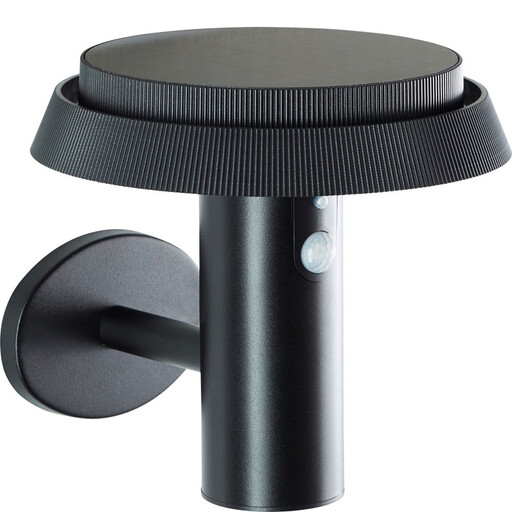
Why it suits this profile: This solar outdoor light with a motion sensor works without permanent wiring and is designed for façades, garden paths and entrances.
The product specification states 500 lumens, an integrated battery and IP44. This makes the light output, power supply and splash protection easier to assess than with a product described simply as “weather-resistant”.
Solar power, motion sensor, 500 lumens, 3000 K and dimensions of 21 × 20 × 18,2 cm.
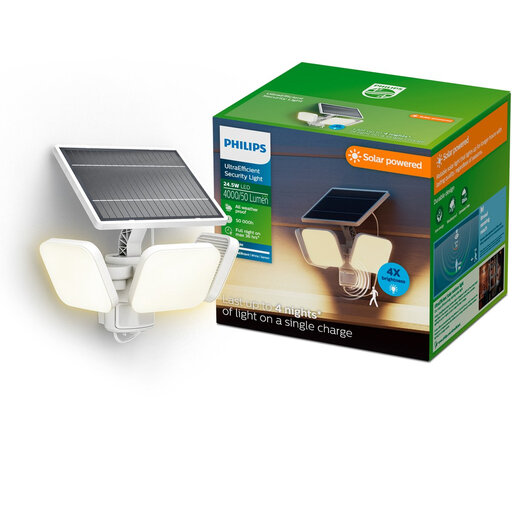
Why it suits this profile: This model is designed for larger outdoor areas where high light output, an adjustable light head and a wide sensor range are required.
The stated IP65 rating, 4000 lumens and sensor range make the key buying criteria easy to verify. The light does not depend on a fixed power cable.
4000 lumens, IP65, 3000 K, adjustable head and, according to the product information, up to four nights of lighting after a full charge.
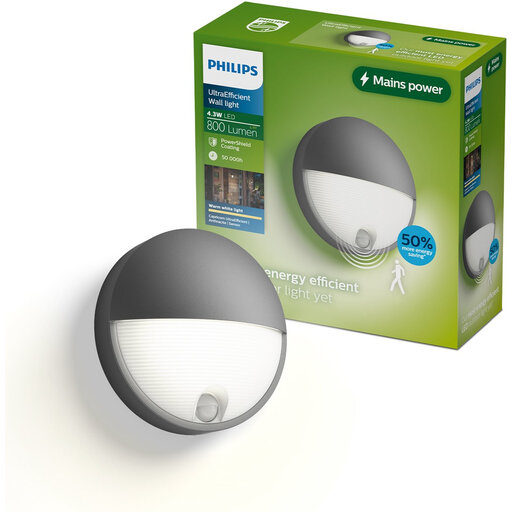
Why it suits this profile: A fixed wall light is ideal for homeowners who want a permanent solution for a façade, entrance or balcony and already have a power connection.
The product specification lists 800 lumens, 2700 K, IP44 and an integrated LED. This means you do not need to choose a separate bulb, but you do need to take wall mounting into account.
800 lumens, integrated LED, warm white light and a combination of motion and dusk sensors.
We have put together a complete, up-to-date list of products that fully meet these strict selection criteria and the applicable European safety regulations.
A solar outdoor light does not use mains electricity, but it does need sufficient sunlight to charge the battery. With a wired LED outdoor light, consumption depends on the wattage and how long the light remains on. A 4,3-watt light that switches on briefly when movement is detected will generally use less energy than a light that stays on continuously all evening.
The operating time per night depends on sunlight, battery capacity, light setting and the number of movements detected. Manufacturers sometimes state the expected LED lifespan or the number of nights the light can operate on a full charge. According to Philips’ own information, the Zyren can provide up to four nights of lighting after a full charge. Treat this as a product specification rather than a guarantee for every weather condition in the Netherlands.
An IP44 outdoor light is protected against splashing water and is suitable for many sheltered outdoor locations. For a completely exposed façade or a position subject to direct water jets, an IP65 outdoor light may be more suitable. Neither rating means that the light can be placed underwater.
