
Vandaag of morgen in huis

Kwaliteit gegarandeerd

Welkomstaanbiedingen ontgrendelen: GRATIS bezorging | Tot 80% korting | Gratis 30 dagen JoyPlus-proefperiode
Download de app
An outdoor light with a motion sensor can be useful by the front door, driveway, shed, balcony or in the garden. The light switches on when movement is detected, so you do not have to search for a switch every time. However, not every solar outdoor light is suitable for the same situation.
A short product title containing terms such as “powerful LED” or “security lighting” does not tell the whole story. Pay particular attention to moisture protection, how the light is charged and its actual light output. This helps you avoid buying a light that barely produces any illumination after a few dark days or turns out to be unsuitable for the place where you want to install it.
Lumens indicate how much light a lamp produces according to its product specifications. However, light distribution, mounting height and beam angle determine how useful that light is in practice. A 180-lumen light may be sufficient for a small balcony, but less suitable for a long driveway. For an entrance or exterior wall, 300 to 500 lumens may be practical. For broad security lighting for gardens and entrances, models with a higher light output are the more logical choice.
Also pay attention to the colour temperature. 2700 to 3000 K produces warm white light for a patio or front door. At around 5000 K, the light appears cooler and whiter, which may provide better visibility on a driveway or rear path.
An IP44 outdoor light is protected against splashing water from different directions, but not against a direct jet of water or immersion. Therefore, do not place this type of light where rainwater could remain in the housing for an extended period. For greater exposure to rain and dust, IP65 may be a more suitable specification.
Also check the mounting method. Wireless outdoor lighting with a magnet is flexible, but the surface must be flat, clean and sufficiently magnetic. A fixed wall light requires a stable wall and, with a 230V connection, installation by a qualified installer in accordance with the instructions.
With solar-powered outdoor lighting, positioning is crucial. A panel beneath a canopy, next to a high fence or in constant shade will charge less effectively. In winter, shorter days and cloudy weather can further reduce the operating time.
Therefore, check whether the light has an on/off or mode button, review the battery information and look at the type of sensor. A dusk sensor switches the light on based on the ambient light level, while a motion sensor responds to movement within its detection area. These functions can work together to save energy, but the exact settings vary by model.
Compare lumens, colour temperature and the shape of the light beam. Also check whether the detection range is given in metres and the direction in which it applies. A sensor may detect movement directly in front of the light differently from movement approaching from the side.
For a small entrance, a compact LED outdoor light with a sensor may be sufficient. For a driveway or wide exterior wall, a longer range, an adjustable head or a higher light output can be useful.
There are three practical options:
A light described as “wireless” in the product description may still need to be recharged regularly. So check whether a battery, cable or charging equipment is included.
The IP rating provides a practical indication of protection against solid particles and water. IP44 is suitable for many sheltered outdoor locations. IP65 offers a higher level of protection against dust and water jets according to the classification. Neither rating automatically makes a light suitable for immersion.
Also consider whether the light is made from aluminium, plastic or a combination of the two. The material alone does not determine how long a product will last; installation, maintenance and exposure to the weather also play a part. Clean the solar panel and light housing with a soft cloth and avoid abrasive products.

Why it suits this profile: This compact solar wall light is designed for a small entrance, balcony, patio or garden wall where no wiring is available.
The specifications state 180 lumens, 2700 K, solar power and IP44. This makes it clearer which smaller applications the light is intended for.
Integrated LED, motion sensor, dimming function and installation without a mains connection.
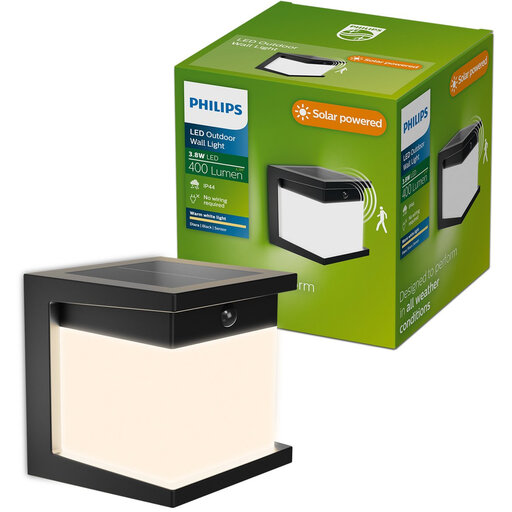
Why it suits this profile: A suitable choice for anyone looking for a smart outdoor wall light with a motion sensor for the garden, balcony or entrance.
The listed features are specific: 400 lumens, 2700 K, two light modes and IP44. Positioning in direct sunlight remains essential.
Solar power, integrated LED, motion sensor and a stated lifespan of 25,000 hours according to the product information.
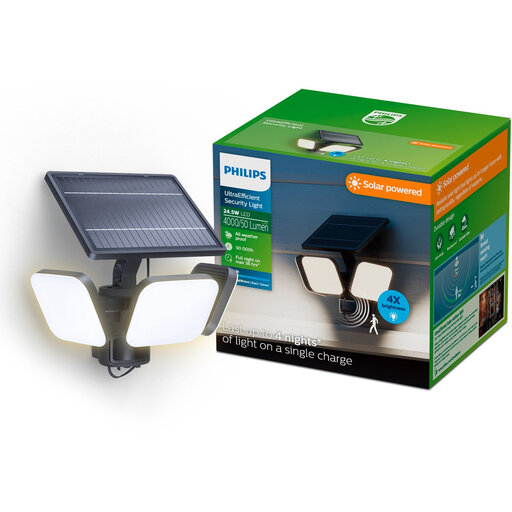
Why it suits this profile: For a wide driveway, rear path or exterior wall where high light output and a wide detection area are required.
The product specifies an IP65 rating and a range of 8 metres when approaching directly and 16 metres for movement from the side. However, check the installation location and exposure to sunlight.
4000 lumens, adjustable light head, solar power and two light modes according to the product description.

Why it suits this profile: This rechargeable light is useful when you do not want to drill or cannot use a fixed power connection.
The light uses a rechargeable battery and USB-C charging instead of relying on sunlight. IP44 does provide splash protection, but it does not mean the housing is waterproof.
300 lumens, 3000 K, motion sensor, magnetic mounting and an integrated 18650 lithium-ion battery according to the product specifications.
We have put together a complete, up-to-date list of products that fully meet these strict selection criteria and the applicable European safety regulations.
Yes, but its output may be lower because of shorter days, cloudy weather and the lower position of the sun. Position the panel as openly as possible towards direct daylight and keep it clean. When buying, check whether the light has a separate on/off button and different light modes.
Its lifespan depends on the type of LED, the battery, the weather and the number of times it is switched on. Manufacturers may state an estimated operating time or lifespan; according to Philips’ own information, some models are specified as providing a certain number of hours of illumination or several nights per full battery charge. Treat such figures as product specifications, not a guarantee for every usage scenario.
A solar outdoor light uses stored solar energy while it is on. A rechargeable model uses electricity when charging via USB. A fixed 230V outdoor light uses mains electricity and can therefore remain on standby continuously. So do not compare only the purchase price; also consider the required installation, charging frequency and desired operating time.
