
Vandaag of morgen in huis

Kwaliteit gegarandeerd

Welkomstaanbiedingen ontgrendelen: GRATIS bezorging | Tot 80% korting | Gratis 30 dagen JoyPlus-proefperiode
Download de app
A motion sensor night light can automatically illuminate a dark bedroom, hallway or toilet as soon as you get out of bed. However, not all models work the same way. Some only react when it’s already dark, while others stay on until you switch them off manually. Brightness, colour temperature and battery life are also not always listed in the same way.
So pay particular attention to these three common pitfalls:
Check whether the product only detects motion or also measures ambient brightness. A night light with a light sensor, for example, only switches on when it’s dark enough. Some models state a threshold value, such as ≤20 lux. This makes the operation more predictable in a bedroom, nursery or hallway.
A motion detection range of 3 to 5 metres is practical for a small hallway or a route beside the bed. Do pay attention to placement: furniture, doors and a covered sensor can affect detection. Position the light so that someone walks past the sensor rather than directly towards it.
For a night light for a bedroom or nursery, a low light output is often sufficient. Look at the value in lumens (lm). A model of 18 to 30 lm provides soft orientation lighting; 400 lm is more suitable for a larger cupboard, stairs, garage or dark storage room.
A dimmable night light offers more control. Five brightness levels are easier to use than just on and off. A memory function can save the last selected setting. This is practical when you always want to use the same soft setting.
Colour temperature also matters:
The term “warm white” doesn’t automatically mean the product is suitable for every room. Always compare the stated Kelvin value with your intended use.
A rechargeable night light works without a permanent connection. Check the battery capacity, charging time and stated usage duration. With daily use, a limited runtime could mean you need to charge it more often.
A plug-in model is immediately available as long as it’s in the socket. Check whether the wall socket is at a suitable height and whether the light blocks any other connection. For the bathroom and toilet, you also need to consider moisture. The product descriptions of the models below advise avoiding moisture and water; so don’t place them directly next to a sink, shower or bath.
ABS plastic and metal are used in several models. This says something about the construction, but not automatically about water resistance or impact resistance. So look for an explicit IP rating if you want to use lighting in a damp environment.
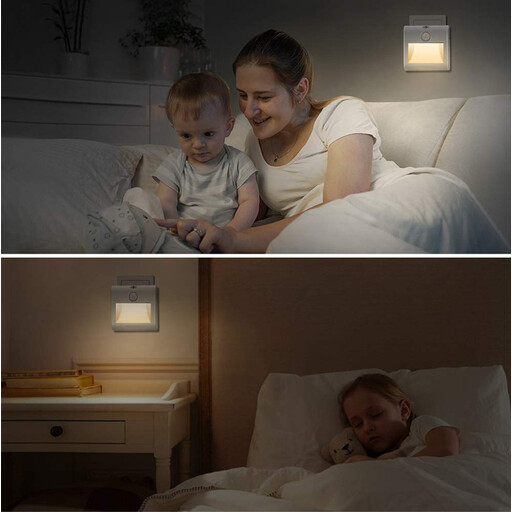
Why this fits the profile: The set of two can be used simultaneously as a night light for the bedroom, hallway or toilet. The combination of motion detection and constant lighting offers a simple start without any extra accessories.
The stated automatic mode activates at a maximum of 20 lux and has a motion detection range of 3-5 metres. This makes it clearer when the sensor is intended to react.
Two lights, 1 W power per light, stepless touch dimming and a memory function. The stated light output is 20 lm.

Why this fits the profile: This rechargeable night light is suitable when you don’t want to use a socket near the desired spot. The two colour temperatures and five brightness levels offer more adjustment options in the bedroom, nursery or hallway.
The 500 mAh battery capacity and a stated usage duration of up to 10 hours in sensor mode make maintenance more concrete than a product without runtime information.
USB charging at 5 V-1 A, 30 lm, three colour temperatures, five dimming levels and a motion detection range of 3-5 metres.
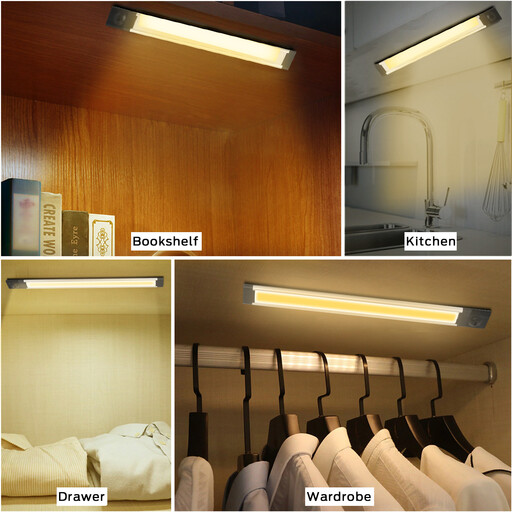
Why this fits the profile: With 400 lm, this model is aimed at situations where a small LED night light doesn’t provide enough light, for example in a long hallway, cupboard, stairs or storage room.
The wide adjustable colour temperature of 2800-6500 K prevents you from being limited to one light colour. The stated dimming function helps to adapt the high light output to the room.
36 SMD LEDs, USB charging, gesture control and mounting with magnets or hooks. Dimensions: 26 x 4 x 1 cm.
We’ve put together a full, up-to-date list of products that fully meet these strict selection criteria and comply with current European safety regulations.
Place the light on the walking route, for example next to the bed, near the stairs or opposite the door. Test the sensor at different distances and check that furniture doesn’t block the view. Only use a plug-in model in a dry, suitable location and keep ventilation openings clear.
That depends on the battery, brightness and number of activations. A model with a stated runtime of up to 10 hours in sensor mode gives a useful starting point, but the actual result may vary. So also check how often you use the light and whether USB charging is practical in your situation.
An LED night light generally uses very little power. The product specifications list values such as 0.5 W or 1 W. The actual consumption depends on the burn time and brightness setting. A motion or light sensor can limit unnecessary burning, while a light in constant mode uses power for longer.
