
Vandaag of morgen in huis

Kwaliteit gegarandeerd

Welkomstaanbiedingen ontgrendelen: GRATIS bezorging | Tot 80% korting | Gratis 30 dagen JoyPlus-proefperiode
Download de app
A motion sensor night light can be a handy addition to your bedroom, nursery, hallway, stairs or wardrobe. The light automatically turns on when you get up or walk past. However, sensor lights vary significantly in how they work, how they’re mounted and how bright they are. A low purchase price doesn’t always tell the full story.
Pay particular attention to these three common pitfalls:
A PIR motion sensor reacts to movement and can, for example, switch on within a range of 3 to 5 metres. A light sensor measures the amount of ambient light, often expressed in lux. A lamp that only turns on at a maximum of 20 lux is mainly intended for dark rooms.
For a night light in a bedroom, nursery or toilet, automatic activation in the dark is usually practical. For a wardrobe, a motion sensor may be more important, because you might need light there during the day too.
Also pay attention to the shut-off delay. Some models stay on for a few seconds, while other sensor lights remain active for longer. An adjustable delay gives you more control in a hallway or on the stairs.
Brightness is usually given in lumens (lm). A compact lamp of around 20 to 40 lm can be sufficient as orientation lighting. For cupboard lighting with a sensor or a dark staircase, more light may be desirable. A model with 400 lm, for example, is considerably stronger than a small plug-in night light.
Colour temperature is stated in kelvin (K):
A dimmable night light is handy when one lamp is used in several rooms. Check whether the dimming is stepless or via a fixed number of settings.
A plug-in LED cabinet light or night light works directly from the mains socket. You don’t need to recharge a battery, but placement is limited by the available wall socket.
A rechargeable night light is more flexible. Look at the battery capacity, the stated run time and the type of connection. A USB lamp with 500 mAh is compact, while a model with 1,100 mAh generally has more reserve. The actual run time depends on brightness, sensor usage and how often the lamp is activated.
For tool-free mounting, magnetic attachments, hooks or adhesive strips are common options. Check that the surface is clean, dry and flat. Don’t place a lamp above a bed or cot if the fixing isn’t secure enough. Products for indoor use must not be exposed to excessive moisture.
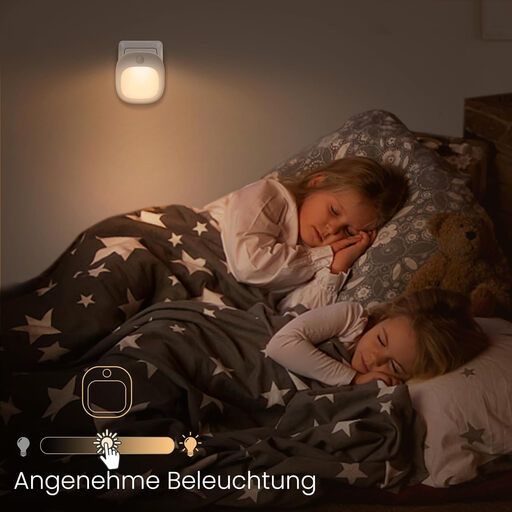
Why this fits the profile: Two compact lights with USB charging are practical for, say, the bedroom and hallway. The lamp features motion detection, three colour temperatures and five brightness levels.
The dimming settings help avoid unnecessarily bright light. According to the description, the sensor works in the dark and within a range of 3–5 metres.
500mAh battery, USB charging, five brightness levels and a stated run time of up to 10 hours in sensor mode.
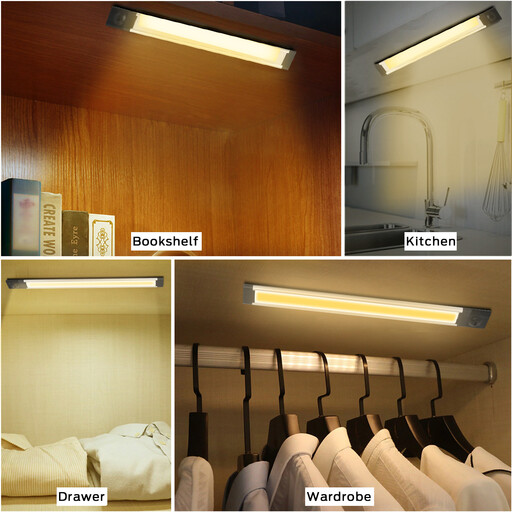
Why this fits the profile: This model is aimed at those looking for a longer, more powerful light bar for the bedroom, nursery, cupboard, stairs or workspace.
The stated 400 lm and adjustable colour temperature make it possible to adapt the brightness and atmosphere to the room.
36 SMD LEDs, 2,800–6,500 K, gesture control with dimming function and magnetic mounting or hanging hooks without drilling.

Why this fits the profile: The long, slim light bars are designed for kitchen cupboards, wardrobes, shelves and other narrow surfaces where a round night light is less suitable.
The dimensions of 400 x 38 x 10 mm make placement predictable. Mounting is done with the included tape, without drilling or screws.
61 LEDs per lamp, PIR detection at 3–5 metres, three colour temperatures and a built-in battery of 1,100 mAh.
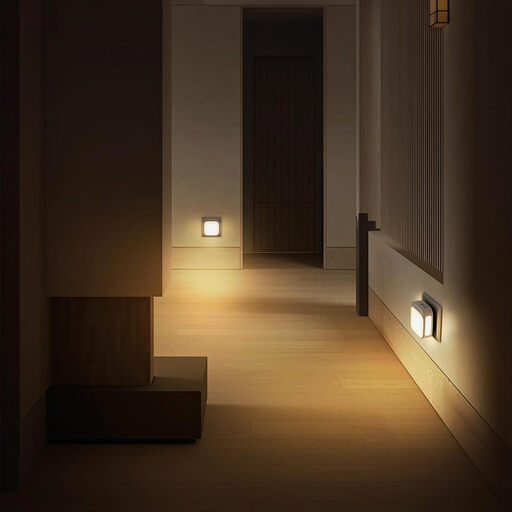
Why this fits the profile: This plug-in model suits households looking for a simple solution for the nursery, bedroom, hallway and toilet without a battery or charging cable.
According to the description, the automatic light sensor switches on at a maximum of 20 lux. The warm white colour and dimming function give you control over the amount of light.
Set of two, 0.3 W power, 2,800–3,000 K warm white and stepless dimming from 10% to 100%.
We’ve put together a full, up-to-date list of products that fully meet these strict selection criteria and comply with current European safety regulations.
Place the light in a spot where the sensor has a clear view of the walking route, for example next to the bed or by the door. Avoid curtains, furniture or other obstacles in front of the sensor. Then test whether the lamp only switches on when it’s dark enough. For a nursery, a low, warm light setting is often more practical than cool, bright light.
That depends on the battery capacity, brightness setting and number of activations. A product with a stated run time of up to 10 hours in sensor mode gives an indication, not a guarantee for every situation. Charge the lamp with the specified USB voltage and regularly check whether the battery still has enough capacity.
A lamp of 0.3 W consumes less energy than a model of 1 W when both are on for the same amount of time. With a motion sensor, the lamp usually isn’t on continuously, so the actual consumption may be lower. Look at the power in watts on the product page and consider how often the lamp is activated each day.
