
Vandaag of morgen in huis

Kwaliteit gegarandeerd

Welkomstaanbiedingen ontgrendelen: GRATIS bezorging | Tot 80% korting | Gratis 30 dagen JoyPlus-proefperiode
Download de app
A night light with a motion sensor can be useful when you need to go to the toilet at night, care for a baby or walk through a dark hallway. However, not every model is suitable for the same space. A light that works well on a bedside table may be less practical in a bathroom, for example, because of moisture, limited placement options or a lack of protection rating.
The main buying pitfalls are usually not related to appearance, but to the technical details.
A sensor light does not always switch on as soon as you move. Pay attention to the detection distance, light threshold and the direction in which the sensor works. With some models, automatic lighting is only activated when the ambient light falls below a certain level. A light with a detection range of 3 to 5 metres may work perfectly well in a hallway, but could be too sensitive or poorly directed beside a bed.
Also check whether the light can be used in sensor mode or continuous-light mode. This choice is useful if you want to use the bedroom night light as fixed lighting during the day.
An LED night light with a colour temperature of 2800 to 3200 K generally gives off a warmer glow than a model rated at 4000 to 4500 K. A cooler light colour can be useful in a hallway or bathroom, where you may want to distinguish objects more clearly. For a baby night light or night-time care, many users prefer lower brightness and warm white light.
Do not just look at the colour temperature, but also at the light output in lumens and the dimming options. A light with 20 lumens is not automatically suitable for every situation. For finding your way around, very little light is often enough; for changing a nappy, a little more brightness may be more practical.
A rechargeable night light is flexible, but its operating time depends on the brightness, selected mode and how often the sensor is activated. A stated maximum runtime often applies to the lowest brightness setting rather than continuous use.
So check:
A useful night light with a motion sensor should clearly indicate when the sensor is active. For several models in this selection, automatic mode switches on at an ambient light level of up to 20 lux, with a detection range of around 3 to 5 metres. These are measurable specifications, but performance still depends on positioning and obstacles in the room.
A night light for the hallway, for example, works differently from a light beside a bed. Position the model so that the sensor faces the direction of travel and is not obstructed by furniture or curtains.
A dimmable night light gives you more control during the night. Stepless touch controls allow for small adjustments, while a model with five brightness levels is easier to use with fixed settings.
A night light with touch controls is particularly practical beside a bed or in a nursery. However, bear in mind that touch controls are not the same as motion detection: you still need to touch the surface to change the setting.
A bathroom or toilet requires extra care. Check whether the product has a clear IP rating. If this information is not provided, do not place the light near splashing water and keep it out of the shower or bath area. The models described advise avoiding contact with water and excessive moisture.
For a bathroom night light, a safe, dry position away from direct splashes is therefore more important than simply having high light output.
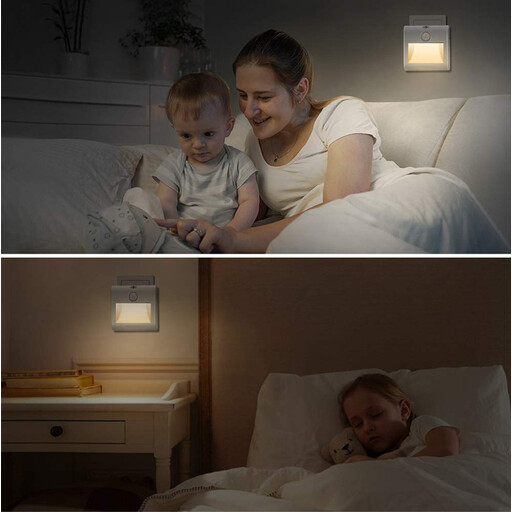
Why this suits the profile: The set of two lights allows you to equip the bedroom and hallway with automatic lighting at the same time, for example.
The product description mentions both a continuous-light mode and a sensor mode, along with a light threshold of ≤20 lux and a range of 3-5 metres.
Two lights, 1 W per light, touch dimming and a memory function. The stated light output is 20 lumens.
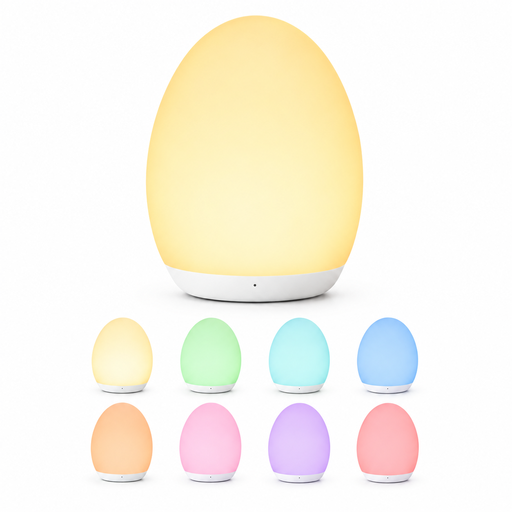
Why this suits the profile: This portable night light is designed for use in the nursery, during night feeds, nappy changes, story time and travel.
The light offers dimmable warm lighting, touch controls, a one-hour timer and requires no app or Wi-Fi connection.
Eight colour modes, a built-in 2000 mAh battery and compact dimensions of 9,2 × 9,2 × 11 cm.

Why this suits the profile: If you use several rooms and do not have a socket beside every bed or in every hallway, this set gives you more flexibility when deciding where to place the lights.
The 500mAh battery capacity, USB charging and stated sensor runtime of up to 10 hours make it easier to assess the power supply in advance.
Two lights, three colour temperatures, five brightness levels, 30 lumens and motion detection up to 3-5 metres.
A wake-up light is a different type of product. The Philips SmartSleep HF3654/01 features adjustable sunrise and sunset simulations, alarm sounds and two alarm times. It is primarily designed as a bedside light and alarm clock, rather than an automatic night light for a dark hallway.
We have compiled a complete, up-to-date list of products that fully meet these strict selection criteria and the applicable European safety regulations.
Place the light in a dry, stable position where the sensor can detect the route you take. Do not point the sensor at a direct light source and do not cover it. Test how it works in the evening, as automatic mode is often only active below a certain light threshold.
This varies depending on the battery and operating mode. The 2-pack described, with a 500mAh battery, states up to 10 hours in sensor mode. The VAVA light states approximately 7 hours at maximum brightness and up to 100 hours at the lowest setting. These are product specifications; in practice, brightness and activation frequency also have an impact.
A 1-watt light uses approximately 0,001 kWh when switched on for one hour. The actual cost depends on your energy tariff and usage time. Sensor mode can limit the number of hours the light is on, while continuous mode uses more electricity. So check the wattage as well as how often the light switches on automatically.
