
Vandaag of morgen in huis

Kwaliteit gegarandeerd

Welkomstaanbiedingen ontgrendelen: GRATIS bezorging | Tot 80% korting | Gratis 30 dagen JoyPlus-proefperiode
Download de app
Coming home in the dark, fumbling to find the keyhole. Or an outdoor light that only switches on after you've already walked past it. A motion sensor light promises convenience and security, but in practice, it can be a different story. Many models look ideal on paper but prove to be impractical or unreliable in daily use.
As a Product Recommendation Officer at Joybuy, I see a lot of products come and go. I'm here to help you see through the marketing jargon and focus on what truly matters. Let's look at the three most common pitfalls so you can make a purchase you'll be happy with for years to come.
outdoor light with a sensor that fills with moisture or starts to rust after one harsh winter is a poor investment.battery-powered light with a sensor offers flexibility, but not if you have to replace the batteries every few weeks.To avoid these problems, it's important to look at a few specific details. These aren't complex technical specifications, but practical features that make the difference between a good and a bad purchase.
The power source determines where and how you can use the light.
closet lighting with a sensor, in the shed, or in places without an outlet. Pay close attention to the battery capacity. A rechargeable light with a sensor via USB is often a practical choice.solar-powered LED light charges during the day and provides light at night. Modern versions can still function even after a few cloudy days. Just make sure the solar panel can catch enough direct sunlight.For an outdoor light, the IP rating is a crucial specification. This value indicates how well the light is protected against dust and moisture.
A good sensor can be adjusted to your situation. Look for the following settings:
Based on these criteria, we have selected a number of products that suit different user profiles.

Why This Fits Their Persona: Ideal for those who don't want to or are not allowed to drill holes. You can easily stick these rechargeable lights in a wardrobe, kitchen cabinet, or dark hallway. The set of two makes it a versatile solution for multiple spots in a rental home.
Bypasses the pitfall of inconvenient power sources. As a rechargeable, battery-powered light with a sensor, no wiring is needed, and installation is done in under a minute.
Ultra-thin design, adhesive strip installation, and three adjustable color temperatures for the right ambiance. Comes as a set of two.

Why This Fits Their Persona: For those who want to powerfully illuminate the driveway, garden, or back entrance for a sense of security. This light runs on solar power, so there are no electricity costs and no complex installation.
Avoids the pitfall of a non-weatherproof outdoor light. With an IP65 rating and robust materials, this model is built to withstand the elements.
Very high light output (4000 lumens according to Philips), a wide detection range, and runs entirely on solar power.
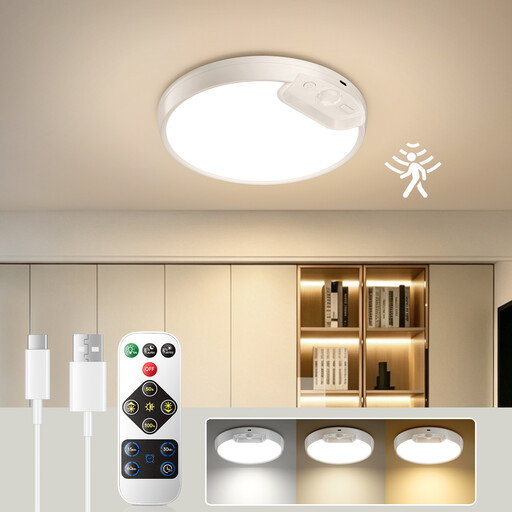
Why This Fits Their Persona: A perfect solution for spaces like the garage, attic, shed, or a spacious hallway where there's no power outlet. This wireless motion sensor ceiling light provides enough light for an entire room.
Tackles the pitfall of the battery drainer. With a large 8000mAh rechargeable battery, you won't have to charge this light often, depending on usage.
Large battery capacity, comes with a remote control, and has adjustable color temperatures and brightness levels.
We have compiled a complete, up-to-date list of products that fully meet these strict selection criteria and safety regulations.
This is adjustable on most models. The duration can vary from about 10 seconds to 15 minutes after the last motion is detected. For a walkway, a short duration is often sufficient, whereas in a garage or shed, you might prefer a longer duration.
Most motion sensor lights are equipped with a dusk-to-dawn sensor (also called a day-night sensor). This ensures the light is only activated when it's dark enough, which saves energy. On some models, you can disable this feature or adjust the light sensitivity, so the light also works during the day if needed.
PIR stands for Passive Infrared. This is the most common type of sensor in these lights. A PIR sensor measures the infrared radiation (heat) in its environment. When a person or a larger animal enters the detection field, their body heat causes a change that the sensor detects, switching on the light.
