
Vandaag of morgen in huis

Kwaliteit gegarandeerd

Welkomstaanbiedingen ontgrendelen: GRATIS bezorging | Tot 80% korting | Gratis 30 dagen JoyPlus-proefperiode
Download de app
Light that comes on automatically is handy by the front door, in the hallway, garage, garden or a dark cupboard. Yet motion sensor lighting can disappoint if you only look at the number of lumens or a flashy product claim. The right choice depends on the location, power supply, detection angle and protection against moisture.
A motion sensor only works well when the detection area matches the direction of movement. A sensor pointed straight at someone can detect movement differently than when someone walks past sideways. So don't just look at the stated range, but also pay attention to the detection angle and mounting height.
Also check for conflicting information. With the Aigostar PIR-360, the product title states a range of 8 metres, while the technical product information mentions a maximum detection diameter of 6 metres. That difference matters when you want to use the sensor for a long driveway or wide hallway.
An IP44 outdoor light is protected against solid objects larger than 1 millimetre and splashing water. This makes it suitable for many sheltered entrances, balconies and facades, but not automatically for direct water jets or prolonged exposure to heavy rain.
For an unsheltered garden, shed or driveway, an IP65 floodlight is often more sensible. IP65 offers higher protection against dust and water jets. Still mount the light according to the instructions and prevent connections from constantly lying in puddles or damp conditions.
More lumens doesn't always mean a better solution. A 4,000-lumen lamp can be unnecessarily bright for a small back door, while 180 lumens may be sufficient for a sheltered path. Also look at the colour temperature. Warm white around 2,700 to 3,000 K gives a softer light; 5,000 to 7,000 K is whiter and is more often used for functional security lighting.
For a hallway or toilet, a range of a few metres is often enough. In a garden or on a driveway, you'll benefit more from a wide angle and a larger range. An adjustable time delay prevents the light from switching off immediately. According to the technical data, the Aigostar PIR-360 has an adjustable delay of 10 seconds to 7 minutes and an adjustable light sensitivity of 10 to 2,000 lux.
A light sensor is also useful when you want to prevent automatic lighting from switching on during the day. Do check whether the product has a genuine motion sensor, a dusk sensor, or both.
There are four practical options:
A wireless motion sensor light isn't always maintenance-free. Check how often recharging is needed and whether the solar panel has a clear view of the sky.
An integrated LED light is compact and doesn't require a separate bulb. With a lamp featuring an E27 fitting, you can choose a suitable LED bulb yourself, but pay attention to the maximum wattage. The Brilliant Todd, for example, has an E27 fitting for a maximum of one 60-watt bulb and is supplied without a bulb.
Clean sensors and solar panels with a soft cloth. Outdoors, don't use aggressive cleaning agents and don't expose an IP44 light to direct water jets. With magnetic models, check that the mounting plate is securely attached.
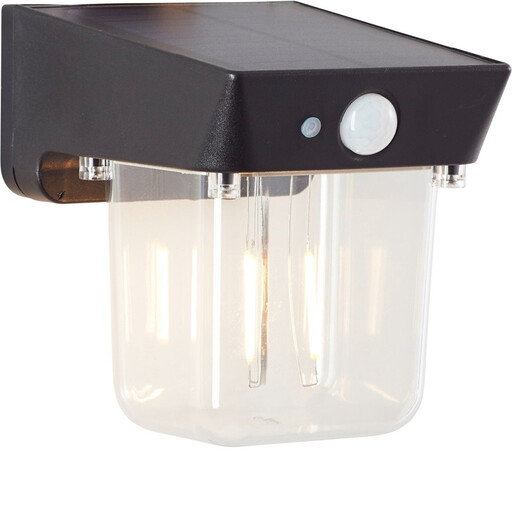
Why this fits the profile: This solar outdoor lighting with motion sensor works without a fixed mains connection and is intended for the garden, patio or entrance.
The specifications clearly state IP44, 180 lumens and an integrated battery. So expect lighting for an entrance or path, not the range of a floodlight.
Solar panel, integrated LED, motion sensor and two light modes; 2,700 K warm white light.
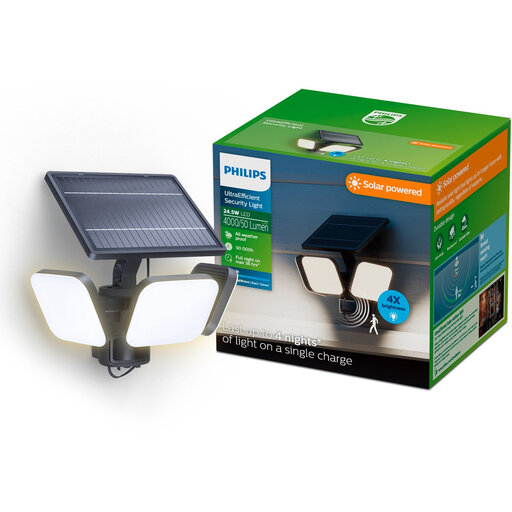
Why this fits the profile: For a large driveway, shed or garden area, the combination of high light output, adjustable lamp head and solar power is practical.
The catalogue states IP65 and 4,000 lumens. This makes the outdoor rating and light output more concrete than a general claim about "powerful" lighting.
IP65, 4,000 lumens, 5,000 K and a stated detection range of 8 metres straight ahead and 16 metres sideways.
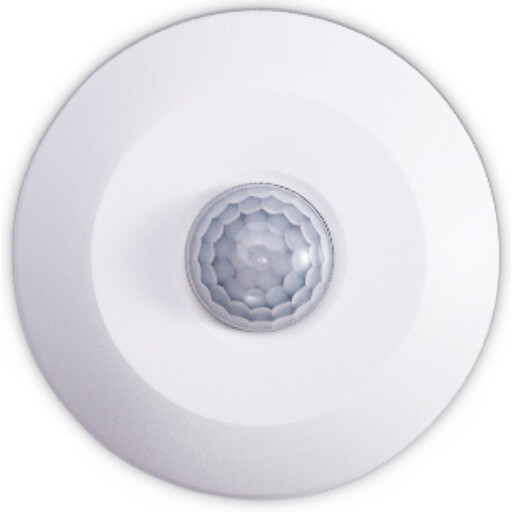
Why this fits the profile: This motion detector is designed to automatically switch existing lighting, fans or other suitable loads.
The settings are verifiable: 10–2,000 lux, 10 seconds–7 minutes and a stated load capacity of 1,200 W. Have fixed electrical installation carried out according to the regulations.
Adjustable light sensitivity, adjustable delay and suitability for multiple types of lighting according to the product description.
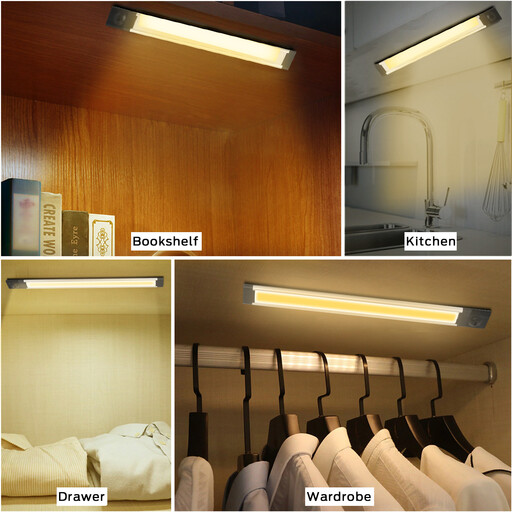
Why this fits the profile: The magnetic mounting and hanging hooks are suitable for cupboards, hallways, garages and stairs where you'd rather not drill.
The product information explicitly states that the device must be kept away from water and moisture. So use it as a sensor light for indoors, not as an outdoor light.
400 lumens, dim function, 2,800–6,500 K and tool-free mounting according to the product description.
We've put together a full, up-to-date list of products that fully meet these strict selection criteria and comply with current European safety regulations.
Mount the sensor so that people walk through the detection area rather than straight towards the sensor. Take into account obstacles such as walls, bushes and doors. With fixed 230V lighting, the power must be switched off and installation by a qualified electrician is recommended.
The lifespan depends on the type. An integrated LED doesn't need a separate bulb, but often can't be replaced individually. With solar lighting, sunlight hours, battery capacity and dirt on the panel all play a role. A rechargeable wireless motion sensor light needs regular charging via USB.
A sensor light only comes on when movement is detected, so the consumption per use can be limited. The actual consumption depends on the wattage, the duration of use and the number of activations. With solar outdoor motion sensor lighting, the energy comes from the battery, but the battery must be sufficiently charged.
