
Vandaag of morgen in huis

Kwaliteit gegarandeerd

Welkomstaanbiedingen ontgrendelen: GRATIS bezorging | Tot 80% korting | Gratis 30 dagen JoyPlus-proefperiode
Download de app
A motion sensor light seems simple: someone walks past, the light comes on and then switches off again. Yet many purchases fail to live up to expectations. The sensor responds too slowly, the light is mounted outdoors in an unsuitable location or the battery needs constant recharging. With a few technical checks, you can avoid paying for features that offer little benefit in your home.
A manufacturer may state a detection distance measured under ideal conditions. In a real hallway, garden or driveway, walls, doors, shrubs and the direction of movement all affect performance. So do not just check the maximum range; also look at the detection angle and mounting height.
A sensor often works differently when you walk directly towards it than when you pass it from the side. For a narrow corridor, you will usually not need a wide-angle outdoor sensor. For a driveway, a broader angle may be useful.
An IP44 outdoor light is protected against solid objects larger than 1 millimetre and splashing water. This makes the rating suitable for many sheltered façades, balconies and entrances, but not for immersion or powerful water jets.
An IP65 solar outdoor light offers greater protection against dust and water jets. IP65 does not mean that the light can be submerged. Always check the exact IP rating and install the light according to the manufacturer's instructions.
A solar motion sensor light needs sufficient daylight to charge its internal battery. A north-facing wall, a balcony beneath a canopy or a location under dense trees can reduce the operating time. Claims about use over several nights come from the brand's product information and may depend on hours of sunshine, the season, temperature and the selected lighting mode.
Pay attention to three settings:
Some sensors also allow you to adjust the light sensitivity. According to the product information, the Aigostar PIR-360 has an adjustable threshold of 10 to 2000 lux and a delay of 10 seconds to 7 minutes. The stated maximum detection range is 6 metres in the technical specifications. Always check the instructions when installing the light, and have a permanently wired model fitted by a qualified installer.
Lumens indicate how much light a lamp produces according to its product specification. For a cupboard or landing, a modest light output is often more comfortable than a bright beam. A driveway or larger garden needs more light, but also consider glare for neighbours or passers-by.
Colour temperature is expressed in kelvin:
An LED motion sensor light generally uses very little electricity. With a wireless model, however, battery capacity is more important than simply the number of LEDs. Check how the light is charged, which cable is included and whether the light source is integrated.
Choose between:
A wireless motion sensor light is convenient for rented homes or locations without a socket. Check whether it is attached with screws, tape or a magnet. With a magnetic wall light, the surface must be flat, clean and strong enough. Clean solar panels and sensor windows regularly with a soft cloth. Never use outdoor models in a way that exceeds their IP rating.
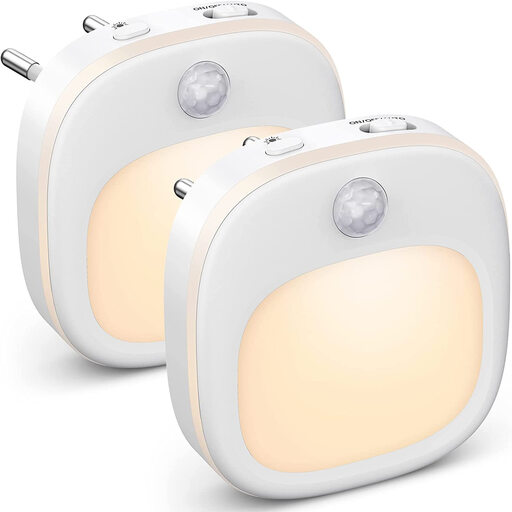
Why it suits this profile: A practical starting point for bedrooms, nurseries, hallways or other indoor spaces where you do not want to install cables. The set includes two lights and offers three colour temperatures.
The product information lists five dimming levels, so you are not limited to one bright light level in a dark room.
2-pack, 3 colour temperatures and 5 dimming levels; suitable for a 100–240 V mains supply.

Why it suits this profile: For homeowners looking for a powerful solar solution for a driveway, garage, garden or façade.
The IP65 specification is clearly stated. Positioning the light where it receives sufficient direct sunlight remains essential for charging performance.
4000 lumens, IP65, adjustable light head and a detection range stated in the product information of up to 8 metres straight ahead and 16 metres sideways.

Why it suits this profile: Designed for larger outdoor areas such as driveways, grounds, patios or garages where wide light coverage is needed.
The specifications list three lighting modes, three adjustable heads and IP65. Check beforehand that the chosen installation location receives enough sunlight.
302 LEDs, a stated light output of 3000 lumens, a 180° detection angle and three lighting modes according to the product description.

Why it suits this profile: An easy-to-install solution for kitchen cupboards, wardrobes, shelves and dark hallways without drilling.
The light is 10 mm thick and, according to the product information, is attached with tape. This means no permanent wiring is needed, but check that the surface is suitable.
61 LEDs, PIR detection at 3–5 metres, three colour temperatures and a rechargeable 1100 mAh battery.
We have put together a complete, up-to-date list of products that fully meet these strict selection criteria and the applicable European safety regulations.
Start with the mounting height and the route people take. Point the sensor towards the area where someone passes, rather than simply towards the light itself. Then adjust the light sensitivity and run-on time. In a hallway, a short lighting duration is often enough; by a front door, a slightly longer duration can be useful when you are looking for your keys.
The service life depends on the light source, the number of switching cycles, the battery and the conditions. With a solar or rechargeable LED light, the operating time per charge decreases as the battery ages or when little sunlight is available. An integrated LED often cannot be replaced by the user. Before buying, check the warranty, charging method and whether the light source can be replaced.
An LED light that only comes on when movement is detected uses less energy than a light that stays on all night. With a mains-powered model, however, the sensor remains connected to the electricity supply. A solar motion sensor light does not use mains electricity, but its performance depends on sunlight, battery capacity and the selected lighting mode. So look at wattage, operating time and settings rather than relying solely on the marketing term ‘energy efficient’.
