
Vandaag of morgen in huis

Kwaliteit gegarandeerd

Welkomstaanbiedingen ontgrendelen: GRATIS bezorging | Tot 80% korting | Gratis 30 dagen JoyPlus-proefperiode
Download de app
A motion-sensor light can automatically illuminate a hallway, cupboard, entrance, driveway or garden as soon as movement is detected. That is useful for families, tenants and homeowners who do not want to keep searching for a switch. However, not every model is suitable for the same location.
A low price or a high lumen count does not tell you everything. Pay particular attention to the conditions in which you will use the light: indoors or outdoors, with or without a mains connection, under a canopy or fully exposed to rain. Choosing the right model helps prevent the light from running out of power too quickly, providing insufficient illumination or proving difficult to install.
IP44 outdoor lighting is protected against solid objects larger than 1 millimetre and against splashing water from different directions. This makes IP44 suitable for many sheltered outdoor locations, such as an entrance, balcony or covered veranda. The rating does not mean that the light can be submerged or withstand powerful direct jets of water.
For an exposed façade or a location where the light receives a lot of rain, it is worth considering a higher protection rating, such as IP65. Also check whether water can drain away from the installation point.
Lumens indicate the total amount of light, but not how widely or directionally it is distributed. A 300-lumen light may be sufficient for a hallway or cupboard, while a driveway or large patio may require more light. The colour temperature also makes a difference:
Also consider the installation height and the angle at which the sensor detects movement.
A solar outdoor light with a motion sensor does not need mains electricity, but the solar panel must receive enough direct daylight during the day. Do not place the light under a solid canopy, behind a high fence or on a north-facing wall without sufficient sunlight. In dark or cloudy periods, the operating time may be reduced.
A wireless outdoor light with a rechargeable battery needs to be charged regularly. Check the charging method, the battery and whether you can easily remove the light. A magnetic rechargeable wall light is flexible, but the mounting plate must be securely attached.
Check the stated range and detection angle. A sensor for a hallway does not need to cover a large area; for a driveway, this can be much more important. Some models offer settings for light sensitivity and activation time. For example, the Aigostar PIR-360 specifies adjustable light sensitivity from 10 to 2000 lux and a delay of between 10 seconds and 7 minutes. The product specifications also state a maximum detection diameter of 6 metres. However, check that the actual coverage suits your installation location.
For a cupboard or small staircase, a compact indoor motion-sensor light is often sufficient. For a façade or garden path, look for around 180 to 500 lumens. For a driveway or larger area, a model with a higher light output may be the more sensible choice.
An integrated LED is generally compact and uses little electricity. For mains-powered lighting, check the wattage. With battery-powered and solar lighting, battery capacity, charging time and exposure to sunlight are more important than the lumen count alone.
Check whether the product is suitable for wall mounting, ceiling mounting, metal surfaces or freestanding use. According to the product information, a fixed 230V light must be connected by a qualified electrician. A model with USB charging does not require permanent wiring, but the fixing must be able to support its weight.
For outdoor use, the IP rating, material and mounting hardware are all relevant. Clean the solar panel and sensor window with a soft cloth. Do not use liquid cleaner if the product information advises against it.
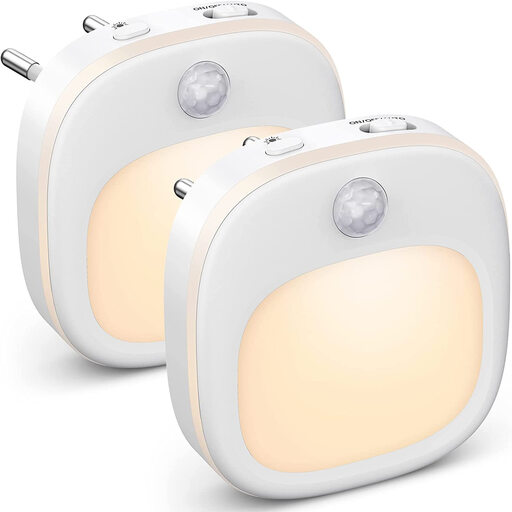
Why it suits this profile: This set is designed for indoor use in places such as a bedroom, nursery, hallway or toilet. The two lights offer three colour temperatures and five dimming levels, allowing you to tailor the lighting to the room.
The adjustable brightness prevents you from choosing a light that is too bright for a small passageway. This model is intended for indoor use and is therefore not suitable for an exposed outdoor wall.
Two lights, 1 W SMD LED and a choice of three colour temperatures with five dimming levels.

Why it suits this profile: This solar wall light is suitable for an entrance, façade or garden without a mains connection where a higher light output is preferred.
The specifications state 1000 lumens, two lighting modes, a dusk sensor and IP44. Installation in a position with sufficient direct sunlight is still essential.
Solar power, 1000 lumens, 3000 K, motion sensor and two adjustable modes.

Why it suits this profile: This model is designed for larger outdoor areas such as a driveway, garage, patio or garden. According to the product description, the three light heads provide broad illumination.
The stated IP65 rating provides greater protection against dust and water than IP44. However, check the local installation and usage conditions before buying.
302 LEDs, a stated light output of 3000 lumens, three lighting modes and a sensor range of up to 60 feet according to the product information.

Why it suits this profile: The wireless design with magnetic mounting is suitable for a balcony, hallway, veranda or any other location where you do not want to install wiring.
The light can be recharged via USB-C and removed when needed. IP44 means protection against splashing water, not complete waterproofing. Attach the mounting plate to a flat, sturdy surface.
300 lumens, warm white light at 3000 K, magnetic mounting and an integrated rechargeable battery.
We have put together a complete, up-to-date list of products that fully meet these strict selection criteria and the applicable European safety regulations.
First, choose a stable installation point with sufficient coverage for the sensor range. With solar lighting, the panel must be able to receive direct sunlight. For a mains-powered light, switch off the electricity and have the connection carried out by a qualified electrician. Always follow the manufacturer's installation instructions.
The operating life depends on the type of light, how often it is activated, the battery and the surrounding conditions. Integrated LED modules often come with a stated lifespan, but the battery may lose capacity sooner. With solar and rechargeable models, regular cleaning and correct charging help maintain performance.
An energy-efficient LED light generally uses little electricity, particularly because it only comes on when movement is detected. With solar lighting, energy is stored in the battery during the day. For a realistic comparison, consider the wattage, operating time, number of activations and any charging costs.
